Three years after
The Undiscovered Country and just a few months after “All Good Things…” concluded their TV adventures, the
Next Generation crew ascended to the big screen in what was deemed by Paramount an inevitability. To assist in the transition was Captain Kirk, who would at last share time with his successor, Jean-Luc Picard. It was to be the biggest moment yet in franchise lore.
The whole idea of it is probably still controversial to this day, far more than anyone realized at the time. The studio basically assumed that, after six films that covered more than a decade, Star Trek was now as much in the movie business as it was television. It calculated that, even with a third series having launched the previous year, the fans would want something to replace the departing flagship, with the same philosophy applied to both stages. If Kirk were no longer making films, then Picard was the next logical choice.
I would tend to argue that Picard should have been in the movie business long before he broke in, if that were really so inevitable. Though it would have robbed audiences of the sublime sendoff for the original crew,
The Undiscovered Country,
Next Generation films might have seemed viable and lucrative as early as 1990, at the end of the new cast’s breakthrough third TV season, when everything was finally clicking into place. Just imagine what “The Best of Both Worlds,” already one of Star Trek’s most famous moments, could have done with a considerable budget.
Humor me a moment. The original crew, back in the 1960s, was cast for television. None of the actors, not even William Shatner, ever got much of a film career, before or after their three seasons serving on the bridge of the Enterprise. By the time they became movie stars, they were all aging. By the time of their last film together, none of them could ever hope to be featured in their own films again. The six Star Trek films are little each of their highest marks of achievement, and they are marks that would never have been achieved without Star Trek.
The
Next Generation cast, however, was in a far different situation. I’m not suggesting that there was no success outside of Star Trek for the original crew, since Shatner and Leonard Nimoy obviously had some other high profile successes during this period of their careers, but that they were to a fault confined pretty specifically to a single beast. They were victims, as Nimoy himself realized early on, of their own limited success, a stroke of luck. The
Next Generation cast had a single advantage: they knew exactly what they were getting into. In a lot of ways, this meant the casting job itself could afford to be a little more expansive. Thus, Patrick Stewart.
Not to begin and end with Stewart, because Wil Wheaton is still to this day more independently famous than he is, but the casting of Patrick Stewart was the singular genius of
Next Generation, more than anything a clear sign that this show knew exactly what it wanted, and would eventually figure out exactly how to do it. Jeffrey Hunter was no William Shatner, after all. NBC wanted a complete overhaul after viewing “The Cage,” and so was brought in dashing James Kirk to replace wooden Christopher Pike. Yet, as with my earlier assertions that
Next Generation was basically Gene Roddenberry’s belated vindication of
The Motion Picture, he once more got the more cerebral version of Star Trek that he always intended, and in turn, finally cast that central character perfectly. It didn’t have to be a Brit to work, but Patrick Stewart was so perfect, so unexpected, that he probably sold his version of Star Trek entirely by himself.
All of this is to get back to how and why
Star Trek Generations came about, and the manner of which it destroyed the franchise as it had come to be known. I would argue that, having finally gotten exactly what he wanted, Roddenberry, had he lived to see it, would have once again have found himself thoroughly repudiated.
With the casting of Stewart, Star Trek was given in an instant exactly the thing it had been searching for since the 1970s, before
The Motion Picture was even conceived: credibility. Stewart himself wouldn’t have guessed it, since he had been struggling throughout the decade he landed the role of a lifetime to make the transition from noted Shakespearean actor to Hollywood success. He landed bit parts in
Dune and
Excalibur, for instance (as to the latter, so did Liam Neeson, and look where that got him at the time). He was an aging, balding veteran with nothing to sell but his air of authority, and that’s not exactly a formula for success. But Star Trek was exactly the vehicle for that persona, even if Star Trek itself didn’t know it. The franchise was stuck in a singular pursuit of success with the same stagnating cast at the time. Only when given a shot to entirely recreate itself could it find exactly what it was looking for.
In other words, ever since
The Motion Picture, Patrick Stewart was exactly what Star Trek had been seeking.
But he became locked up by a television show, and the early seasons are ample demonstration that the fit simply wasn’t comfortable. Even in his best hours Stewart always felt out of proportion. What the third season did was elevate the material to his level, is all. What I’m arguing is that it would have been just as well to transplant to his natural medium of film at that moment than continue what was suddenly a success on television. Audiences and ratings are not my concerns here. The material is. Clearly, with the Borg the creators had already discovered something that would be properly stimulating, and intriguing, enough to carry a film in exactly the way the original crew had been searching for a decade, but in a way that was actually natural.
Again, I don’t mean to knock the original cast or its films, because I’ve already spent a good deal of time talking about their merits, but merely to suggest that everything those experiences had been attempting to do out of necessity, the new cast could pull off naturally. To paraphrase Shinzon, they were a cast bred for film.
But to actually do something is different from the theory of it. Perhaps it was waiting the extra four seasons, perhaps it was because no matter how much the cast fit the bill, the audience never thought it was as necessary as the studio did, the
Next Generation cast ultimately failed to meet expectations. Pretty spectacularly.
Generations itself proved as much, first one out of the block.
The problem ended up being, the setup was too perfect. Patrick Stewart had already proved for seven seasons that he was a dynamic and confident lead actor, so his sudden appearance on the big screen felt redundant and uninspired. In 1994, the hunger for the next Star Wars had completely evaporated, was transforming into something else entirely, a need for blockbusters to definitively prove their own worth, no more hangers-on need apply. It was no longer good enough to be cinematic or ambitious, but rather to demonstrate something that hadn’t been seen before. Star Trek was certainly no longer new.
It wasn’t even enough to do what the franchise had never done before, what had been the implicit promise ever since “Encounter at Farpoint” in 1987, the meeting of the captains, which
Generations was all about. The culture was backing away from excessive commitments, which the 1980s had mined more thoroughly than any era since serials, but Star Trek was asking for exactly that, dangling a payoff just when nobody cared anymore.
In fact, a lot of critics suggested that what
Generations amounted to was a glorified serial, its moments stolen beat for beat from some earlier, antiquated time. It was like, Kirk and Picard meet. So What?
Maybe it didn’t help that what everyone realized by the end of the film was that
Generations wasn’t so much a momentous occasion so much as itself the end of an era, signified by the death of Captain Kirk, merely aiding in the big rescue instead of driving it. More than any of his own films, Kirk’s last film appearance was all about how human this larger-than-life figure had really become. He was giving up the franchise and his own legend at the same time.
Replacing him? Some dude who moped, even cried, crawled around in dusty rocks. Instead of Spock, the iconic Vulcan whose death was as famous as his life, this new captain was supported by a neurotic android who spent the entire film in an insane frenzy.
So let’s finally get to Data (Brent Spiner). No character after Picard better represents the
Next Generation cast. Unlike the captain, however, Data was tailor-made for television, given a clear direction with an ambiguous destination that was never meant to be reached. He was the puppet who wanted to be a real boy. Just as Picard had been made to be the mirror opposite of Kirk, so too was Data the opposite of Spock. He was the outsider fans were allowed to love. Pop goes the weasel.
Data’s greatest TV virtue was turned into his greatest cinematic sin in an instant.
Generations gave him the emotions that had been denied him quite deliberately for seven seasons, limiting what Spiner could do, and at the same time providing a steady and reliable personality. Now the android was free to do everything the actor could, which must have seemed like the best way possible to mark a transition, to make a distinction between mediums. Instead, it was a disaster. The only scene where it truly works is the first time everyone realizes how naturally Data and Picard work together, a moment in an impressive set called stellar cartography, when Stewart and Spiner are allowed to do what they do best, act, in the very example of what separates this cast from its predecessor.
Everything else just confuses the audience. Everything that attempts to make a movie out of this cast that has been making movies for the past five years, one hour at a time, feels like an effort. I’m not saying this because that’s the way I feel. I loved and still love
Generations. But that’s the reaction of the audience, whether it has ever been voiced that way or not. It’s just as well that Shatner didn’t get his elaborate skydiving sequence finished, because the parallels with
The Final Frontier would have been too obvious.
Generations has lots of things in common with
The Undiscovered Country, naturally. It still doesn’t feel dated, because it was shot with so much care by director David Carson, to disguise all the elements that had just been seen on television in far more grand scales, all the mood lighting, that it pretty much stands as the
Motion Picture effort of the
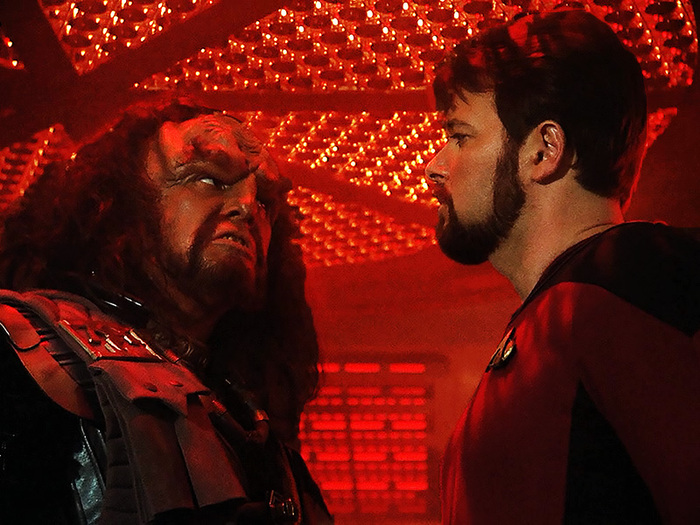
Next Generation films, something that works so hard to look the part that it somehow fails to feel it, too. Klingons play a key role, led by the Duras sisters familiar to TV audiences and anchored by Brian Thompson in another of his thankless Star Trek roles, but they’re almost beside the point. If Soran (Malcolm McDowell) didn’t need co-conspirators, they wouldn’t have been in the film at all.
It’s in Soran, however, that the film really starts to find a pulse. McDowell is such a familiar character actor, and is so well-known for
A Clockwork Orange, that his work in
Generations will probably be overlooked forever. Yet more than Shatner, Stewart, or Spiner, he’s what keeps everything together. Never mind how he’s the subtle link between generations, an unassuming if egomaniacal individual who pretty much does his best to keep to himself throughout the entire movie. That much pretty much sums up Khan, too. At times, when anyone wants to try and explain what they don’t like about the movie, beyond the “meaningless” and “insulting” death of Kirk, they’ll say it’s the first
Next Generation attempt to steal the formula from
Wrath of Khan. They’ll completely emasculate Soran, just that easily.
Yet McDowell is the casting coup of Patrick Stewart, repeated, for
Generations. He doesn’t have a lot to do, and he really doesn’t need to do a lot, because his character is the idea floating through the story, just as the Nexus is floating through space. He is the embodiment of time, the very thing he spends most of his dialogue talking about. McDowell and Soran are a match made in heaven. You believe Soran because you’ve never known quite what to believe about McDowell, what it is that makes him relevant, despite a long career and very little to show for it. You can call him the stand-in for Star Trek itself in the film, the cynical heart of an earnest production. He doesn’t want immortality. He simply wants what he once had a tantalizing taste of, a sense of infinite possibilities. He never knew what he wanted until he stumbled into it, and then couldn’t shake it until he got it back. He just didn’t realize what it did to him.
In that sense, as the film itself cleverly insinuates,
Generations does give Picard back to the Borg, exactly as the next film does, as every audience member had been wanting since “Best of Both Worlds,” but was constantly denied except for little gifts here and there. If the original crew got its fill of serialized storytelling in its string of six films, then the new crew had been teasing it for seven seasons, but hardly ever actually capitalizing on it.
Next Generation was always about episodic material, but tinged with a real sense of the material world, and that’s what
Generations attempted to emulate, notably with its strange idea of a realm where your heart’s desire could be magically obtained, where doing the right thing means being counterintuitive in the most obscene sense possible.
Isn’t that
Generations in a nutshell? I like to argue that people sometimes stumble into exactly what they need, and sometimes still, simply don’t realize it. They want something else, so reject what they actually get, even if it’s exactly what they need. I don’t think Kirk is ever any better, any more relevant, any more real, than when he’s pining for that lost love, Antonia, riding a horse and trying to figure things out, only to snap out of his funk and realize, as he always does, that he’s capable of doing exactly what needs to be done, regardless of the consequences. Picard, likewise, is a man who has a lot of history the audience was simply never allowed to explore, but who always rises above his circumstances and grasps the noble truths he seeks to uphold, the wisdom he embodies, if not always actually lives up to. More than anything, he is a living conduit of tradition, which makes him entirely appropriate as the second captain of the franchise, and the man to pin this movie on, the one looking over the next horizon (which of course he literally does at the end of the film).
Pointedly, I would say, the
Next Generation movies, right from the start, take a little more exclusive look at storytelling than the six preceding entries. They never look at Federation presidents and deliberations. These kinds of moments are avoided entirely. Picard and Stewart are capable of embodying every kind of authority necessary, both in their reactions to the guest characters this captain always interacts with directly as well as the cast that was assembled around him all those years ago. Perhaps it’s telling, the role Guinan (Whoopi Goldberg) plays here, the only time she makes a meaningful appearance in the four films, the sage voice, the only one, Picard needs in moments of reflection.
In 1994, after my first experience, the first Star Trek I saw in a theater, I had arrived late and felt throughout it a feverish anticipation. I made it bigger than it really was. But even later, when
Generations came back down to earth, it never lost its grandeur, its simple grace. It was, to my mind, an unqualified success. It was a completely different beast from the original crew films that had come before. It did feel more natural, perhaps for the reasons I’ve speculated about in this piece, perhaps because it was a matter of timing for me personally.
It’s almost like a cross between
The Motion Picture and
The Undiscovered Country: competent, timid.
Generations exists in a bubble. It’s separated from the three films that follow it visually, but also in the sense that the possibilities of the big screen haven’t been fully embraced yet, like a
Next Generation version of an original crew film. Picard is less an authority here than reactionary. There’s little doubt that he’s the lead character, but Patrick Stewart has yet to fully understand the new possibilities. He’s still acting like someone on TV.
But even for that, I love it.