Showing posts with label Diana Muldaur. Show all posts

Wednesday, June 24, 2015

The Next Generation 2x22 "Shades of Gray"

rating: **


Memory Alpha summary
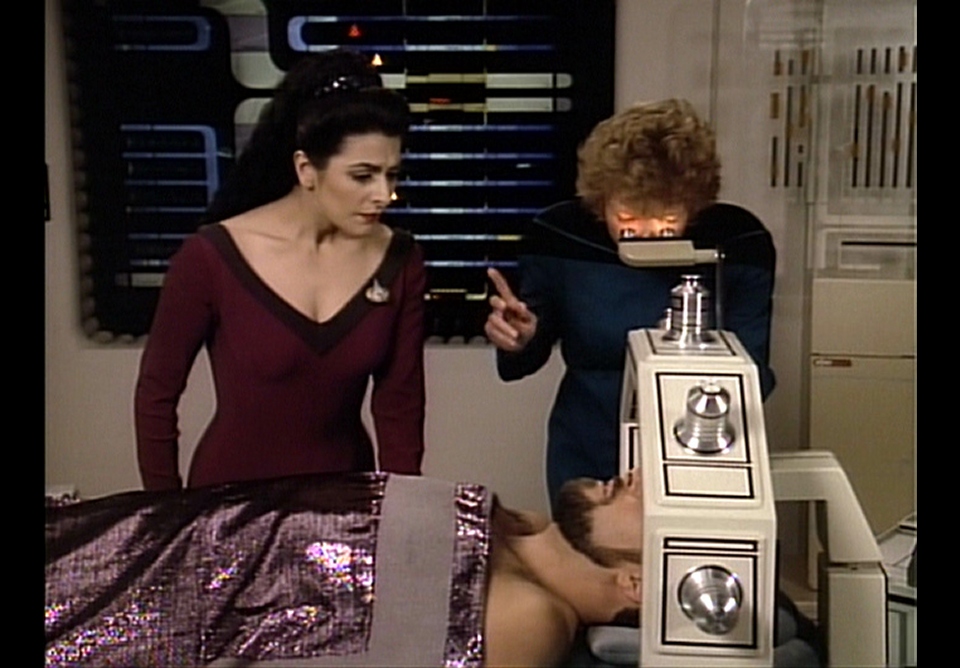
via Treks in Sci Fi
Pulaski: "Just one more minute."
Producers: "You realize this is
a clip show, right? And you want to
waste some of that valuable non-clip
time on you?"
Pulaski: "Dammit, I'm a doctor
not a screenwriter."
The clip show.  For some fans, this has always been an unforgivable waste of an episode.  They don't particularly care that the whole second season was compromised by the '88 Writers Guild strike (if you can't remember that, how about the '07/08 one?), just that this particular episode made for a poor season finale at the very least.

But there's more than one way to view "Shades of Gray," one of which being hindsight, which actually turns out to be quite valuable.

In context, "Shades" is pretty valuable.  It's one last reminder of how the whole second season seemed poised to make Riker the lead character over Picard, if need be to fix continuing creative ailments, find the show's true voice.  Of course, later the voice turned out to be just fine with the characters as they were, more or less, just more properly balanced.  Nobody knew that at the time.  Something more radical was considered.  This is pure speculation on my part, but the evidence of the second season speaks for itself.

"Shades" also serves as a testament to everything the first two seasons tried, a best (or perhaps best and worst) of the series to that point, which might actually serve as an excellent way for fans who don't otherwise want to wade into the complete experience to get a feel for what the show was like before the third season brought it into what everyone remembers best.  

For anyone looking for more nuanced opinions of Star Trek than what immediate, gut reactions said at the time and continue to inform general thought, "Shades" is everything you need to know in a nutshell.  In one sense, a clip show for a series two seasons old with every indication of continuing seems improbable even now, and creatively it couldn't have been very fulfilling, but conceptually it ends up doing a lot more than it seems.  This is where perspective comes into play.  No, I am not saying it's a classic, but it's far more significant than a lot of other episodes that try to do a lot more and fail more spectacularly.  And it's character-focused, in ways the second season routinely tried to be and in fact was generally at its most successful when it was, which is exactly the lesson the third season took, that Next Generation was better when it focused on its rich cast of characters rather than, like its predecessor in the original series, just throwing concepts at fans and hoping they'd stick, with the odd amusing commentary from a handful of memorable personalities.

That's how you defend an otherwise maligned episode.

four quarter analysis
franchise * series * essential * character

notable guest-stars:
Diana Muldaur
Colm Meaney

Tuesday, June 23, 2015

The Next Generation 2x21 "Peak Performance"

rating: ***


Memory Alpha summary

via Tim Lynch Reviews
Picard vs. Riker...
need I go on?
Consider this, if you are going to be a fan terminally disgruntled with the clip show season finale "Shades of Gray," the real end of the second season.  The fight that seems to have been pitched metaphorically between Picard and his first officer, Riker, finally happens.  Sort of.

"Peak Performance" boasts significance for a number of Next Generation creations aside from the leading officers of the Enterprise.  The whole episode is predicated on preparations for further Borg encounters.  It's also the only Ferengi episode of the season.  (Fun fact!  The Borg were created to make up for how lousy the Ferengi turned out to be, at least initially.)  And that strategist from the Zakdorn.  Yeah.  The episode didn't quite nail the strategist or the Zakdorn, unfortunately.  If you have an unfavorable opinion of the episode, it's because of that guy.

But you can almost ignore him, because the crew rises to the occasion, easily the best ensemble effort of the season.  The stars, however, are the ones simulating war in opposing starships, Picard and Riker.  I've been postulating in my thoughts throughout the season that it seemed somewhat likely that the creators had seriously entertained the idea of finding a fix for the series by replacing Picard with Riker as the lead character.  Riker had an excellent head-start with "A Matter of Honor," and generally came off better than Picard throughout the season, though they notably both shined in the series standout "The Measure of a Man," which may have also been the point where they started to realize, maybe Picard is not such a lost cause after all.  And so both are put to the ultimate test at last in "Peak Performance."

Picard retains the Enterprise in this scenario, while Riker is given command of a far lesser ship, which again puts the emphasis on where they currently stand, Riker having to prove himself while all Picard has to do is prove competent, a little opposite of the dynamic from the rest of the season, but by this point completely earned, and exactly as it should be.

And the funny thing is, much as in "Measure of a Man," standing between them, as it were, is Data, who also finally has a culmination of the odd relationship he's had with Pulaski throughout the season.  Data is challenged to defeat the master strategist (never mind that the challenge itself looks silly), can't do it (leading to a precursor of his self-doubt in Star Trek Generations and even The Doctor's internal conflicts in Voyager), but finally manages a draw, a novel solution to what is otherwise something of a variation on the famous no-win scenario known as the Kobayashi Maru test (as featured in the second and eleventh films).

Well, as I said, an excellent alternative for concluding the season.

four quarter analysis
franchise * series * essential * character

notable guest-stars:
Diana Muldaur
Armin Shimerman

Monday, June 22, 2015

The Next Generation 2x20 "The Emissary"

rating: ****


Memory Alpha summary

via Treknologic
"Today is a good day for style!"
When Next Generation's second season nailed it, it really nailed it.  And thus we reach the last great episode of the season, "The Emissary."

Which means we've finally reached the point where the series has figured out how to present Worf, a character whose importance not just to the series but the franchise would grow exponentially.  So basically what I said about "Manhunt" in regards to Lwaxana Troi.  This was a season dedicated to figuring out the characters.  Sometimes it worked exceptionally ("The Measure of a Man") and other times not as much ("The Icarus Factor").

In terms of lasting significance, "Emissary" may have the second greatest legacy of the season after "Q Who?" (which introduced the Borg) as it features K'Ehleyr, perhaps the best of the franchise's periodic efforts to feature "a former lover" (seriously, this is a whole Star Trek trope, and yes it's a fiction trope in general but Star Trek embraced the idea almost as enthusiastically as Space Nazis...and now we will end this parenthetical phrase...).

K'Ehleyr herself only survived to make one additional appearance ("Reunion"), but it completely opened up Worf's possibilities, not just because of the son they had together (Alexander, who would become a recurring character), but after "A Matter of Honor" (another second season classic, which actually featured Riker rather than Worf) stands as the birth of true Klingon nuance, a culture that flourished throughout the rest of the franchise until reinvention in the reboot era.

But aside from legacy, again, the episode itself works miracles for Worf, who until that point had languished under writers who seemed about as eager as Gene Roddenberry to have a Klingon in Picard's crew.  Worf's own alienation was previously poorly defined and depicted, until he had another strong Klingon to play off against (and in subsequent Worf episodes, having other strong Klingons to play against proved to be a continuing source of strong material).

All of which makes the ending ironic, because Worf's not the only one who has a hard time being Klingon, his lover does, too, but they have to pretend to be exactly that, just a couple of regular warriors.  But after this, it's much, much easier for regular Klingon warriors to populate Star Trek.  For the first time, being Klingon means something other than cunning or prowess.  And that is a very good thing.

four quarter analysis
franchise * series * essential * character

notable guest-stars:
Suzie Plakson
Diana Muldaur
Colm Meaney
Diedrich Bader

Friday, June 19, 2015

The Next Generation 2x19 "Manhunt"

rating: ****


Memory Alpha summary

via The Viewscreen
"And then, sir?"
"Then we eat them."
We first meet Lwaxana Troi in the first season episode "Haven."  But this is her proper introduction.  It is an out-and-out classic, and every subsequent appearance, whether in Next Generation or Deep Space Nine, is an effort to recapture exactly this magic.  Only in her DS9 appearances, actually, does Lwaxana get to do much that's substantially different, thanks to her odd relationship with Odo (though Next Generation's "Half a Life" serves as something of a preview for that).

In short, she drives everyone crazy.  Usually you need Q to accomplish that, but then, maybe Lwaxana always was Q without all the omnipotence.  She's just omnipresent.  Yay!

In fact, let's take that a step further.  Q episodes before "Manhunt" feature Q in the role of a challenger.  Q episodes after "Manhunt" feature Q in the role of a trickster.  Is this a coincidence?  I think not.  Now, just imagine an episode with Q and Lwaxana...Thankfully this never, ever happened.  Everyone would've gone insane...

"Manhunt" also features the prism of Picard and Riker contrasting against each other, which "Peak Performance" two episodes later also does (not to mention the preview from "The Measure of a Man").  In that sense, it's the culmination of a season's worth efforts to distinguish the two and make it less of a competition, perhaps the tipping of the scales away from Riker and back toward Picard, as the second season had clearly flirted with early on.  The show's creators knew there was a problem.  They didn't necessarily know what the problem was, but they did considerable work trying to figure it out.  Again, as I've stated previously, the revelation that was the third season would not have been possible without all the work from the second.  "Manhunt" is so casual about it you probably wouldn't even expect that kind of effort behind it.  

But then, like Q, Lwaxana was a character designed to find stress points.  She just happened to be the first of the two to actually push the series to its best all on her own.  

four quarter analysis
franchise * series * essential * character

notable guest-stars:
Majel Roddenberry
Diana Muldaur
Robert O'Reilly
Carel Struycken
Colm Meaney

Thursday, June 18, 2015

The Next Generation 2x18 "Up the Long Ladder"

rating: [no stars]


Memory Alpha summary

via Trekcore
And then she takes that skirt off
and there's one that rides much lower
beneath it.  Sexy Trek.
Clearly the idea of a society strapped for new DNA was something of a cherished trope.  Suffice to say that if it were at all possible to recommend this episode for actual viewing, I'd cite that.  But I won't even give you further franchise examples.  Just skip this one.  Run screaming over the hills.

And the funny thing is, this horrendous "Irish episode" (if you have any memory of this episode at all, assuming prior viewing, that should tell you all you need to know; well, that and the caption text to the left) is not even the "Irish episode" that fans tend to call a terrible, terrible episode.  That dubious honor goes to Voyager's "Spirit Folk," a follow-up to its own "Fair Haven."  I never understood the problem with Voyager's version of the "Irish episode."  Because it couldn't possibly be this bad.

And it bad on a number of levels, and offensive on a number of them, too.  Some of them are not even cultural.  This is a huge step back for the entire series, really, the proof that everything needed to be thoroughly re-examined so something like this could never, ever happen again.  It's bad like the worst of the first season.  It is the worst of the second season.  In its faint defense, it's not as bad as the worst of the first.  But it definitely belongs in the first, although its presence in the second, as I've suggested, is a sign that things really did need to change, no matter how much the second season started turning things around.

And well, anyway, it's even a bad episode for the original series, which "Up the Long Ladder" seems desperate to evoke in a quasi-Next Generation way (even the title leans that way).  When you have Scotty or Chekov using ridiculous accents it's one thing.  When you visit alien cultures or evoke clearly identifiable human cultures, it's much more advisable to consider what you're about to do.  The original series usually had some reason to do this sort of nonsense.  No such excuse here, even. 

And it's another huge step back for Riker, casting him in all the wrong light, just as "The Icarus Factor" before it.  And I stress again, the second season was in most other ways such an excellent showcase for Riker.  But I guess I understand why the season finale, the infamous clip show "Shades of Gray," despite being a Riker episode, is generally considered poorly by fans.  Because by that point, all the commander's good will had virtually dried up.

And to top it all off, there's a tepid Worf subplot that's like a bad rip-off of Picard's from the previous episode, "Samaritan Snare."  Just overall completely baffling.  And yet when fans talk about the worst episodes in the franchise, they generally bring up episodes in which they're basically quibbling with the premise.  When you talk about bad episodes, talk about the ones that are absolutely, unquestionably, executed poorly.  Like this one.

And the absolutely saddest part?  O'Brien is in this episode.  You know, the most famous Irishman in Star Trek history.  The one who is perhaps the character in Star Trek with the most dignity imaginable, even though most of his episodes did horrible, horrible things to him.  What were they thinking???

four quarter analysis
franchise * series * essential * character

notable guest-stars:
Diana Muldaur
Colm Meaney

Wednesday, June 17, 2015

The Next Generation 2x17 "Samaritan Snare"

rating: ***


Memory Alpha summary

via Star Trek
Geordi and friends!
Let's just get this out of the way: the idiotic Pakleds are all but Next Generation acknowledging and apologizing for how poorly the Ferengi turned out in the first season.  And in their idiotic way, they're brilliant.  A species that gleefully steals everything they have, it's genius.

And to watch La Forge interact with them, it's kind of the beginning of the series realizing he works best when he's immensely frustrated.  Frustrated La Forge is different from how virtually any other character would be.  He doesn't get angry.  He works around it.  In fact, it's strong motivation for him.  And it proves that you don't have to be a miracle worker to be a great engineer.  (Although to be fair, in contrast to the Pakleds, anyone would be a great engineer.  Or a miracle worker, for that matter...)

Putting all that aside, however, this episode ought to be known for one thing: the big reveal concerning Picard's artificial heart.  Later (in "Tapestry") we get a vivid look at how exactly that happened, but like La Forge among the Pakleds, this is a major character breakthrough as well, another sign that the second season really was the turning point of the series, where the pieces began to fall into place and greatness began to enter the discussion.

What's great about Picard's dilemma is that it's also good for Wesley, putting him into a new and better context as well, not to mention the moment where Picard and Wesley finally move past that whole awkwardness of Picard not exactly being comfortable with someone so young being around.  And it's not just Wesley who benefits from the events of the episode.  In fact, it nicely contextualizes Picard's relationship with the whole crew, something the whole series had been waiting for since the start and possibly very necessary indeed (right up until "Best of Both Worlds" it's entirely conceivable that Next Generation actually had Riker around as a kind of backdoor option).  This is to say nothing about Patrick Stewart but rather the character as it had been used to this point.  Finding a reason why he behaves the way he does, not just that he's the opposite of Kirk but why and why that's not a bad thing, is the first step in what then amounts to a very short journey.  Because as of the third season, with Picard finally in shape, the rest of the series is, too...

four quarter analysis
franchise * series * essential * character

notable guest-stars:
Diana Muldaur

Friday, June 12, 2015

The Next Generation 2x15 "Pen Pals"

rating: *


Memory Alpha summary

via CBS
This is a better image for the episode
than Candy Apple Girl.  Just trust me.
The image I've chosen, and you can see for yourself how I've chosen to caption it, is actually two-fold in its significance.  Picard riding a horse.  Hey, so remember in Star Trek Generations how Picard rides a horse?  You can point to this episode as the origin of that.  So much has been made of William Shatner's interest in horses, but Generations depicted Picard and Kirk on horses not as a concession to Shatner but because it has every relevance for Picard.  It's a whole movie that tries to depict Picard as dynamically as possible.  And seeing Picard on a horse is perhaps the second time the second season (his brilliant defense of Data in "The Measure of a Man" being the first) finally nailed him.  The first season had been so anxious concerning him (see just how anxious as he drops random French enthusiasm into his duties early early on...), and Riker had a brilliant head-start in the second.  I mean, things were bound to turn around, right?  (Yes, a bit of a pun, there.)

But this is not a Picard episode.  It's a Data episode.  The one featuring the Candy Apple Girl, otherwise perhaps identified as the worst make-up job of the franchise since Next Generation's own "Too Short a Season," otherwise known as the little girl who joins Data in the eponymous relationship.

No photographic evidence here!

But what about the rest of the episode?  Right, there's another character trying to horn in on the action.  This time it's Wesley Crusher, in another of those stories that try to develop his...non-career.  And yes, I get that there's some logic to his ship duties, but if you're not especially kind about it this is easily the most ridiculous thing about the whole series.  And I like Wesley!  Anyway, that's kind of what happens.  He trains for greater responsibility.  Even though technically he has no responsibility.  As far as Starfleet's concerned, anyway...I'm not sure the series ever really nailed that aspect of the character.  Early on his status as boy genius was botched horribly, and then there was a whole episode explaining how he didn't rate as a boy genius...as far as Starfleet's concerned, anyway...So to persist with this was perhaps the leading problematic element of the series (and why quite pointedly he's not seen in this light past the second season).

What else?  What about Data???

Right.  His story is tied up in a Prime Directive dilemma.  This should make for excellent drama.  It doesn't.  Instead it offers an uncharacteristic story concerning a little girl he forms a relationship with.  The series somewhat surprisingly liked this story type enough to repeat it twice, another time with Data ("Hero Worship") and one with Worf ("The Bonding").  Every single time it's awkward, but it's most awkward in "Pen Pals."

All of which is to say that when people say the series did not officially become good until the third season, it's episodes like "Pen Pals" that should be understood as standing in the way of a second season that otherwise makes great strides toward that future...

four quarter analysis
franchise * series * essential * character

notable guest-stars:
Diana Muldaur
Colm Meaney
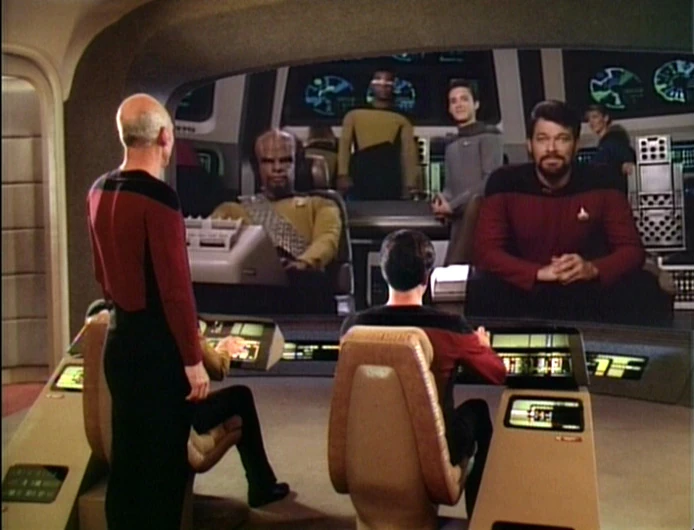
Nikki Cox

Thursday, June 11, 2015

The Next Generation 2x14 "The Icarus Factor"

rating: **


Memory Alpha summary

via Let's Watch Star Trek
All the other memorable shots involve either
Klingon painsticks (yay!) or
stuff that kind of resembles Tron.
So I went with this one.
"Icarus Factor" is somewhat problematic.  It's a character-centric episode that on the one hand probably helps establish Worf better than at any other prior point in the series as an alienated Klingon, as well as some actual background information on Pulaski.

And it introduces Riker's dad.  Who at one point actually looks far more significant to Pulaski.

And it is, until "The Best of Both Worlds," the most prominent exploration of why Riker stays onboard the Enterprise rather than accepting his own command.

On these two scores, then, I call the episode problematic.  As psychological insight goes, it's rarely a bad thing to see where exactly a character came from.  What made Riker than man we know?  Apparently a father who actively competed with him, but who failed in forming a decent relationship with him because both of them were grieving the death of Riker's mom.  And they're more alike than they'd like to admit.  That sort of stuff.

Which is all well and good.  Except Riker's dad becomes a complete nonfactor in the rest of the series.  A series that repeatedly returned to Troi's dear old mum (yay!), even introduced every conceivable member of Data's "family," and just about anyone else you could imagine as relevant to a series that otherwise spent a minimum amount of time in the day-to-day lives of its characters.  That's got to count for something, right?  That Riker's dad leaves an uncomfortable legacy?  That a season that to this point had looked like the best possible showcase for Riker turns in an episode like this?  

And about that promotion deal.  Part of the problem of an ensemble is wanting that ensemble together together as long as possible.  Next Generation kept its ensemble as relatively intact as possible.  This meant Riker was never going to leave the series except under very unlikely circumstances.  So to draw attention to the likelihood and the in-universe reality of this situation not once but several times (the earliest such moment actually coming in the first season!) brings with it a different set of specifications for legacy potential.  And actually, "Icarus" is a more nuanced view of it than "Best of Both Worlds."  But there's no competing with "Best of Both Worlds."  There just isn't.  

So where does that leave the episode?  How does it fail if it seems to go to great lengths to expand the boundaries of what the series typically does, before during and after this moment in its run?  Again, the answer is in the series itself.  Riker's dad is never seen again.  The writers were scared enough to pursue the notion of Riker and Troi's romance (which finally culminates in Star Trek Nemesis, released more than a decade after this episode).  Which is to say, the implications of this episode are...problematic.  There's every chance you can consider it as a bold character statement.  And there's also the chance, the more cautious one, that "Icarus" makes a strong character look uncharacteristically weak.  And that's what family tends to do, right?  Except when it happens to Troi, there's never such a dilemma.  The series owns that relationship.  This one looks like it was culled from a soap opera.

I don't know.  This is the kind of experience that demonstrates the birthing pains the series undoubtedly was still experiencing.  For everything the second season did right, there's a reason the third season was still necessary to do everything...more right.  "Icarus Factor" might be considered to be the episode, more than any other, where this can be seen playing out.

four quarter analysis
franchise * series * essential * character

notable guest-stars:
Diana Muldaur
Colm Meaney
Mitchell Ryan
John Tesh

Tuesday, June 9, 2015

The Next Generation 2x13 "Time Squared"

rating: **


Memory Alpha summary

via Den of Geek
"Still no cure for baldness?  Damn."
Picard and Picard, what is Picard?  "Time Squared" is more like "Picard Doubled."  The opening scene, by the way, is also endlessly duplicated in every single Neelix meal ever from Voyager.  But more importantly, there's a definite franchise trope being featured in the episode, someone meeting themselves.  And the viewer having to figure out along with the crew what's going on.  A big time travel mystery.

There are ways this could be more memorable.  One such way is from Next Generation itself, the later "Cause and Effect."  Even Deep Space Nine's "Visionary" is much more interesting, and even features multiple O'Briens running around.

The biggest drag on "Time Squared" is that it inadvertently represents Picard in the cold-fish light that typified much of his early appearances, part of what really helped make Riker pop in the second season, because Riker was presented anything but cold fish.  The time travel gimmick leaves one Picard difficult to interact with for much of the episode.  None of this is to say the episode is bad, but that it treats everything, including the viewer and the characters, from a distance.  It would become the trademark of the series to feel much more inclusive, which was what helped separate new Star Trek from what it had once been, when it was much more typical for Kirk and Spock to be nearly the only characters worth investing in.  Picard's crew truly became a family, which was why that final season in the final episode ("All Good Things...") with Picard finally joining the poker game, is so affecting.  The Picard from "Time Squared" is about as far from that moment as he can possibly get.  Which in turn typifies how the second season is usually considered.  Even though poker came from this season, the series wasn't quite ready to embrace it, so to speak.  

Which is to say, "Time Squared" is squarely from a period of the series where it hadn't quite reached its level best.  And this is an instance where it shows.  Enjoyable, but trust me, things get better.

four quarter analysis
franchise * series * essential * character

notable guest-stars:
Diana Muldaur
Colm Meaney

Friday, June 5, 2015

The Next Generation 2x12 "The Royale"

rating: ****


Memory Alpha summary

via Tor
Later it would be a fistful.
For now, merely a hatful.
Like "Contagion" before it, "The Royale" is very much Next Generation doing an original series episode (not quite as literally as "The Naked Now," mind you), plunking the crew in the midst of a situation that draws them out of their normal future context into something more familiar.  In this instance, a casino.

Hey, baby needs a new pair of shoes!

Actually, "Royale" is a much, much less convoluted version of "A Piece of the Action."  Both are about books that somehow totally transformed societies.  Not religiously, mind you, just culturally.  "Piece of the Action" made gangsters out of a planet exposed to a book about...gangsters.  "Royale" is an extrapolation of a book an astronaut had with him.  Actually, this is kind of like a holodeck episode.  It's kind of like a lot of episodes, really.  For a change, I will not list every episode it reminds me of.

Suffice it to say, but "Royale" is a fascinating little entry.  It's kind of a humble little experience, but it's also kind of a classic.  No.  Not "kind of."  It is a classic.  It just might be the episode that proves that the second season is not as much of a bust as fans can sometimes suggest, that a huge portion of what the series ultimately became did in fact come from this season.  

Because, wouldn't you know, but "Royale" boils down to a poker episode.  This is an element of the series that had only just been introduced in "The Measure of a Man," and was in fact the last thing anyone saw the crew do in the series finale, "All Good Things..."  It's also a sign that the season had found a winning hand for Riker (who's so important, in fact, that the season finale, the controversial clip show "Shades of Gray," in fact revolves around him), who's perhaps the happiest he is all series when he realizes he gets to play poker in order to resolve the crisis at hand.  I mean seriously! 

Deep Space Nine had a baseball episode ("Take Me Out to the Holosuite") and even a casino caper of its own (Badda-Bing, Badda-Bang"), and the character of Vic Fontaine for a time allowed a PTSD-stressed Nog to find some relief in a fantasy ("It's Only a Paper Moon").  Of course, Reg Barlcay tried that, too ("Hollow Pursuits").  I'm sorry, I said I wouldn't do that.  (Here's another!  Spock allowing Pike a kind of happy ending from the illusions of the Talosians in "The Menagerie.")  And the funny thing is, "Royale" is a story told entirely in hindsight.  The whole thing's a mystery.  By the time we find out what really happened to create the casino, it all makes perfect sense.  The poor astronaut was tortured to death!  By a recreation of a bad novel!

Like I said, fascinating.  And I think it's an episode that has been easy to overlook.  But I've loved it since the first time I saw it.  It's a surprisingly smart story even though it hangs on a lot of elements that don't seem to add up to such a thing.  And it's a wonderful way to find the series coming into its own, even though it seems so easy to dismiss as a nonsense gimmick that should be more appropriate for an earlier time in franchise history.

Well, don't take my word for it.  Take a gamble and watch it for yourself...

four quarter analysis
franchise * series * essential * character

notable guest-stars:
Diana Muldaur
Colm Meaney
Sam Anderson

Thursday, June 4, 2015

The Next Generation 2x11 "Contagion"

rating: **


Memory Alpha summary

via Den of Geek
"You see here by my demonstration
that everything about this episode
is completely harmless."
"Contagion" is Next Generation doing an original series episode, the crew trying to figure out what went wrong with another ship and hoping the same won't happen to them.  In fact, the franchise later adapted the model so that the problem was a little more direct, and so this is a general trope you'll find throughout Star Trek.  And this is otherwise not a particularly notable example.

There's also an ancient civilization leaving its technology laying around to create havoc, another franchise trope.  And the thing about this one is that it's revisited, much more on-point, in the Deep Space Nine episode "To the Death."  So there's that going for it.  Sort of.

The most memorable moment of the episode, and this is very telling about how generic and mostly forgettable "Contagion" otherwise is because I would never have been able to place the scene without a reminder of its context, is when La Forge takes a wild ride in the turbolift, getting his VISOR knocked off in the process, and literally gets shot onto the bridge at the end of it.

This is also a Romulan episode.  But otherwise, except to note this, you can forget all about that, because there's really no point.  The series ends up doing a bunch of good and noteworthy Romulan episodes.  This is not one of them.

What more do you need to know?  Oh, and it also contradicts what happens to Data just a few episodes earlier in "The Schizoid Man," although this is probably the only element "Contagion" can boast about.  Here the android deals with a corruption of his system a lot more logically.  

That's pretty much it.  The whole thing is an experience in the series desperately trying to find its voice, something you'd expect from the first season.  But essentially, Next Generation had two first seasons.  Or depending how much you value the third season, three of them...

four quarter analysis
franchise * series * essential * character

notable guest-stars:
Diana Muldaur
Colm Meaney

Wednesday, June 3, 2015

The Next Generation 2x10 "The Dauphin"

rating: **


via Don Rockwell
Not Ashley Judd, but she'll do.

Decent character work for Wesley, especially considering how annoying he was in the first season, that's what awaits you in "The Dauphin."

The object of his affection is the princess (in effect) of a world struggling to find peace between warring factions.  There's shape-shifting involved, Worf nudging toward the Worf who's actually recognizable from later seasons, and Guinan once again proving sage advice.  And because this is a strange crew indeed, none of them knowing what to do about love.  Seriously, that's kind of weird, right?  Although maybe yet another conscious step away from that lothario Kirk...

The story of a first love can be kind of rote, but it allows Wesley to guide the episode away from its own particular context and into a feel for what the series would be like once it finally figured itself out (hence: that note above about Worf), meaning trips to Ten Forward that don't necessarily have to do with Guinan, but merely as a place that would take on great social significance, where a lot of guest characters would be brought, actually, but also where a lot of the main characters would talk about what's going on.

In a weird kind of way, "Dauphin" ignores most of what makes Wesley a specific character (the later episode I reference in my latest clever caption, "The Game," is a Wesley romance that does feature Wesley as a specific character) but in doing so allows the viewer to view him differently, as a guide into the series, not as a surrogate for young fans but merely as someone capable of giving a tour without it seeming like work.  Who else was going to be able to do that?  And so once again, this is the second season struggling inch for inch to discover what truly makes Next Generation work.  All too often, the third season is given all the credit.  But the groundwork begins in episodes like "Dauphin."

It's all too rare when Star Trek can use tropes in an episode, seem like the tropes are the only thing it really has on its mind, but ultimately transcend those tropes.  This is one of those instances.  But those tropes have their moments, too.

four quarter analysis
franchise * series * essential * character

notable guest-stars:
Diana Muldaur
Colm Meaney
Whoopi Goldberg

Tuesday, June 2, 2015

The Next Generation 2x9 "The Measure of a Man"

rating: ****

Memory Alpha summary

via Planet Shannon
"Alas, poor Data!"
"Commander, I am right here."
"...A fellow of infinite jest
and bad whistling..."
One of the indisputable classics of the franchise is also the first true moment of Next Generation brilliance as Data's right to exist on his own terms is put on trial...with Picard defending and Riker prosecuting!

Some nutty Starfleet specialist wants to construct a whole line of androids, using Data as template.  In order to do so, he would have to disassemble Data.  As far as Starfleet is concerned, this is a done deal.  Picard chooses to challenge.  It is in many ways the beginning of the relationship that blossoms in the later films.  (It's also the first time the crew plays poker, which would become a series staple.)

Some of the concepts are later echoed in Deep Space Nine (Odo's early existence meaning coming up against those who don't understand what he is, as referenced in "The Alternate" and :The Begotten") and Voyager (The Doctor comes across legal arbiters with different conclusions in "Author, Author"), and if you want to get technical about it, Enterprise (Trip's clone in "Similitude").

And while it is undeniably important for Data and a strong moral argument against slavery (which even Picard doesn't think about until he talks the matter over with Guinan in arguably her first truly significant moment), "Measure" may in fact best be considered Picard's finest moment to that point in the series, providing Patrick Stewart with the best material he'd had as the good captain, something that makes him passionate for the first time as he argues for Data's existence and all the implications therein.  Court drama has surprisingly been a reliable trope in the franchise, but never better than in "Measure."

Which also means, for second episode in a row, Riker gets to shine.  Increasingly, he emerges as a character best defined by the experiences he wish he didn't have, not because they're physically traumatic, but emotionally.  There's a version of Riker who is probably locked up in his quarters with PTSD from all the times he had to confront situations like making such a fine argument against Data that even Picard wonders if it can be countered.  The fact that Riker is forced into this particular nightmare is somewhat tossed into the episode, but by the time it plays out, it's a terrific example of how tight-knit the crew really is.  

It should be noted that Starfleet doesn't uniformly conclude the matter in a feel-good way.  Admiral Dougherty in Insurrection seems to think of Data as no more than an android that needs to be deactivated because it has caused too many problems.  I don't think this or the later Voyager episode referenced above devalues "Measure" in the slightest, but rather helps add to the realism of the story and the richness of the franchise.  The series continues to reference "Measure," too, and Starfleet never does seem to learn.  I think that's something we can relate to here in the early 21st century, alas...But an episode like this one reminds us that sometimes we do manage to get it right.

One final note: it's interesting and perhaps telling that Dr. Pulaski is nearly a complete non-factor in the proceedings, despite the fact that she's the character introduced during the season who's the first to question how exactly to approach Data's status as a sentient being.  The writing is on the wall, as it were, that she will ultimately be swept into general insignificance in the grand scheme of the series, as of this episode.

four quarter analysis
franchise * series * essential * character

notable guest-stars:
Whoopi Goldberg
Colm Meaney
Diana Muldaur

Friday, May 29, 2015

The Next Generation 2x8 "A Matter of Honor"

rating: ****

Memory Alpha summary

via Mission Log Podcast
This is literally the point at which
Riker is extremely glad
he grew that beard.
Next Generation, for the first time, truly becomes something great.  And oddly enough, even though it's with a Klingon episode, it's not Worf who gets the spotlight but Riker.

"A Matter of Honor" is all about a clash of civilizations.  Riker serves as an exchange officer aboard a Klingon vessel, and it's the first time Klingon culture is really explored, not in the vague terms and in fact questionable presentation that had been typical for Worf previously (with the possible exception of "Heart of Glory;" later Deep Space Nine episodes featuring Klingons owe a huge debt to "Honor"), or the conniving villains featured in the original series and movies (with the obvious exception of the later Undiscovered Country).

It works extremely well for the Klingons, obviously, but also for Riker.  This is the first time he's really relevant as a character, and it helps set him further apart not only from Picard but Kirk, who was obviously used as a pattern (as was Decker from The Motion Picture).  And yes, I think having the beard helped give him the needed edge.

Less successful is the second series appearance of the Benzite species, visually unique but ultimately a failure given how alien they were (strange to say, right?).  The whole subplot is one big advertisement for how they ended up failing worse, more or less, than the original version of the Ferengi.  It's bad when Riker fits in better with the Klingons than the Benzite exchange officer does aboard the Enterprise.

four quarter analysis
franchise * series * essential * character

notable guest-stars:
Diana Muldaur
Colm Meaney
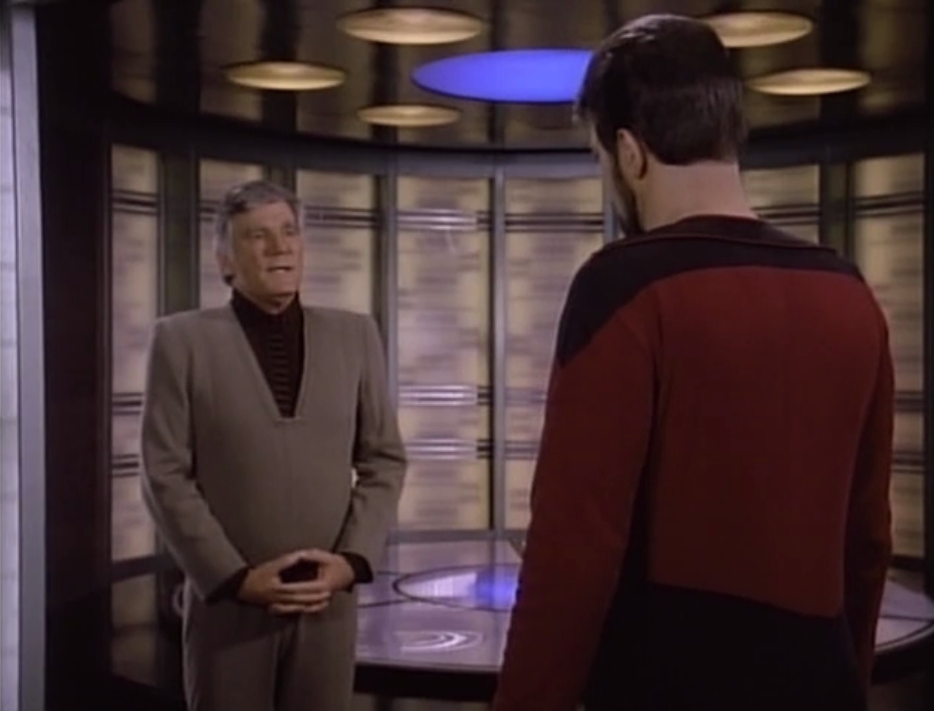
Brian Thompson

Thursday, May 28, 2015

The Next Generation 2x7 "Unnatural Selection"

rating: **

Memory Alpha summary

via CBS
"Number One, we need to make Dr. Pulaski
even less likable.  Suggestions?"
"That's easy.  Make her even more old."
"Make it so."
Like "The Deadly Years" before it and other episodes later, all with clever excuses as to why the trope is being used again (such as an alien screwing with Dr. Bashir in the Deep Space Nine effort "Distant Voices," or simply having a look at what the characters look like in the future, most cleverly executed, because they actually recast him, with Jake Sisko in "The Visitor" from the aforementioned series), "Unnatural Selection" as a title translates to "premature aging."  

It is better than "Too Short a Season" from a season earlier (which features the rare but not unheard-of de-aging trick, also seen in the animated series entry "The Counter-Clock Incident"), so there's that.  (Next Generation loved old-age make-up so much it was actually featured twice more, "Man of the People" and "All Good Things...," and another that doesn't quite go that far, "Future Imperfect."  Yeah.  To its credit, after "Too Short," it really couldn't be done worse.)  

And the crux of the story is poor Dr. Pulaski being the only main character stuck rapid-aging.  It's somewhat sad, because this counts as her big shot at doing something medical-related, being her only spotlight episode, and it ends up not being particularly flattering, says nothing about her, and...wait, is this the reason no one talks about Dr. Pulaski?  Other than, y'know, as that attempt to duplicate McCoy?  Except she really wasn't.  She was a terrific shot in the arm for the series, and I'll always argue that it would have been better to acknowledge that she existed.  But her relationship with Data would always be problematic.  McCoy and Spock they weren't.  Pulaski just didn't get Data.  The fact that she was not prominently featured in "Measure of a Man" is telling.

Anyway, the character the episode does serve well is O'Brien.  This is actually the first time he really emerges as someone notable, rather than merely the guy who keeps showing up, which is to say when he stops being someone like Kyle from the original series and quite literally makes a name for himself (seriously, even though O'Brien debuted in the first episode of the series, "Encounter at Farpoint," "Unnatural Selection" is when he gets a name).  

Which is to say, if you want to watch this episode for any particular reason, it's probably for O'Brien's sake.

four quarter analysis
franchise * series * essential * character

notable guest-stars:
Diana Muldaur
Colm Meaney

Wednesday, May 27, 2015

The Next Generation 2x6 "The Schizoid Man"

rating: *

Memory Alpha summary

via Star Trek
This brief glimpse of Bearded Data
is probably more noteworthy
than the rest of the episode.
"The Schizoid Man" is essentially the best the season could do with Data until "The Measure of a Man," an instant all-time classic.  You can see the tiny connecting pieces from "Schizoid," derived from the earlier "Datalore," that lead to "Measure," but the best that can be said of "Schizoid" is that it's a gimmicky episode that's outclassed in much of what it attempts to be by the later "Inheritance" (in which we meet Data's "mother") and even "Silicon Avatar" (in which Data's ability to hold multiple memories comes is explored).

All of which is to say, it's somewhat painfully simplistic.  In the full context of Data's adventures, it's even ridiculous, given how reductive it is about his functioning, about exactly what the scientist in "Measure" thinks of him before Picard successfully argues otherwise.

So, some ornery old dude downloads his consciousness into Data, and the crew has to figure this out.  Actually, it's very much "Datalore" all over again, with a guy claiming to be Data's "grandfather."  And so the episode is a light walk through who and what Data is supposed to be like.  If it had been done later in the series, when there was a much more firm grasp of everything, perhaps this is a story that could have worked.  But as it is, it doesn't.  Best to pretty much forget it.  As a touchstone to where the series and Data were at this point, it's indicative of all the wrong things, but it's still somewhat fascinating to consider, that things that seem so obvious now could be so badly misread.  So you can watch this one, I won't say you shouldn't, but you should be aware that this is hardly Next Generation at its best.  Not its worst, because there are plenty of episodes from the preceding season that amply demonstrate that (and later ones that are certainly head-scratchers).  Just, approach with caution.

four quarter analysis
franchise * series * essential * character

notable guest-stars:
Suzie Plakson
Diana Muldaur
W. Morgan Sheppard

Tuesday, May 26, 2015

The Next Generation 2x5 "Loud as a Whisper"

rating: **

Memory Alpha summary

via Trekcore
I really should ask Sarek if mind melds
can distribute hair follicles, too...
"Loud as a Whisper" is both hugely important and an artifact from the developing Next Generation as it was in its second season.

So let's explain that.  "Whisper" is basically the first time the series embraces what would later become one of its defining characteristics, the idea of Picard and his mission being more of diplomacy than action.  Yet the lead character is a guest character, making it a somewhat awkward note to start on.  That the character is deaf is almost the whole thrust of the story, but he needs the same kind of support Picard later amply demonstrates in the much more memorable "Sarek."

Technically, it's Troi who helps the guy, and in a general sense, you can think of "Whisper" as a Troi episode, but I don't think anyone would hold it against you if you didn't.  The third cast member with something notable to speak of is La Forge, who's informed by Dr. Pulaski that he can exchange his VISOR for ocular implants.  In that sense, "Whisper" is for La Forge in the movies what "Descent" is for Data in the movies, the seed of an idea later executed somewhat belatedly, the answer to a character feature that remained static in the series despite the occasional nod to how things could just as easily be different.  And this is actually a somewhat throwaway moment in the episode!

I hesitate to recommend the episode too strongly because although it's certainly notable for any number of reasons, what you feel about it ultimately depends on whether or not you sympathize with the guest character or end up annoyed with him.  Both are possible.  And the story, really, would have been so much more notable had it been the first time Picard dips his toes in diplomacy.

But this is very much a series in transition.

four quarter analysis
franchise * series * essential * character

notable guest-stars:
Colm Meaney
Diana Muldaur

Friday, May 15, 2015

The Next Generation 2x4 "The Outrageous Okona"

rating: **

Memory Alpha summary

via The Movie Blog;
the scary part of this image is that it makes Okona look
like adult Wil Wheaton
Okona could have become Next Generation's Harry Mudd.  (He could also have been the show's Han Solo.)  But then the series became known for things from the second season such as introducing the Borg ("Q Who?") and "The Measure of a Man," and then the third season convinced everyone that the series was good after all, and so the collective memory of the first two seasons became very hazy at best, and that's all you need to know about Okona.

Because in execution, Okona, a charming rogue, is about as brilliantly executed as the rest of Next Generation's attempts to be "edgy."  (Best execution: Ro Laren.  But then, she was once de-aged.  And then Kira became the better Bajoran.  Which is all kinds of ironic.)  That is to say, Okona is kind of the symbol of what Next Generation is when you take away every other possible definition: kind of soft shoe.  Kind of...soft in general.  (Come see Worf!  The easiest-to-defeat tough guy ever!)

None of which is to say you shouldn't watch "The Outrageous Okona."  It's an episode that could have had far greater significance if the series had developed any other way than it did.  But in the end, Okona has about as much impact out of the episode as he does in it: Data steals the show trying to be funny.

So yeah.  What ends up being memorable in an episode that tries to do something very, very different for the series is a competing element, one that explores part of what was Data's original premise: an android that wishes to be more human.  Because really, as much as this is said about Data, the most that was ever really done with this gimmick was in the later movies.  That's kind of weird, right?

Sounds like an episode to rediscover, right?  

four quarter analysis
franchise * series * essential * character

notable guest-stars:
Billy Campbell
Joe Piscopo
Whoopi Goldberg
Teri Hatcher

Thursday, May 14, 2015

The Next Generation 2x3 "Elementary, Dear Data"

rating: ***

Memory Alpha summary

via Star Trek; and no one in this picture looks odd at all!
Not the essential Moriarty episode (that would be the later "Ship in a Bottle"), but his debut is certainly noteworthy, too.

"Elementary, Dear Data" could have been one in a series of franchise experiences randomly name-checking famous historical and/or fictional things, and it could have been one in a series of franchise experiences randomly featuring a transporter and/or holodeck malfunction, but...

It becomes something else entirely.  The holodeck is challenged to give Data a worthy rival.  Since he is playing the part of Sherlock Holmes at the time, the creation takes the form of Holmes' arch-rival Professor Moriarty.  But then this Moriarty literally takes on a life of his own.

Predating the historic "Measure of a Man," which discussed the substance of Data's own artificial life, as well as the matter of a different remarkable hologram entirely, Voyager's Doctor, the creation and predicament of Moriarty, a self-aware construct, "Elementary" marks a considerable development in the season's efforts to find the heart of Next Generation, exploring not only the show's characters, but finding something entirely unique for the series as a whole.

What could easily have been a gimmick episode easily forgotten not only becomes something special very quickly, but is later followed up with an even better episode.  What more do you want me to say about it?  Best of all it not only serves Data extremely well, but is perhaps the best example of Dr. Pulaski's true legacy.  Without her, Moriarty would not exist.

four quarter analysis
franchise * series * essential * character

notable guest-stars:
Diana Muldaur
Daniel Davis

Wednesday, May 13, 2015

The Next Generation 2x2 "Where Silence Has Lease"

rating: *

Memory Alpha summary

via IO9; oh, don't be so surprised;
you're wearing a red shirt, aren't you?
"Where Silence Has Lease" is one of those episodes that has such a thoroughly convoluted title, that's practically all you need to know about it, one of the rare instances outside of the original series and Deep Space Nine where they were trying to be all poetic about it...and failed miserably.

As for the episode itself, it's about as remarkable as its title, a general excursion with one of Star Trek's favorite tropes, an alien being who has no idea what it's like to be human, and so sets about trying to figure that out.  Except the whole episode is more or less the crew being screwed around with in exactly the way Q would do it, without Q, and by the end such a poor replacement that you can't help but feel ripped off.  And that's how most fans tend to think about the episode, and as such it's thoroughly a member of the first-and-second season club of Next Generation.  It's not terrible (except the underwhelming way the alien in question is eventually presented visually), and in fact has a few character moments that try to be insightful (one of Riker's funniest moments occurs here, in which he overenthusiastically confirms that he wants to end the ship's self-destruct sequence; Worf, meanwhile, has far less convincing material more or less thrown his way, as in with the majority of his material from this point in the series), and so I offer a tepid recommendation.  Just know that this is hardly the series at its best.

four quarter analysis
franchise * series * essential * character

notable guest-stars:
Colm Meaney
Diana Muldaur

Related Posts Plugin for WordPress, Blogger...