Showing posts with label Whoopi Goldberg. Show all posts

Saturday, March 5, 2022

Star Trek: Picard 2x1 "The Star Gazer" Review

rating: ****

the story: Picard finds himself drafted into a most unexpected scenario, and then, of course, things spiral out of control...

review: The focus of this review will be the window into the background of Jean-Luc Picard that "The Star Gazer" uses for its title, the relationship with his mother that we're allowed to see for the first time.  This is an essential contribution to the character's lore.

Storytelling in the franchise originally focused only on the moment.  Any information about biographical details surfaced in dialogue.  There were never flashbacks.  The first exception to this occurred in Deep Space Nine's pilot, "Emissary," in which the Prophets grant Sisko, and the viewer, a vision allowing him to revisit how he met his wife Jennifer, and of course the first moments of the episode, in which we see how she died, during the Battle of Wolf 359.  Later, in Voyager, Tuvok's past is glimpsed in "Gravity," and "Flashback" provides a visit into his early Starfleet career.  The precedent to all this was The Animated Series' "Yesteryear," in which Spock visits himself when he was a child.  It wasn't until Star Trek, though, that the storytelling was allowed to be a truly organic element, where the narrative was able to jump from one time period to another, from the moment of Kirk's birth to Spock's formative years as he struggles to reconcile his Vulcan and human halves.

In "The Star Gazer" we see our first-ever look back at Picard in a similar manner.  Through the rivalry with his brother, explored in "Family" from Next Generation, we knew something of his origins, and we had even seen both his mother and his father in various visions.  In this episode, however, we see Picard as a child, interacting with his mother.  Interestingly, this sequence even evokes the Picard we hear about in Nemesis, whose conversations with Shinzon explore how he became interested in space.  The rest of the episode, as has the series itself, is steeped in more of his career than the mere fact that he was once in command of a starship that was lost in battle with a mysterious foe (that turned out to be the Ferengi!).

So yes, this is not Next Generation Part 2, but very much its own story, very much centered on Picard, for anyone still confused about this.  And this is the episode some of us have been really clamoring for, a visit with Guinan!  It happens to delve into the nature of Picard's romantic aloofness, as he happens to be falling in love with the nice Romulan lady who assists him at the vineyard and still trying desperately to deny such a thing could be happening...

The cast of the first season returns and they're all off on new adventures of one variety or another...until the final moments of the episode, in which the Borg are once again rearing their technological and biological distinctiveness and...Q!  Even more than Guinan, true aficionados have been craving for another clash between Picard and Q ever since 1994.  So it is very much cause for celebration.

criteria analysis:

  • franchise - A relatively new tradition of allowing a character's full history to be seen and entered into canon is embraced.
  • series - Picard, for all intents and purposes, fulfills several long-held desires by welcoming both Guinan and Q into the fold.
  • character - Picard, as never before, blossoms as a fully-dimensional character free from the typical constraints of franchise storytelling.
  • essential - Perhaps more so than Kirk and Spock's arcs in Star Trek, seeing this come about at the end of a long life is if anything even more rewarding.  This is historic in all the right ways. 
notable guest-stars:
Whoopi Goldberg (Guinan)
John De Lancie (Q)

Wednesday, July 20, 2016

The Next Generation 6x22 "Suspicions"

rating: ****

the story: Crusher's investigation into the death of a Ferengi scientist puts her career into jeopardy.

similar to: "Remember Me," "Ethics"

my thoughts: The question about The Next Generation is how Crusher was so easy to drop after the first season, and what was gained when she returned again in the third, because she remained a notoriously difficult character to crack.  Most of the time, it seemed as if the failure was on the part of the actress portraying her, Gates McFadden, but the fact that nearly every episode that focused on Crusher featured a single theme might also be telling.

Simply put, Crusher tended to box herself into corners.  In "Ethics" it was, as the title of the episode implies, her ethical stance against a colleague who otherwise epitomizes the Star Trek custom to feature mavericks of their respective fields (if they're a main character, this is a good thing, and if they're not, it's not).  Next Generation, in the choice not even to have a main character portray the chief engineer in the first season, seemed to shy away from the idea of exceptionalism, with the cautious Picard leading the way. 

There's also "Remember Me," in which Crusher is as literally isolated as you can get (although this sort of thing happened to other Star Trek regulars, too), with everyone disappearing around her, and no one believing Crusher when she attempts to explain what's happening.  Taken together, "Remember Me" and "Ethics" present a pretty convincing portrait of who and what Crusher was in the series ("Sub Rosa" can be included as well, but to no one's credit).

What does this have to do with "Suspicions"?  This is the episode where this portrait of the character comes together.  This is one of those episodes with a framing narrative where we meet the character after the worst of it has already happened (Deep Space Nine's "Whispers" is a similar achievement, while that show's "In the Pale Moonlight" is the best one, and Voyager's "Thirty Days" is a step or two below), but more than that, it's about explaining why Crusher is so easy to isolate, because she's a character who isolates herself, and it takes extreme circumstances to prove it.

"Ethics" made it look like she was merely the good guy, and "Remember Me" was merely a fun experience.  "Suspicions" paints Crusher into such a corner that she feels the only way to get out is to actually remove herself entirely from the equation, risk everything to prove she was right about her investigation. 

In the best way, "Suspicions" challenges everything the viewer thinks it knows about Star Trek.  Like Enterprise's "Judgment," which introduced a Klingon who wasn't happy to be defined as a warrior, the presence and significance of a Ferengi scientist blows open the classic stereotype that even a prejudice-free concept like Star Trek can let creep in when introducing alien cultures.  Even as Deep Space Nine was introducing Ferengi who weren't merely villains or comic relief (although they could still be both), and hadn't yet introduced further wrinkles into the culture (the second and third seasons would do that), Next Generation finally suggesting that itself, for having produced all the stereotypes to begin with, was a bold move, one seemingly buried in a story that focuses on Crusher instead of the scientist.  It's not merely about producing sympathetic characters in a species otherwise considered the enemy (the series did that with Romulans all the time).  No, to go out of its way and find that ill-fated little Ferengi scientist...it was kind of a metaphor for Crusher, too.

Look below the surface.  It took six seasons, but Crusher was finally figured out.  And she helps bring further depth to the series, and franchise, along the way.  Yeah, I've been guilty of making Crusher look bad.  Sometimes it's all too easy.  But she has a way of bringing out the most surprising material, too, in a very good way.

"Suspicions" is a classic in ways few other classic episodes are.  Like Crusher herself, it may be easy to overlook, but it shouldn't be.

This one's also notable as the last time Guinan appears in a TV episode.

criteria analysis: franchise - series - character - essential (all criteria met)

notable guest-stars:
Whoopi Goldberg (Guinan)
Patti Yasutake (Ogawa)
James Horan

Tuesday, May 24, 2016

The Next Generation 6x7 "Rascals"

rating: *

the story: Picard, Guinan, Ro, and Keiko are de-aged.

similar to: "One Little Ship" (Deep Space Nine), "The Counter-Clock Incident" (The Animated Series), "Before and After" (Voyager), "Too Short a Season" (Next Generation)

my thoughts: This is one of those episodes I have a real conflict with.  On the one hand, it's the rare episode that reverses one of the franchise's favorite tropes (characters aging).  On the other, it's akin to episodes like "Genesis" (Next Generation; characters devolving), "Threshold" (characters evolving), and "One Little Ship" (characters shrinking).  On the other hand, it's actually got its own tradition ("Counter-Clock Incident" from The Animated Series, "Before and After" from Voyager, and "Too Short a Season" from Next Generation itself).

But "Rascals" remains pretty unique, in that it literally features young actors taking the place of established ones.  To me, it's as tough a concept as "Threshold" has always been ("Threshold" is routinely listed as one of the worst episodes in the whole franchise).  I can easily stomach "Threshold."  "Threshold" is, ultimately, less of a gimmick episode and more of a concept episode (what happens when you pass Warp 10?).  "Rascals" has to live and die, ultimately, on its own merits.

The young actors as a whole are pretty terrible.  This was the last era in which casting directors could get away with this sort of thing.  By the end of the millennium (Haley Joel Osment in The Sixth Sense), they'd starting looking for real talent.  The actor playing the young Picard is particularly egregious. 

What makes this worse is that it's such a pivotal character episode.  It's the last regular appearances of Ro and both O'Briens in the series, and one of Guinan's last (before two appearances in the movies, Generations and Nemesis).  It's insane that this moment is all but ruined by having child actors perform the roles for the majority of the episode.

And yet, and yet...It's good for Ro's character, and good for Keiko's.  It positions the O'Briens for how they would interact throughout Deep Space Nine, and is the first time we see Ro as meaning anything as an individual since, basically, "Ensign Ro." 

And we get that nice little scene where the young Picard pretends to be Riker's son.

So as you can see, I have a conflicted relationship with "Rascals."  I group it most with "One Little Ship" because it's an absurd gimmick of an episode that really shouldn't work, and yet it kind of does.  The worst, in the end, that can be said about it is that Alexander, in a whole episode filled with other kids, is once again reduced to being relatively pointless in an episode where he should have been one of the most important characters.  Anyway...Let's just move on.

criteria analysis: franchise - series - character - essential

notable guest-stars:
Colm Meaney (O'Brien)
Rosalind Chao (Keiko)
Whoopi Goldberg (Guinan)
Michelle Forbes (Ro)
Brian Bonsall (Alexander)
Hana Hatae (Molly)

Friday, April 22, 2016

The Next Generation 6x1 "Time's Arrow, Part 2"

rating: ****

the story: Picard saves Guinan's life, and Mark Twain meets the 24th century.

similar to: "Storm Front" (Enterprise)

my thoughts: Okay, so let's recap.  Enterprise later ambiguously (or not) concludes its Temporal Cold War in "Storm Front," and everyone's wondering in "Time's Arrow" just how Guinan met Picard, and the nature of their intense bond.

It helps to keep in mind the nature of Guinan's people as explored in Star Trek Generations.  There, we learn that they have incredibly intimate bonds.  It's what they do.  So naturally, that's what Guinan forms with the guy who saves her. 

That's the short version.

The longer one actually has Guinan spending more time with Data, who's busy trying to keep his head attached to his body.  Guinan actually meets the whole crew in turn of the 20th century San Francisco.  But it's Picard who decides to stay behind and make sure she's okay.  This is a younger Guinan, who hasn't yet lost her planet to the Borg.  She's young, she's rebellious, and she's exploring her potential.  The imp who later challenges Q ("Q Who?") doesn't yet exist.  The know-everything Guinan, who's more aware than anyone ("Yesterday's Enterprise") doesn't exist yet.  But they can be reconciled.  Picard is the person who makes it possible, with a leap of faith

Actually, it's possible to explain this by analogy, and it's right there in the episode, with an old codger named Mark Twain.  A lot of this is implied.  If you know Twain at all, you know him as a cynical optimist.  History remembers him best for The Adventures of Huckleberry Finn, and his many famous quips.  Yet by the time of the events in this episode, he's nearing the end of his life, and more cynical than ever.  He doesn't believe in a hopeful future, certainly not in Data and his odd experiments...

I must confess.  I didn't always like this episode, and it was because of Twain.  Frankly, I found him annoying and obnoxious.  And I didn't see how any of it explained the bond between Guinan and Picard.  But then I realized, Twain's journey parallels Guinan's.  And the bridge?  The unnamed young Jack London.

In the episode, London hasn't even become a writer yet.  Yet he is destined to complete the literary era of American frontier adventure, which Twain himself embodied.  So he continues and expands on the narrative, just as Star Trek as a whole does.  Guinan was every bit as lost as Twain, as London, before Picard came along, the symbol of the hopeful future.  It's this hope Guinan embraces, just as Twain does, just as London is about to.

And that's why Picard is so important to her, and why she's so important to him, because they prove to each other that they're not wrong.  That's Star Trek in a nutshell.  And that's why this one's a classic, and absolutely essential.

criteria analysis: franchise - series - character - essential (all criteria met)

notable guest-stars:
Whoopi Goldberg (Guinan)
Jerry Hardin

Thursday, April 21, 2016

The Next Generation 5x26 "Time's Arrow, Part 1"

rating: ****

the story: Data's head is unexpectedly discovered in a cavern below San Francisco.

similar to: "Storm Front" (Enterprise)

my thoughts: Well.  Here we go: the secret origin of Guinan and Picard's relationship.  Was it worth the wait?  It's complicated...but yeah, it really is.  It just needs some special insight.

Remember Enterprise's Temporal Cold War?  That was an arc that lasted the span of the series, but ended on an incredibly ambiguous note in the fourth season two-part opener "Storm Front," in which we never find out who Future Guy is, one of the central riddles of the series.  Or do we?  I have my theories.  I believe that the alien who collaborates with the Nazis is Future Guy.  But without confirmation, it's just speculation.

"Time's Arrow" is a little like that.  Guinan is one of the trickiest characters in franchise lore.  Steeped heavily in mystery in her earliest appearances, the more we learn, the more we must decide if all that mystery was really worth it.  This is the central question of just how much was lost from the creative transition from the second to third seasons.  And it entirely hinges on "Time's Arrow."  Clearly the entire season had been leading toward it, just as Worf's in "Sins of the Father" inevitably led to "Redemption" (which itself served as a sequel to "Yesterday's Enterprise," which is what led to "Time's Arrow"...), so again, the question must be asked, Was it worth it?

Before we even get there, we have to examine what the bulk of the episode is actually about, which is an improved version of the previous "Next Phase," in which the crew once again deals with matters of mortality.  It's odd that the episode is so heavily centered on that (actually, two-part Star Trek episodes often work like that) without a lot of fan memory making much of it, but there you go, and as Data episodes go, it's a pretty good one, worthy of the finest tradition ("The Measure of a Man," for instance).

But in order to solve the mystery of what happened to him, and possibly prevent it (or cause and remedy it), the crew has to journey to the past, and at Guinan's insistence. 

...And in order to find out the answer to the question I keep posing, you will have to wait until the second part of this episode...(Hint: it's totally worth it.)

criteria analysis: franchise - series - character - essential (all criteria met)

notable guest-stars:
Whoopi Goldberg (Guinan)
Jerry Hardin
Marc Alaimo
Alexander Enberg

Monday, April 18, 2016

The Next Generation 5x23 "I, Borg"

rating: ****

the story: The unexpectedly comes into possession of a Borg drone, and must determine what to do with it.

similar to: "The Abandoned" (Deep Space Nine), "Drone" (Voyager), "Stratagem" (Enterprise)

my thoughts: If the franchise hadn't done a number of similar episodes itself later, "I, Borg" would seem to be a peculiarly singular accomplishment: sympathy for the devil.  I mean, you can certainly find it elsewhere, but it's not the easiest story to do, and it seems all the less likely for having been done with the Borg, who in "The Best of Both Worlds" proved to be the iconic Next Generation villains.

Simply put, this is one of those impossible experiences that define the franchise at its best.  Although it led to somewhat questionable storytelling logic ("Descent, Part 2") later rectified (Star Trek: First Contact, Voyager), "I, Borg" features a nuanced follow-up for Picard as he confronts a representative of the Collective that nearly ruined his life, and deciding that instead of destroying it or using it (Starfleet can be pretty awful), he'll give an abandoned drone a second shot, now that it's been severed from the hive mind.  It'[s chilling and wonderfully human at the same time.

Later versions of this story feature threats from relatively more benign circumstances, but this is the episode that explores ramifications scarcely considered possible previously.  It's like "Devil in the Dark" in its naked complexity, and could only have been done in an era where serialized storytelling was in its nascent state.  The whole story would have been vastly different had Picard been hunting this opportunity (and thus the difference between, say Enterprise's "Stratagem").  Having stumbled into it and knowing exactly what's going on from the start, more or less (unlike, say, "The Abandoned" from Deep Space Nine or "Drone" from Voyager), it's a moment of cerebral meditation in the best tradition of the series.

Like "The Drumhead" before it, "I, Borg" is an oblique continuation of "The Best of Both Worlds," but an essential part of its story all the same.  For Picard, in all possible regards, this is the conflict of his life.  It's another classic.

criteria analysis: franchise - series - character - essential (all criteria met)

notable guest-stars:
Whoopi Goldberg (Guinan)
Jonathan Del Arco

Wednesday, April 13, 2016

The Next Generation 5x22 "Imaginary Friend"

rating: *

the story: A little girl's imaginary friend becomes real.

similar to: "The Bonding" (Next Generation), "Alter Ego" (Voyager), "Exile" (Enterprise)

my thoughts: A great deal similar to "The Bonding," in which a little boy is manipulated by aliens, "Imaginary Friend" is another tangential Alexander story (there were a ton of these after he becomes a recurring character in "New Ground" during the fifth season...) proving that maybe the series didn't really know what to do him after all.  I mean, it's odd that they were still doing a "Bonding" episode with a recurring boy in the cast line-up and not have him in the lead.

Yet it's not a complete waste, because the kid in the lead is played by the precocious Noley Thornton, who would later appear in Deep Space Nine's "Shadowplay" in a much better story.

But as you can see above, this kind of story was a franchise trope, and a season that otherwise was packed with excellent episodes sometimes had to fall back on old standby material to pad itself out.  That's what "Imaginary Friend" basically is, padding.  Watch it if you're a season completest, but otherwise you can certainly consider skipping it...

criteria analysis: franchise - series - character - essential

notable guest-stars
Brian Bonsall (Alexander)
Noley Thornton
Whoopi Goldberg (Guinan)
Patti Yasutake (Ogawa)

Friday, February 19, 2016

The Next Generation 5x3 "Ensign Ro"

rating: ****

the story: Ro Laren joins the crew and butts heads with everyone.

similar to: "The Galileo Seven" (original series), "Hollow Pursuits" (Next Generation), "Emissary" (Deep Space Nine), "Caretaker" (Voyager)

my thoughts: This is about as explosive a character introduction as you can get, and the first sign that Gene Roddenberry's edict of a perfect future was not going to outlive Roddenberry himself (this episode in fact aired three days before his death).  Although never taken quite as literally as the legend suggests, Star Trek's creator envisioned a time when humanity had moved on from petty differences.  Except the character of Spock frequently came up against it, experiencing bigotry in such episodes as "The Galileo Seven."  Next Generation had previously examined the misfit in the character of Barclay in "Hollow Pursuits," someone who doesn't get along with his fellow officers for whatever reason.  And yet Ro Laren was a clear escalation of this theme, a bold departure for a series that has frequently been labeled with having the most vanilla characters in the whole franchise, everyone far too chummy chummy.  Even McCoy frequently, and famously, needled Spock.

In many ways, "Ensign Ro" was the first episode of the rest of the franchise, from Deep Space Nine to Voyager and even Enterprise (a planet of xenophobes is explored in "Demons"/Terra Prime," two of its best hours).  Never mind that it introduces Bajorans, too, and thus completes the Next Generation guide to Deep Space Nine (after "The Wounded," introducing Cardassians, and "The Host," introducing the Trill, and not to mention the crucial battle of Wolf 359 in "The Best of Both Worlds, Part 2" which serves as the secret origin of Sisko).  Ro is the character who can break the rules, and thus introduces characters who are pointedly looking for redemption, which is what the casts of Deep Space Nine and Voyager are looking for in spades.  (Never mind, too, that late in the season we get a preview of Voyager's Tom Paris in "The First Duty.")

There's a whole story around Ro, in which she's being used as a pawn by a misguided Starfleet admiral in a game of chess with the Cardassians (who in just a few episodes become more interesting than the Romulans are throughout the series, arguably), but the character herself is so compelling, it's easily worth focusing on her alone, the impact this one blazing appearance leaves behind.  And yes, she makes a few other appearances, but few of them are as compelling as this one (except its companion, "Preemptive Strike").

The episode also works as a spotlight for Picard in much the same way as "Darmok" before it, and serves to further build toward Guinan's biggest moment in the forthcoming "Time's Arrow," so it's got a lot going for it.  Easily to earn classic status.

criteria analysis: franchise - series - character - essential (all criteria met)

notable guest-stars:
Michelle Forbes (Ro Laren)
Whoopi Goldberg (Guinan)

Tuesday, February 9, 2016

The Next Generation 5x1 "Redemption, Part 2"

rating: ****

the story: The end of the Klingon civil war sees scrambling on all sides to effect their best possible result.

similar to: "The Best of Both Worlds, Part 2" (Next Generation), "The Search" (Deep Space Nine), "Kir'Shara" (Enterprise)

my thoughts: A true Next Generation classic concludes, perhaps the defining story of the series, as various strands come together, some touched on in the preceding entry, others newly introduced.

The operatic nature of Klingon politics kind of speaks for itself at this point.  More compelling are the matters of Sela and Data in command of a starship.  In Sela is a peculiar legacy of the series, the re-introduction of Denise Crosby into series lore after her departure in the first season and subsequent return in the landmark "Yesterday's Enterprise," the events of which are herein recounted to notable skepticism until Guinan steps in to try and make sense of them.  The results are almost more compelling for the character of Guinan than Sela.  Sela returns in "Unification," while Guinan's past is finally explored in "Time's Arrow," both within this season, so clearly "Redemption" necessarily set up as well as concluded storylines for the series, another mark of its crucial nature.

And yet, the big confrontation between Picard and Sela is almost academic.  Less so is Data's arc in the episode, in which he requests field command in the task force assigned to curb the fighting.  It's a direct reflection of how Starfleet is still coming back from the devastation of the Borg crisis in "Best of Both Worlds," and a unique further examination of how Starfleet as a whole views Data.  Those unfamiliar with him, it seems, still underestimate him.  His rebellious first officer believes Data, an android, to view everything in cold terms, neglecting the human element, the sacrifices that may result from his strategies.  Never mind that in other episodes we're reminded that this is precisely makes command material.  In Data it's seen as a flaw.  So he must once again demonstrate his brilliance in order to be accepted.  Although one aspect of the episode, it's worth remembering in its impact on Data as a whole.

Of course, there's also the matter of how Worf finally resolves his relationships with the Klingons and Starfleet.  That's the essence of "Redemption," how it all reflects around this character.  Both Data and Sela only serve to reflect what happens to Worf, after all.  And the end of the episode is a direct answer to "Sins of the Father," in which he made a difficult decision that led to "Redemption" in the first place.

It's one of the most significant moments in the series, and in the franchise, and largely defines what makes Star Trek what it is, more interested in the personal moments than in the greater ramifications, the ability to turn away from the drama rather than be defined by it.  If this had been Star Wars, Worf would never have even considered rejoining Starfleet, much less letting slip his opportunity for revenge.  If you ever wanted to explain the differences between the two franchises to someone, "Redemption" is exactly the story to use as your example.  Star Trek features space exploration, but it's about the exploration of self first and foremost.  Even if the self is an alien from a warrior culture who ended up joining a different family entirely.

And yet, of course, the Klingon saga in Star Trek only grew larger.  That's the beauty of "Redemption."

criteria analysis: franchise - series - character -essential (all criteria meta)

notable guest-stars:
Denise Crosby (Sela)
Whoopi Goldberg (Guinan)
Tony Todd (Kurn)
Robert O'Reilly (Gowron)
Barbara March (Lursa)
Gwynyth Walsh (B'Etor)
Colm Meaney (O'Brien)

Monday, February 8, 2016

The Next Generation 4x26 "Redemption"

rating: ****

the story: Klingon civil war breaks out thanks in no small part to Romulan instigation, leading Worf to make a difficult decision.

similar to: "Way of the Warrior" (Deep Space Nine), "The Expanse" (Enterprise)

my thoughts: In many ways, "Redemption" is far more important to Next Generation's legacy than "The Best of Both Worlds."  Where the latter is plenty iconic, "Redemption" defined in large part the show's legacy, which can be felt in each subsequent Star Trek series and in television generally.  It's the point where serialized storytelling became more important than serialization, not because of soap opera qualities or some general goal, but because the mythology of a concept became the most important aspect of the storytelling.

I'm incredibly tempted to write a whole article on the predecessors and successors to "Redemption," from Next Generation itself, from other series, other movies.  It's a legacy that quickly eclipses "Best of Both Worlds."  It's really that important. 

For starters, it introduces the Duras Sisters, Lursa and B'Etor, who end up impacting the franchise in ways the far more limited and utilitarian Duras himself ever could.  They appear throughout the remainder of the series, in Deep Space Nine, and join Khan and the Borg as familiar figures to appear in the movies when they meet their demise in Generations, always scheming but in increasingly unpredictable ways.  In a lot of ways, they're the true legacy of Harry Mudd, and they're a lot harder to forget.

If you start only from "Sins of the Father" and "Reunion," in which Worf enters the Klingon fray more directly than at any other point in his life, "Redemption" expands those developments and builds on them.  In Star Trek lore, Klingons have opera.  In the episodes themselves, this is the Klingon opera, a crescendo of all the best work the series had done to this point, and in a lot of ways, the rest of it was kind of a letdown, never really trying something this ambitious again (there's the realm of Deep Space Nine).

This is the meat and potatoes of the franchise mandate, coming to terms with an alien culture, in ways the original series and Spock could only play at, even in the movies.  Worf's conflicts are indeed epic.  Although he does return to Starfleet, the fact that he leaves at the end of this episode and season is completely unprecedented, and prove the depth of his character and the series around him.

This is a culmination, besides, of the rich character work that was the season at the peak of its creativity, and it successfully and artfully weaves high drama around a main character and significant guest stars around him, something that had heretofore eluded both the season and series so far, so often with one or the other dominating, but never both at the same time.

And the story only gets better...

criteria analysis: franchise - series - character - essential (all criteria met)

notable guest-stars:
Robert O'Reilly (Gowron)
Tony Todd (Kurn)
Barbara March (Lursa)
Gwynyth Walsh (B'Etor)
Whoopi Goldberg (Guinan)
Denise Crosby (Sela)

Friday, February 5, 2016

The Next Generation 4x25 "In Theory"

rating: **

the story: Data attempts to have a romantic relationship.

similar to: "Family," "Data's Day"

my thoughts: I've had something of a conflicted relationship with this episode over the years.  On the one hand, it's a valuable experience of what it's like to interact with Data on an intimate basis, and on the other, it really doesn't give him enough credit.

"In Theory" joins a suite of episodes from the fourth season that take a slice-of-life approach to the series, including "Family" at the start of it and "Data's Day" near the middle.  "Theory" is the most simple of them, and therefore the easiest to take for granted.  Yet it may be the most valuable.  It's one thing to accept Data as a member of the crew, and another to accept that the crew accepts him.  Often enough, we're remembered that other people haven't always been as accepting, but "Theory" presents what it's like to actually accept him, warts and all, including all the idiosyncrasies that are so easy to take for granted.

Fans hate it when they're introduced to characters who are relevant for one episode, but are otherwise represented as relevant on a continued basis to the ones we otherwise have followed all along.  As with the rest of the season, "Theory" is interested in someone for their unique perspective, and so use them as a catapult to help the story along.  The woman who falls in love with Data, however, is kind f beside the point.  Unlike O'Brien in "The Wounded" or Barclay in "The Nth Degree," it wouldn't have benefited anyway (say, Nurse Ogawa) to have been used, from the available pool, and so let's just move on to Data himself.

The most telling scene is when Data explains everything he was processing at a given moment, and it's the rare moment where we're allowed to view him as the complex mechanism he really is.  His girlfriend is pretty annoyed that she's just a part of his thought process, but it's exactly what Data should be doing.  It's painful when he programs himself for love (Voyager's Doctor had better examples of such attempts, such as "Real Life" or "Tinker Tenor Doctor Spy"), but again, that just goes to show he inexperienced he really is, despite his many years of service with humans.

"Theory" is hardly to the caliber or significance of "Measure of a Man," but it's still a valuable insight into Data and his greater role in the society of the crew.  And besides, just as Wesley discovered before him, it's dangerous but incredibly amusing to ask crewmates about love!

criteria analysis: franchise - series - character - essential

notable guest-stars:
Colm Meaney (O'Brien)
Rosalind Chao (Keiko)
Whoopi Goldberg (Guinan)

Friday, January 15, 2016

The Next Generation 4x17 "Night Terrors"

rating: (no stars)

the story: Troi attempts to figure out why no one can achieve REM sleep.

similar to: We'll skip this one.

my thoughts: When talk about bad episodes, they normally focus on concepts that just didn't work for them, such as someone stealing "Spock's Brain," or Next Generation characters appearing in Enterprise's final episode ("These Are the Voyages...").  They rarely bring up clunkers like "Night Terrors."  I have no idea why.

This is the kind of episode that can be summed up in one sequence: Troi floating in space, crying "Where aaaaare youuuuu?"

And I will let that set in for a moment.

Apparently it was a nightmare to shoot.  When the nightmare in shooting completely translates to the screen, you know there's a problem.  Those same fans often bring up Star Trek V: The Final Frontier as the worst film in part because they have little faith in it creatively (William Shatner directs, is plague by the perennial Star Trek movie problem of not having enough time to finish his vision; see also: Star Trek: The Motion Picture, another favorite among chatter about the worst of the franchise).  Yet to actually watch Final Frontier, you can quibble about special effects not being impressive enough or creative choices, but nothing you see on the screen is nearly as bad as the image described above from "Night Terrors."

So to me, that's what defines bad Star Trek.

The episode in general is horribly uninspired, the franchise on autopilot, as riddled with tropes and devoid of real character content as you can get.  I don't pin this on the character of Troi, but Next Generation's habit of forgetting that, generally, it did characters far better than the original series.  No, I'm not talking the affinity and familiarity of Kirk, Bones, or Spock.  But about depth of characterization.  And there's just no depth here at all.  Poor Miles and Keiko O'Brien are so soon reduced to story fodder it's like the episode was trying to take a huge step back for the series.  Worf contemplating suicide?  For any other time he was feeling low, this is just a mockery of his character.

It's that bad.  And worse, it doesn't even try to play along with established character traits.  Troi is half-Betazed.  The guy who technically leads her to the terrible sequence is a full Betazed.  Yet he spends the entire time comatose, and the best way he can communicate is enigmatically?  It's just bad storytelling.

Next Generation unquestionably features a certain level of quality storytelling over all.  And yet, sometimes it was far too comfortable in taking it easy.  Fans bellowed that later series (Voyager, Enterprise) coasted on good will (and sputtered because they both used it up quickly), but that very level of quality was evident well before they ever made the air.  And the second season of this series at its creative peak (generally agreed to have begun in the third season) releasing material of this poor caliber is just insulting.

Yet the fans...You get the point.  "Night Terrors" is kind of like the barometer of bad in Star Trek.  If you can somehow stomach it, if you find it easy to gloss over, then your ability to judge the franchise objectively is completely compromised.  It's the kind of episode you would rather the uninitiated not sample as their first taste of Star Trek.  Because it will forever bias them, too, unquestionably.

If you want to know what kind of fan I am, just read this review.  Typically, I don't react to episodes like this.  There are some fans who made it a habit to react to whole series this way.  That's just ridiculous.  But there are episodes truly deserving that ire.  Such as this one.

(For those wondering if the season as a whole completely degenerates, it doesn't.  There are some really good episodes coming up!)

criteria analysis: franchise - series - character - essential

notable guest-stars:
Colm Meaney (O'Brien)
Rosalind Chao (Keiko)
Whoopi Goldberg (Guinan)

Wednesday, January 13, 2016

The Next Generation 4x16 "Galaxy's Child"

rating: **

the story: Geordi meets the real Leah Brahms

similar to: "Hollow Pursuits" (Next Generation), Star Trek: First Contact, "Author, Author" (Voyager)

my thoughts: A sort of sequel to "Booby Trap," the episode where Geordi interacts with a holographic version of Dr. Brahms, "Galaxy's Child" is one of those episodes where you can squarely ignore the sci-fi crisis elsewhere happening, if you so choose, and instead focus on the character development happening along the way.

Geordi is one of the more hapless romantics in Star Trek lore, not because of his VISOR, but because of the basic problem of not really knowing what to do around the opposite sex.  Ironically enough, this duo of episodes encompasses the experiences of another engineer in the crew, the infamous Barclay as introduced and featured in "Hollow Pursuits," who is far more comfortable interacting with people in the holodeck than in real life.

(No, these are not episodes based on the Internet age.)

That Geordi somewhat duplicates that in these episodes is a little ironic, because no one would otherwise associate him with Barclay's rich psychoses.  Yet that's kind of what happens with Dr. Brahms, whom he first meets in deceptive holographic form.  This episode is all about learning what the real person is like.  Suffice to say, she's almost the complete opposite of everything Geordi previously thought he knew about her.  Only O'Brien has worse luck, in general.

That makes for a pretty fun episode.  Not only can you discard the rest of it, you really wouldn't be missing much.  This is a rare opportunity in the series to just watch a single character squirm from very human circumstances.  Unlike Scotty, Geordi was not known as a miracle worker.  He wasn't even known as an engineer originally.  Yes, he's hugely capable in that regard, but he becomes more and more useful as one of the more relatable people in the crew, and this is probably the episode to see why. 

criteria analysis: franchise - series - character - essential

notable guest-stars:
Susan Gibney (Brahms)
Whoopi Goldberg (Guinan)

Monday, January 11, 2016

The Next Generation 4x14 "Clues"

rating: **

the story: The crew begins to suspect something's wrong with Data when things don't add up and he looks increasingly guilty.

similar to: "The Menagerie" (Original Series), "The Omega Directive" (Voyager)

my thoughts: For most of the episode, "Clues" feels like a fairly generic mystery, with the crew trying to figure out why they seem to have lost time.  I prefer to think about it less in terms of the way most of the episode unfolds, and more about its ultimate implications.  It's best considered as a Data episode.

Just as Spock made himself look bad (in "The Menagerie") and Janeway had to withhold information from her crew (in "The Omega Directive"), what might have been an ultimately hackneyed story about Data being controlled by aliens (it's a Star Trek trope with spotty history, believe me) instead turns into another exploration of what sets the android apart.  I think ultimately the way the story approached limited its impact, actually.  A more straightforward story would have been more useful in that regard.  To salvage "Clues," you can of have to ignore most of it.

The series routinely attempted to feature Data in circumstances that exploited his unique nature as a nonhumanoid.  Most of the time it did so from oblique angles (Voyager was far less bashful with the Doctor, and even Enterprise with Phlox), as if making Data stand out too much would, well, make him stand out too much.  His ability to experience the alien culture mostly teased in the episode, and then have to lie about it, could have been far more interesting (would he really be incapable of tying up all the loose ends in the effort?). 

But, the episode is poised as a mystery, so you must accept that Data inevitably has his own limitations.  So to watch him try is as much as you'll get, and it's at least worth it just for that.  Theoretically he would experience moments like this all the time, maybe not to such a dramatic extent, but at least things he can't properly convey, or moments that he can't properly share, like how Geordi sees everything differently because of his VISOR, or Worf because he is a Klingon.  Which makes this a somewhat clumsy but still fascinating way to explore another aspect of what sets him apart and yet still a welcome member of the crew.

In the end, then, "Clues" is a better riddle about Data himself than the aliens he's attempted to help shield from the outside world.

criteria analysis: franchise - series - character - essential

notable guest-stars:
Colm Meaney (O'Brien)
Whoopi Goldberg (Guinan)
Patti Yasutake (Ogawa)

Friday, January 1, 2016

The Next Generation 4x10 "The Loss

rating: **

the story: Troi loses her empathic ability.

similar to: "Broken Link" (Deep Space Nine), "Mortal Coil" (Voyager)

my thoughts: Of all the episodes that centered around Troi, this is probably the most important, the essential one, where her whole character is deconstructed.  Like taking away Odo's shape-shifting ability ("Broken Link" and half the episodes of the fifth season) or Neelix's will to live ("Mortal Coil"), taking away her half-Betazoid-derived powers is about as big as it can get.

Naturally, she's completely devastated, and the episode is a complete examination of her coping with that, and how she fits in with the rest of the crew, with or without her empathic ability.  The result is about as fascinating a character study as Next Generation ever did, even if it's wrapped up in a fairly generic sci-fi story that is otherwise undistinguished (don't blame the series and/or franchise if you don't like that sort of thing; it's pretty much half the reason Star Trek exists at all, something a lot of people have a hard time understanding).

What results is a version of Troi who's more significant than perhaps she is otherwise, in the series or later films, someone who has unique insight not only into the minds of others but the psychology of the situation.  This would have been fascinating to explore later, but Troi reverts to what she always was, which is a real shame, and somewhat diminishes the impact of the episode.

On its own, "The Loss" is a classic allegory in the best Star Trek sense, what might almost be described as a PTSD episode (Deep Space Nine's "It's Only a Paper Moon" explores this in more detail, and more directly).  The fact that it features Troi and augments her character, however briefly, is kind of a bonus. 

If you're a fan of Troi, this is the one to watch.

criteria analysis: franchise - series - character - essential

notable guest-stars:
Whoopi Goldberg (Guinan)

Thursday, July 23, 2015

The Next Generation 4x2 "Family"

rating: ****


Memory Alpha summary

via Ode to Jo & Katniss
Picard's happy thoughts include
his brother being cloned by Pakleds.
"We need wine.  Wine is good."
The only episode that could possibly have topped "The Best of Both Worlds Part 2" as a follow-up to the dramatic third season finale in fact followed it, making that three classics in succession, surely the best of times.

Unless you're Picard and your efforts at recuperating from the Borg ordeal somehow find you at great odds with your brother all over again, just like the old days, very much another thing best left in the past.  Except the experience becomes wonderfully cathartic.  (By the way, if you've never seen "Family" but have seen Star Trek Generations, watching the episode helps make sense of Picard's emotional troubles there.)

Other than Picard, the big winner of the episode is Worf, whose human foster parents we finally meet, and they're just about what you'd expect for how he turned out.  It's every bit a strong continuation of Worf's ascension to the forefront, along with Picard, of the series.  If you're wondering where Data, the third member of Next Generation's big three, is during the episode, because he's the only member of the cast left out, you'll have to wait until the next episode, "Brothers."

The legacy of "Family" is keen.  Enterprise reprises the concept in "Home," following the events of the Xindi third season (it's another classic, by the way).  In a lot of ways, it's also a template of how Deep Space Nine would operate throughout its run, taking a more thoughtful approach to the lives of its characters, something Voyager did in a much more insular fashion (by necessity), while Enterprise was a mix of both.  In a sense, it's the birth of what the franchise would become, a flowering and broadening of the storytelling capabilities so that the main characters weren't so often lost in the shuffle of a given episode, needing to rely less on gimmicks for dramatic heft.  Who better to kick it off than Patrick Stewart?

four quarter analysis
franchise * series * essential * character

notable guest-stars:
Colm Meaney
Whoopi Goldberg

Wednesday, July 22, 2015

The Next Generatio 4x1 "The Best of Both Worlds, Part 2"

rating: ****


Memory Alpha summary

Star Trek TNG Episode Guide
"I am thinking of calling it
Picard.  What do you think?"
The most famous story from The Next Generation concludes, featuring the famous Battle of Wolf 359 (to that point and arguably remaining the most famous starship battle of the franchise, depicted again and serving as the basis for Sisko's origin in the Deep Space Nine pilot "Emissary") as Locutus (the assimilated Picard) and the Borg are defeated.

Where the first part focused on Riker's unwillingness to assume his own command, the second part is a full depiction of what it would look like.  Naturally he's completely competent.  He's willing to take advice from anyone, even Guinan, who offers the chilling thought that maybe Picard really is gone for good.  Except that's not good enough for Riker, who quickly undertakes a bold plan to kidnap him back, using the Borg's own passivity against unperceived threats against them.

From there it becomes what even the creators of the episode sometimes fretted as an anticlimactic way to end the epic: inside Data's lab.  Except it's a perfectly Next Generation thing to do, perfectly characterizing the more cerebral aspects of the series and allowing its logic to play out in ways that maybe were never quite pulled off with the same aplomb again.  Picard offering, at a subconscious level, the Borg command that is in effect synonymous with the computer virus of Independence Day (there's really nothing wrong with either means of victory), is a clever way to avoid a merely physical conclusion, thought instead of fought.

Then the episode ends in a way that would later become a trademark of Deep Space Nine, and sometimes featured in Enterprise: with the emotional damage of the preceding events felt.  Next Generation itself would only do it once more, at the end of "Chain of Command."  Both times are brilliantly realized in their complete understatement.  Picard emerges as more and more relatable because of moments like these, as he expresses rare vulnerability in a leading man.

This is how you tell big stories in Star Trek.

four quarter analysis
franchise * series * essential * character

notable guest-stars:
Elizabeth Dennehy
Whoopi Goldberg
Colm Meaney
George Murdock

Tuesday, June 16, 2015

The Next Generation 2x16 "Q Who?"

rating: ****


Memory Alpha summary

via Pinterest
Of particular interest in this debut of the Borg
...is the clash between Guinan and Q!
This is a Q episode.  This is the debut of the Borg.  And surprisingly, this makes perfect sense.

Let's start with Q.  After his debut in the series pilot "Encounter at Farpoint" and follow-up appearance in "Hide and Q," the god-like being to end all franchise god-like beings is on-hand to help shove the series to new and greater heights, like a cue (heh) for everyone to acknowledge that to this point Next Generation had not really lived up to its potential.

Everyone loves Q, though, right?  Do I have to do a hard sell for him here?  Yet this is perhaps the only other time besides the concept of the trial in the pilot and reprised in the series finale ("All Good Things...") where he gets to be something other than an imp, can be taken seriously, because he forces Picard to acknowledge once and for all that humanity has much to learn.  And it's the one and only time he scores on that point, too, beyond a shadow of a doubt.

By introducing the Borg.  Yes, the first season teased these most formidable of foes, but it took until "Q Who?" to not only to know what they actually look like, but what they are, what they represent, and that, yeah, they really are like nothing Star Trek had seen before.

I call this a classic although it's to be understood that "Q Who?" doesn't really compare to the series high point, "The Best of Both Worlds," in which the Borg make their biggest-ever impact, in effect giving Next Generation its lasting legacy.  For one the look of the Borg isn't quite nailed, although everything else is, including their cube ships that are perhaps more distinctive and menacing than any drone could ever hope to be.  The menace of the cube is amply demonstrated all right...

Besides Q and the Borg, there's also Guinan.  Throughout the series but especially in her debut season the amiable bartender existed in an impenetrable air of mystery, and only sometimes is there any real attempt to dispel it.  Even after two additional appearances in the movies, the portrait remains unfinished, even though she emerges as less than she's suggested to be in moments like the one that helps make "Q Who?" that much more impactful.  She is in fact presented as a legitimate threat to Q.  Which ends up being, for anyone knows based on all remaining evidence, a wild overstatement, but in this moment it does more than any prior appearance to prove how important Guinan really is.  Like Q she ultimately transcends any efforts to limit her despite growing familiarity doing its keen best.

So that's a lot to chew on.  Aside from "Measure of a Man," it's hard to conceive of another episode from the first two seasons as significant or worthy of significance as "Q Who?," and that's really all you need to know if you're looking for a simple enough recommendation.

four quarter analysis
franchise * series * essential * character

notable guest-stars:
John De Lancie
Whoopie Goldberg
Colm Meaney

Wednesday, June 3, 2015

The Next Generation 2x10 "The Dauphin"

rating: **


via Don Rockwell
Not Ashley Judd, but she'll do.

Decent character work for Wesley, especially considering how annoying he was in the first season, that's what awaits you in "The Dauphin."

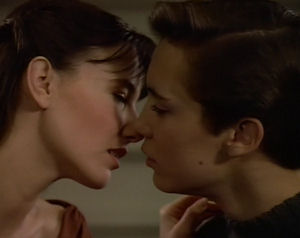
The object of his affection is the princess (in effect) of a world struggling to find peace between warring factions.  There's shape-shifting involved, Worf nudging toward the Worf who's actually recognizable from later seasons, and Guinan once again proving sage advice.  And because this is a strange crew indeed, none of them knowing what to do about love.  Seriously, that's kind of weird, right?  Although maybe yet another conscious step away from that lothario Kirk...

The story of a first love can be kind of rote, but it allows Wesley to guide the episode away from its own particular context and into a feel for what the series would be like once it finally figured itself out (hence: that note above about Worf), meaning trips to Ten Forward that don't necessarily have to do with Guinan, but merely as a place that would take on great social significance, where a lot of guest characters would be brought, actually, but also where a lot of the main characters would talk about what's going on.

In a weird kind of way, "Dauphin" ignores most of what makes Wesley a specific character (the later episode I reference in my latest clever caption, "The Game," is a Wesley romance that does feature Wesley as a specific character) but in doing so allows the viewer to view him differently, as a guide into the series, not as a surrogate for young fans but merely as someone capable of giving a tour without it seeming like work.  Who else was going to be able to do that?  And so once again, this is the second season struggling inch for inch to discover what truly makes Next Generation work.  All too often, the third season is given all the credit.  But the groundwork begins in episodes like "Dauphin."

It's all too rare when Star Trek can use tropes in an episode, seem like the tropes are the only thing it really has on its mind, but ultimately transcend those tropes.  This is one of those instances.  But those tropes have their moments, too.

four quarter analysis
franchise * series * essential * character

notable guest-stars:
Diana Muldaur
Colm Meaney
Whoopi Goldberg

Tuesday, June 2, 2015

The Next Generation 2x9 "The Measure of a Man"

rating: ****

Memory Alpha summary

via Planet Shannon
"Alas, poor Data!"
"Commander, I am right here."
"...A fellow of infinite jest
and bad whistling..."
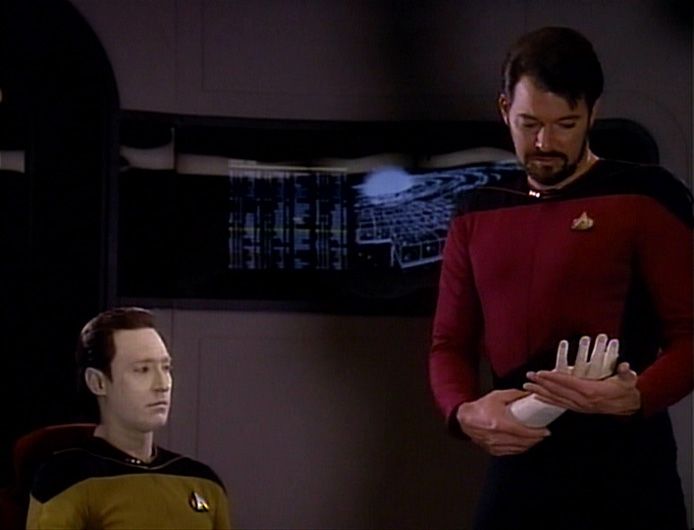
One of the indisputable classics of the franchise is also the first true moment of Next Generation brilliance as Data's right to exist on his own terms is put on trial...with Picard defending and Riker prosecuting!

Some nutty Starfleet specialist wants to construct a whole line of androids, using Data as template.  In order to do so, he would have to disassemble Data.  As far as Starfleet is concerned, this is a done deal.  Picard chooses to challenge.  It is in many ways the beginning of the relationship that blossoms in the later films.  (It's also the first time the crew plays poker, which would become a series staple.)

Some of the concepts are later echoed in Deep Space Nine (Odo's early existence meaning coming up against those who don't understand what he is, as referenced in "The Alternate" and :The Begotten") and Voyager (The Doctor comes across legal arbiters with different conclusions in "Author, Author"), and if you want to get technical about it, Enterprise (Trip's clone in "Similitude").

And while it is undeniably important for Data and a strong moral argument against slavery (which even Picard doesn't think about until he talks the matter over with Guinan in arguably her first truly significant moment), "Measure" may in fact best be considered Picard's finest moment to that point in the series, providing Patrick Stewart with the best material he'd had as the good captain, something that makes him passionate for the first time as he argues for Data's existence and all the implications therein.  Court drama has surprisingly been a reliable trope in the franchise, but never better than in "Measure."

Which also means, for second episode in a row, Riker gets to shine.  Increasingly, he emerges as a character best defined by the experiences he wish he didn't have, not because they're physically traumatic, but emotionally.  There's a version of Riker who is probably locked up in his quarters with PTSD from all the times he had to confront situations like making such a fine argument against Data that even Picard wonders if it can be countered.  The fact that Riker is forced into this particular nightmare is somewhat tossed into the episode, but by the time it plays out, it's a terrific example of how tight-knit the crew really is.  

It should be noted that Starfleet doesn't uniformly conclude the matter in a feel-good way.  Admiral Dougherty in Insurrection seems to think of Data as no more than an android that needs to be deactivated because it has caused too many problems.  I don't think this or the later Voyager episode referenced above devalues "Measure" in the slightest, but rather helps add to the realism of the story and the richness of the franchise.  The series continues to reference "Measure," too, and Starfleet never does seem to learn.  I think that's something we can relate to here in the early 21st century, alas...But an episode like this one reminds us that sometimes we do manage to get it right.

One final note: it's interesting and perhaps telling that Dr. Pulaski is nearly a complete non-factor in the proceedings, despite the fact that she's the character introduced during the season who's the first to question how exactly to approach Data's status as a sentient being.  The writing is on the wall, as it were, that she will ultimately be swept into general insignificance in the grand scheme of the series, as of this episode.

four quarter analysis
franchise * series * essential * character

notable guest-stars:
Whoopi Goldberg
Colm Meaney
Diana Muldaur
Related Posts Plugin for WordPress, Blogger...