Showing posts with label Eric Menyuk. Show all posts

Friday, September 23, 2016

The Next Generation 7x20 "Journey's End"

rating: ****

the story: Wesley Crusher finally discovers his destiny.

what it's all about: Some fans accuse Star Trek: Insurrection of being an unnecessary duplication of the earlier seventh season episode "Homeward."  Which is ridiculous.  It actually has more in common with "Journey's End," a true forced relocation story.  (But they're still pretty distinct, and you don't have to think of them in relation to each other at all.)

There's a lot of stuff going on here.  One is the more subtle Voyager groundwork episode of the season (the later "Preemptive Strike" actually features the Maquis, rather than "just" problems with Cardassians demanding things of the Federation).  The other is that this is a Star Trek episode about Native Americans that takes them much more seriously than "The Paradise Syndrome" from the original series.  Usually Star Trek metaphors use something other than what they're actually talking about, but because "Journey's End" features another attempt at forced relocation, it works perfectly well, and is allowed to properly resonate with history, as Picard points out (which actually makes Insurrection resonate quite well with this episode, too, thank you).

But you can put all that aside.  This is the last real appearance of Wesley Crusher.  After becoming a scapegoat among fans for the wildly inconsistent quality of the early seasons, this former series regular left and then only made sporadic return appearances.  Blink and you'll miss his only movie appearance (at Riker and Troi's wedding reception in Star Trek Nemesis).  But then, after "Journey's End" it would have been very difficult to pull off anyway without making it the whole focus of the story.  Fans made it clear they didn't like anything but a happy cheery follow-up when Kes finally returned in Voyager's "Fury," for instance.

No, this is a whole culmination for the character, and the payoff for "Where No One Has Gone Before," when we first meet his spirit guide, the Traveler.  Wes's journey was always about discovering his unique destiny.  Everyone tried so hard to just make him a Starfleet officer, a legacy he would've shared with his mother, Dr. Crusher, and his dead father, but he always seemed pointed in a different direction.  (Jake Sisko very quickly made a similar decision in Deep Space Nine).

What makes this episode so interesting is that it suggests a whole alternate version of Next Generation, where Wes was the lead character, and the point was to help him reach this exact point.  His last two appearances before this, "The Game" and "The First Duty" all the way back in the fifth season, very clearly set him up this in how poorly he seemed to be fitting in with Starfleet culture in his later years.  His inability to tell right from wrong in "First Duty" might have made Wes seem uncharacteristically like something other than the golden boy image he'd cultivated for so long, but the truth is, all it did was prove that he was meant for something else, something bigger.

All this sounds absurd to anyone who still hates Wes with a passion.  Good for them.  The rest of us can revel in the nuances of this character as they emerged over time, and how everything finally makes sense in "Journey's End," which is kind of the ultimate Next Generation philosophical rebuke of the original series, where a character in a similar situation would have been bad-guy-of-the-week.  Where Q, especially in the series finale, went out of his way to do much the same, having Wes do it, too, and with far less bother, just the basic human decency embodied by his mentor Picard, was also the ultimate affirmation of everything this season tried to accomplish, which was to make a final statement about the series itself, how tragedies in our past can still lead to a better tomorrow.  Isn't that the Star Trek message in a nutshell?  The decisions we make, if we make the right ones, make the future a better place, in big and small ways. 

If Wes goes off and becomes a superbeing, what else is there to say about that without making it the whole focus of the story?  Again, Kes serves as textbook example for this.  She ended up becoming very confused.  But she didn't have a guide anymore.  That's Wes's big advantage.  For all the time he seemed like he didn't have anyone who could understand him (least of all the audience), he really did always have someone to help him.  Picard hated to love him.  The Traveler never stopped believing in him.  In "Where No One," it's Wes who understood the Traveler because he didn't take his eye off him.  Well, you can bet it became the reverse.

Anyway, for an unpopular character, Wes certainly got the best possible sendoff anyone had in this series.  This is only fitting.

criteria analysis:
  • franchise - Rebukes the original series, in a good way.
  • series - Finishes out a longstanding arc in the series.
  • character - Wes's best episode.
  • essential - It ties everything together!
notable guest-stars:
Wil Wheaton (Wes)
Richard Poe (Gul Evek)
Natalija Nogulich (Admiral Nechayev)
Eric Menyuk (the Traveler)

Wednesday, July 29, 2015

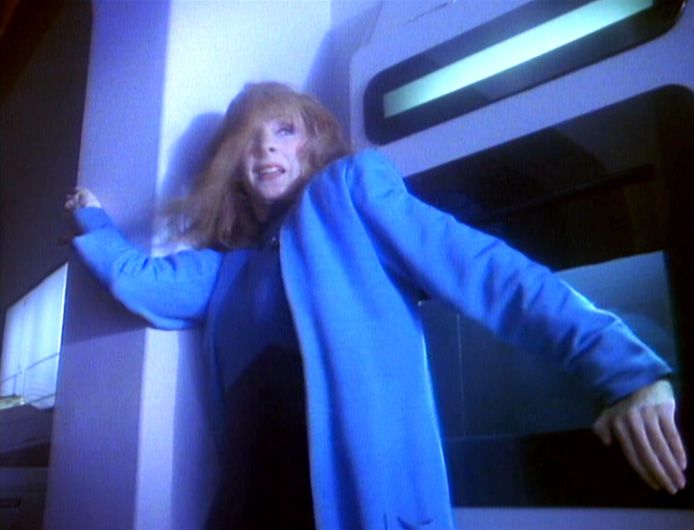
The Next Generation 4x5 "Remember Me"

rating: ****


Memory Alpha summary

via Planet Shannon
"Do the Crusher," alas,
fails to catch on either
as a pop song or a dance,
the latter being far crueler
to our dear light-footed doctor
Arguably the best Dr. Crusher episode and one of the best concept stories of the franchise, reminding everyone that Star Trek is science fiction not just because it's set in the future, but because it can execute some cool ideas when it wants to as well.

As a Crusher episode, "Remember Me" is crucial to the character's legacy.  Easily the weakest of the Next Generation ensemble, dropped for an entire season (the second), Crusher was eventually a near-complete non-factor in the movies, and in the series was mostly interesting either as a mother (to Wesley) or sometimes-lover (Picard).  As a doctor she could be shrill ("Ethics") and even surprisingly close-minded ("The Host"), putting her at the bottom of the profession in the franchise as a whole, too.

All of that meant that she was a hard character to write for, receiving the minimum of spotlight episodes throughout Next Generation's run.  So to make her shine, considerable effort had to be made, and on this occasion, the writers truly went above and beyond.  This is the episode that includes the classic line: "If there's nothing wrong with me, maybe there's something wrong with the universe!"

Think of it as kind of the inverse of Deep Space Nine's "The Visitor," which was an episode about Jake Sisko dealing with the loss of his father to a freak anomaly.  Here it's Crusher attempting to reconcile the loss of, progressively, everyone!

The big payoff for the whole experience is that it becomes part of the Traveler cycle, which was kind of like Next Generation's version of the later Enterprise Temporal Cold War, something neat that popped up every now and then but never really got the focus it needed to leave the lasting franchise impact it deserved.  Which also means that this is the only time Crusher is relevant in her son's biggest arc.

The only other time Crusher has an episode nearly as compelling is "Suspicions," which in fact seems designed to try and recapture the magic of "Remember Me."

four quarter analysis
franchise * series * essential * character

notable guest-stars:
Eric Menyuk
Colm Meaney

Friday, November 30, 2012

The Next Generation 1x6 "Where No One Has Gone Before"

****

Before we go much further, let me just mention the title of this episode.  It's another call and response from the original series, but one that like the episode itself is perhaps the first sign since Q that The Next Generation is going to be a notable enterprise all its own.  It comes from the famous mission statement that Kirk and Picard speak over the credits of every episode, with that one crucial difference, "one" instead of "man," just as years later Enterprise would eliminate the split infinitive concerning the boldness of the adventures when essentially having Zefran Cochrane creating it.  As with the later example, it's Star Trek trying to grow up a little, just as in the casting of the older Patrick Stewart to be the captain of this new crew.  Of course, there will always be fans who suggest such quibbles aren't necessary to fix.

Anyway, so "Where No One Has Gone Before" is the best Wesley episode of the season (arguably the only good one).  It's the introduction of his cosmic destiny, something that wouldn't be visited again until the final season.  Had the series been launched later, it's very probable that subsequent creators would not have allowed such an important character development to be overlooked.  It's arguable that this is a lot of what the series should have been about, and that Deep Space Nine, especially with Sisko's relationship to the Prophets, that Star Trek itself later figured this out.

The Traveler, then, is a lot like Q, Next Generation introducing a giant concept that could very well have been like something out of the original series but instead transformed into an integral element of the mythology that shaped later franchise developments.  On the surface he's just the catalyst for crazy warp engine experiments (tagging along very much with one of those original series misguided-Starfleet-officers-of-the-week) that push Picard's ship into one of several far-out journeys into unknown territory (happens again in "Q Who?" and eventually becomes the premise of Voyager).  But when we find out that it's the Traveler making everything happen (unfortunately while being exploited, which is another nice aspect of the episode), and that he's marked the erstwhile annoying boy genius Wesley as another like him.

Q was the first to suggest that Next Generation was about taking Star Trek to the next level, figuring out how to not only explore strange new worlds but to, well, go where no one has gone before.  Later seasons, although technically superior in every way, lost this thread and later series never really got it back.  That's one reason why this episode still stands out.

franchise series * essential * character

Notable guest-stars:
Eric Menyuk
Dennis Madalone


Memory Alpha summary.

Related Posts Plugin for WordPress, Blogger...