Showing posts with label Majel Roddenberry. Show all posts

Tuesday, January 17, 2017

Deep Space Nine 4x21 "The Muse"

rating: ***

the story: Odo's last fling with Lwaxana Troi, as well as Jake's flirtation with literary greatness.

what it's all about: Even though the title of the episode leans toward Jake's story, it's hard to tell which one should be considered the real lead.  This is the last of Lwaxana's nine appearances across Next Generation and Deep Space Nine.  In a lot of ways, this third appearance in Deep Space Nine is the completion of her redemption from the role of irritant in Next Generation, where she was second only to Q in that regard, with the occasional sympathetic outing whereas in this series only one in three ("Fascination") is she served up for comedic potential. 

Rather, since she first showed up in "The Forsaken," Lwaxana formed an unexpected bond with Odo.  Both were able to interpret the other better than anyone else had in their lives, and be comfortable around and accepting of each other, too.  In a lot of ways, Lwaxana is the reason Odo went on to a happy relationship with Kira, something that went beyond easy familiarity, and one step beyond what Lwaxan and Odo were able to do together.

The episode finds her in another bad relationship.  Unlike what would've happened in Next Generation ("Cost of Living" comes to mind), Lwaxana finds someone (Odo) willing to help her out of it, who isn't distracted by her brash impulses but instead recognizes what's at the heart of a complicated individual, because again, that's what Odo always wanted and needed, too.

The other side of the episode is Jake being inspired to work his best stuff, but at the cost of another of those parasitic aliens who're always cropping up in Star Trek.  Like "Shattered Mirror" immediately preceding this episode, it's like another callback to "The Visitor" earlier in the season, but one that somewhat unfortunately is tied up in gimmick storytelling, something that the series in general tried to avoid, and so it's always odd when it happens.  But the end result is the same, and it's that we get to see Jake truly advance along the road to his destiny, something the series never really revisited, except in the more war-pertinent role of journalist, which came with its own complications. 

Like the rest of the season, "The Muse" represents a definitive moment of transition, but it also shows the limitations of hesitation.  Lwaxana's story is very much her own.  Jake is very much caught up in a situation rather than his life.  Situations are what make up life, but more often than not, Deep Space Nine demonstrated more directly, less obliquely, how those situations add up.  If the work of resolution is left so completely to other episodes, and not merely in terms of serialization, something is lacking in the story.  This is an example of the series struggling to combine franchise expectations with its own best impulses, and falling short.

criteria analysis:
  • franchise - Formulaic elements abound.
  • series - Which hamper the best instincts of Deep Space Nine.
  • character - Still, this is good material for Jake, Odo, and Lwaxana.
  • essential - It's necessary connective material.
notable guest-stars:
Majel Roddenberry (Lwaxana)
Michael Ansara

Monday, November 21, 2016

Deep Space Nine 3x10 "Fascination"

rating: ***

the story: Lwaxana Troi's visit unleashes a lot of awkward romantic confessions...

what it's all about: "Fascination" is one of those episodes that could have been a disaster.  If it had been done in the first season, it would have been a disaster.  In fact, it looks almost exactly like a first season episode, except the third season saw such an advanced understanding of the series, this would have been very hard to accomplish.  So while it's something of a farce, "Fascination" also happens to have the distinction of being grounded thoroughly in the lore of Deep Space Nine, with a lot of interesting and fruitful observations to make.

The presence of Lwaxana is itself a notable aspect of the episode, even though it serves in that regard as somewhat trivial compared to the two other episodes of this series she appears in ("The Forsaken" and "The Muse"), she at least helps Odo realize that he has feelings for Kira, which is crucial to the whole series arc for both of them.  For the rest of the episode, Lwaxana is a glorified McGuffin, the magical reason why everyone's acting strangely.

So let's put her aside.  There's also Bareil, the normally stuffy, repressed Bajoran love interest of Kira, who joins everyone else in the complicated tangle mentioned in the story summary above.  But it gets better!  There's Jake Sisko admitting he loves Kira, which is one of the most hilarious things the series ever did, and because this is how complicated things get, Kira's too busy kissing Bashir to really notice (Alexander Siddig and Nana Visitor were married for a time after this; must have been terrible days on set!).  And so on.

But the real meat of the episode, it turns out, is O'Brien and Keiko continuing to hash out the status of their relationship, which was a recurring element of the season.  While everyone else is worried about whether or not they're being honest, these two are agonizing over very real concerns, and it grounds the whole thing nicely.  That and a look at Bajorans celebrating one of their favorite holidays, one of the few times a holiday is celebrated at all in Star Trek lore.

"Fascination" is indeed fascinating.

criteria analysis:
  • franchise - This one looks like a typical anything goes farce you'll find elsewhere.
  • series - But it's another one perfectly grounded in Deep Space Nine logic.
  • character - Good character work all around, especially for the O'Briens.
  • essential - I'll stop short of calling it a classic, because it points more than it leads.
notable guest-stars:
Majel Roddenberry (Lwaxana Troi)
Philip Anglim (Bareil)
Rosalind Chao (Keiko)
Hana Hatae (Molly)

Monday, September 5, 2016

The Next Generation 7x7 "Dark Page"

rating: ***

the story: It seems Lwaxana Troi has been hiding a secret pain...

what it all means: This is the only Lwaxana episode (in Next Generation and Deep Space Nine) where Lwaxana herself does not dominate the story.  In some respects, it's the first time her daughter Troi is in control.  Granted, for horrible reasons, but...

"Dark Page" is in some respects the first truly seventh-season episode of the seventh season, the first deep cut into backstory the season allows to fully breathe.  Unlike "Descent, Part 2" or "Interface," this is a truly relevant story of the series, with no qualifications needed.  It even has aliens-of-the-week who go out of their way to help rather than hinder, which is about the one and only time in franchise history this happens.

But you need to be a fan of the series to appreciate it, because without the context, you have no idea what's missing from Lwaxana, and thus why it's so important that this is the rare excursion into taking her seriously ("Half a Life" is the best such example).

Why Troi has two mysteries under her belt this season (the later "Eye of the Beholder" as well) is something of a mystery itself, or just maybe why it took the series so long to let her be featured this way (contrary to what some say, she was always one of the series' strongest characters, when given half a chance, including her standout appearance in the pivotal "Skin of Evil" from the first season).  Too often, she was stuck in lousy episodes with lousy relationships with lousy aliens of the week.  In fact, part of what makes "Dark Page" so refreshing is that it seems to go out of its way to refute that this was ever even necessary, and again, that makes it more a Troi episode than a Lwaxana episode.  We learn Lwaxana's deep, dark secret, but we also learn how strong Troi is entirely on her own.

(I mean, usually she has to be pretty tough around her mother, but not this tough!)

From here, it becomes easier for the season to delve into rich character work, of the kind far removed from the gimmicky early efforts.

criteria analysis:
  • franchise - Might be baffling for the uninitiated.
  • series - Although perfect for the initiated!
  • character - Good for Lwaxana.
  • essential - Great for Troi!
notable guest-stars:
Majel Roddenberry (Lwaxana Troi)
Kirsten Dunst

Friday, March 18, 2016

The Next Generation 5x20 "Cost of Living"

rating: **

the story: Lwaxana Troi is engaged to be married,  but that hardly prevents her from continuing to be a pest, this time enrolling Alexander into her shenanigans.

similar to: "The Muse" (Deep Space Nine)

my thoughts: Building on "Half a Life" the previous season, "Cost of Living" makes Lwaxana Troi to be something other than a constant irritant, but to a lesser degree.  It kind of does the same for Alexander, at last as far as his progress from "New Ground" goes.

For whatever reason, Next Generation loved recurring characters who were sources of conflict.  From Q to Ro Laren to Barclay, most of them were pretty much more trouble than they were worth, at least as far as the regular crew was concerned.  Two characters who absolutely epitomized this were Lwaxana and Alexander, so it was only natural that they converged into a single story.  The result was supposed to better represent both of them.  The flipside to these recurring characters was that it was as much a challenge to the crew as to the audience to find redemption for them.  (Redemption was a big thing for Star Trek creators at this point.  Deep Space Nine and Voyager both predicated on it.)

Which is to say, "Cost of Living" is all about trying to find sympathy for outcasts.  Lwaxana constantly makes bad choices romantically, and Alexander chafes at his father Worf's ideas about parenting.  Both would be better off in a colony such as the one Lwaxana conjures on the holodeck, full of free thinkers.  Yet because Star Trek itself craves orders, the episode ends with reluctance more than resolution, Lwaxana's engagement broken off and Worf at least agreeing to sample the maverick program that has so distracted his son.

The whole thing is part of how Worf ends up with Lwaxana's daughter, Deanna, at the end of the series, both of them equally exasperated by their unwieldy family members.  "Cost of Living" is important, in part, because of that, but it succeeds only so far as it talks about these things but doesn't at all attempt to resolve them.  You don't expect a single episode, years before the series is ready to be over, to attempt resolution, but for a series perpetually gun-shy about character development, when an episode comes along that make a bold statement but instead makes a mild one, you kind of have to find fault with said episode.

Still, there are some really great moments in it, from Alexander laughing at dinnertime to that poor guy who eats his planets, and the phrase, "The higher the fewer" (said two times with equally ridiculous profundity).

criteria analysis: franchise - series - character - essential

notable guest-stars:
Majel Roddenberry (Lwaxana Troi)
Brian Bonsall (Alexander)
Carel Struycken (Mr. Homn)
Tony Jay

Monday, January 25, 2016

The Next Generation 4x22 "Half a Life"

rating: ****

the story: Lwaxana Troi serves as the voice of reason as she argues for an elderly man's right to live.

similar to: Star Trek II: The Wrath of Khan

my thoughts: Just as "The Nth Degree" a few episodes earlier used Barclay, "Half a Life" ingeniously uses Lwaxana Troi in strict contradiction to her established character diameters.  Previously known at best as a comedic presence and at worst a pest, Lwaxana would not have been considered worth taking seriously at any rate.  (For another such instance, witness Deep Space Nine's "The Forsaken.")

Just as Kirk felt old and pointless in the first and second movies, this episode tackles the matter of what aging members of society can still contribute.  As is usual for the franchise, it presents an extreme example, literally an alien culture that condemns the elderly to death (a few years ahead of the Jack Kevorkian debate in the real world), and is one of the best examples of topical subject matter in the franchise, one of the more positive tropes and frequently the source of its best material.

And for a change, the voice of the opposition, the poor man at the center of the story's own daughter, doesn't come off as stilted, possibly because it's Michelle Forbes' first franchise appearance.  She'd inhabit the more familiar guise of Ro Laren next season.

But it's really Lwaxana's moment to shine, and it's so unexpected and it works so unexpectedly well, that it's easy to take for granted, but it deserves to be remembered as a classic. 

criteria analysis: franchise - series - character - essential (all criteria met)

notable guest-stars:
Majel Roddenberry (Lwaxana)
Michelle Forbes
David Ogden Stiers
Colm Meaney (O'Brien)
Carel Struycken (Mr. Homn)

Friday, June 19, 2015

The Next Generation 2x19 "Manhunt"

rating: ****


Memory Alpha summary

via The Viewscreen
"And then, sir?"
"Then we eat them."
We first meet Lwaxana Troi in the first season episode "Haven."  But this is her proper introduction.  It is an out-and-out classic, and every subsequent appearance, whether in Next Generation or Deep Space Nine, is an effort to recapture exactly this magic.  Only in her DS9 appearances, actually, does Lwaxana get to do much that's substantially different, thanks to her odd relationship with Odo (though Next Generation's "Half a Life" serves as something of a preview for that).

In short, she drives everyone crazy.  Usually you need Q to accomplish that, but then, maybe Lwaxana always was Q without all the omnipotence.  She's just omnipresent.  Yay!

In fact, let's take that a step further.  Q episodes before "Manhunt" feature Q in the role of a challenger.  Q episodes after "Manhunt" feature Q in the role of a trickster.  Is this a coincidence?  I think not.  Now, just imagine an episode with Q and Lwaxana...Thankfully this never, ever happened.  Everyone would've gone insane...

"Manhunt" also features the prism of Picard and Riker contrasting against each other, which "Peak Performance" two episodes later also does (not to mention the preview from "The Measure of a Man").  In that sense, it's the culmination of a season's worth efforts to distinguish the two and make it less of a competition, perhaps the tipping of the scales away from Riker and back toward Picard, as the second season had clearly flirted with early on.  The show's creators knew there was a problem.  They didn't necessarily know what the problem was, but they did considerable work trying to figure it out.  Again, as I've stated previously, the revelation that was the third season would not have been possible without all the work from the second.  "Manhunt" is so casual about it you probably wouldn't even expect that kind of effort behind it.  

But then, like Q, Lwaxana was a character designed to find stress points.  She just happened to be the first of the two to actually push the series to its best all on her own.  

four quarter analysis
franchise * series * essential * character

notable guest-stars:
Majel Roddenberry
Diana Muldaur
Robert O'Reilly
Carel Struycken
Colm Meaney

Friday, March 20, 2015

The Animated Series 2x3 "The Practical Joker"

rating: *

Memory Alpha summary

via Cygnus X1; most illogical...
"The Practical Joker" is popularly regarded as the retroactive first appearance of the holodeck, later to debut officially and become a staple in The Next Generation and its successors, but in many ways it may even be considered the first "holodeck episode" in all its notorious glory.

Oh, and speaking of Next Generation, "Joker" is pretty similar, all told, to "Emergence" as well.

That and it's a Romulan episode.

No, not Romulan episode as in "Balance of Terror," but more like, and you just knew there would be another Next Generation reference, "The Neutral Zone," which is an episode you might not typically think of as a Romulan episode (you may even consider the third element of that one, the first hint of the later Borg invasion, more significant!), yet there they are all the same.

And that's the kind of episode "Practical Joker" is.  Equal parts relevant and complete nonsense, it's not exactly "Trouble with Tribbles" hilarious in humor, but probably that's another association you can make in terms of what they were thinking when it was made.  

You can, ah, inflate or deflate the episode's worth at your own risk.  (There's an in-joke in the preceding sentence.  Yeah.)

four quarter analysis
franchise * series * essential * character

notable guest-stars:
Majel Roddenberry
James Doohan

Wednesday, March 18, 2015

The Animated Series 2x1 "The Pirates of Orion"

rating***

Memory Alpha summary

via Star Trek; we're not just green, you know
If it's the start of a new season from a series featuring Kirk as captain, you can bet it's an episode featuring some trauma happening to Spock.  Yeah, the second season of the original series kicked off with the classic "Amok Time," while the third with the infamous "Spock's Brain."  This time it's "The Pirates of Orion."

The problem this time is a little like condensing "Amok" and "Brain" into one, Spock in a straight-up medical emergency that sends the crew scrambling to save him.  I shouldn't need to point out that this is the third episode to focus primarily on Spock (after "Yesteryear" and "The Infinite Vulcan"), demonstrating a clear series preference for the character.

Beyond Spock, as the title suggests "Pirates" also features the enigmatic Orions, usually at that point best known for their green-skinned "slave girls," or for that surprise element of "Journey to Babel" in which they were saboteurs.  In Deep Space Nine, two episodes ("Honor Among Thieves" and "Prodigal Daughter") focus on the Orion Syndicate, which might be considered an update of the eponymous pirates, how the culture in general tends to act when not dominated by their women (as revealed in one of several Enterprise appearances, "Bound").

As the image suggests, the episode features Orions who are not, in fact, green-skinned.  This is commonly considered a production mistake.  But obviously humans feature diverse pigmentation, and so do Klingons and Vulcans.  If this series is to be considered canon at all, "Pirates" might as well be considered canon establishment of the same for Orions. 

It's a fine episode that stays away from the weirder inclinations of the series and a strong link to the rest of the franchise, in various and surprising ways.

four quarter analysis
franchise * series * essential * character

notable guest-stars:
George Takei
Majel Roddenberry
James Doohan

Friday, March 13, 2015

The Animated Series 1x15 "The Eye of the Beholder"

rating: *

Memory Alpha summary

via the Agony Booth (still fun for the whole family!)
Perhaps bearing the distinction of the most subdued episode of the series, "Eye of the Beholder" takes the opposite tack seen in various other franchise stories concerning the relative intelligence of humans.  Whereas it was common for god-like beings to belittle the idea, "Beholder" is actually more akin to the revelation about the Horta in the original series episode "Devil in the Dark."

As in, don't judge a book by its cover.  Our heroes are put in an alien zoo, and must convince their captors that they don't belong there.

And that's about it, really.  A pretty simple affair, nothing too flashy, a much more cerebral experience than is typical for the series, less dominated by the visual flair animation made so tempting, or falling back on familiar elements.  It's an episode, generally, that could easily have fit in with its live action predecessors.  

four quarter analysis
franchise * series * essential * character

notable guest-stars:
Majel Roddenberry
James Doohan

Thursday, March 12, 2015

The Animated Series 1x14 "The Slaver Weapon"

rating: ***

Memory Alpha summary

Continuing the series-specific hotstreak from "The Ambergris Element," "The Slaver Weapon" is another quintessential episode.

via the Viewscreen
In a one-and-done affair, "Slaver Weapon" features the Kzinti, who might be considered this show's true Klingons (featured for the only time in "Ambergris").  I've always wanted to reconcile the Kzinti with a hostile species mentioned in Deep Space Nine ("The Adversary"), the Tzenkethi.  (Apparently Robert Hewitt Wolfe agrees.)

The Kzinti might be considered at the very least the Gorn of the series.  They're one of several distinctly alien species that have never appeared elsewhere, even in the expanded CGI depictions from Enterprise, and they alone merit an entire episode featuring their impact as a species as well as a fairly extensive look at their culture.

In the episode, they contend with Starfleet in pursuit of an ancient weapon.  The only truly unfortunate element is the name of the species who created the weapon.  

This is your chance to see what Kirk-era Star Trek is like without Kirk, by the way, and of course that's the more objective selling point of "Slaver Weapon."  It's an episode that features Spock squarely in the lead, supported by Sulu and Uhura.  Scotty and McCoy join Kirk in omission, though Jimmy Doohan remains in his versatile voice acting capacity.  As a Spock episode, it's perhaps not very enlightening, other than the fact that he clearly can carry Star Trek just as well as Kirk.  Historically significant in that regard.

four quarter analysis
franchise * series * essential * character

notable guest-stars:
James Doohan
Majel Roddenberry

Wednesday, March 11, 2015

The Animated Series 1x13 "The Ambergris Element"

rating: **

Memory Alpha summary

"The Ambergris Element" may be the best possible example of what only this series could get away with.

via Let's Watch Star Trek
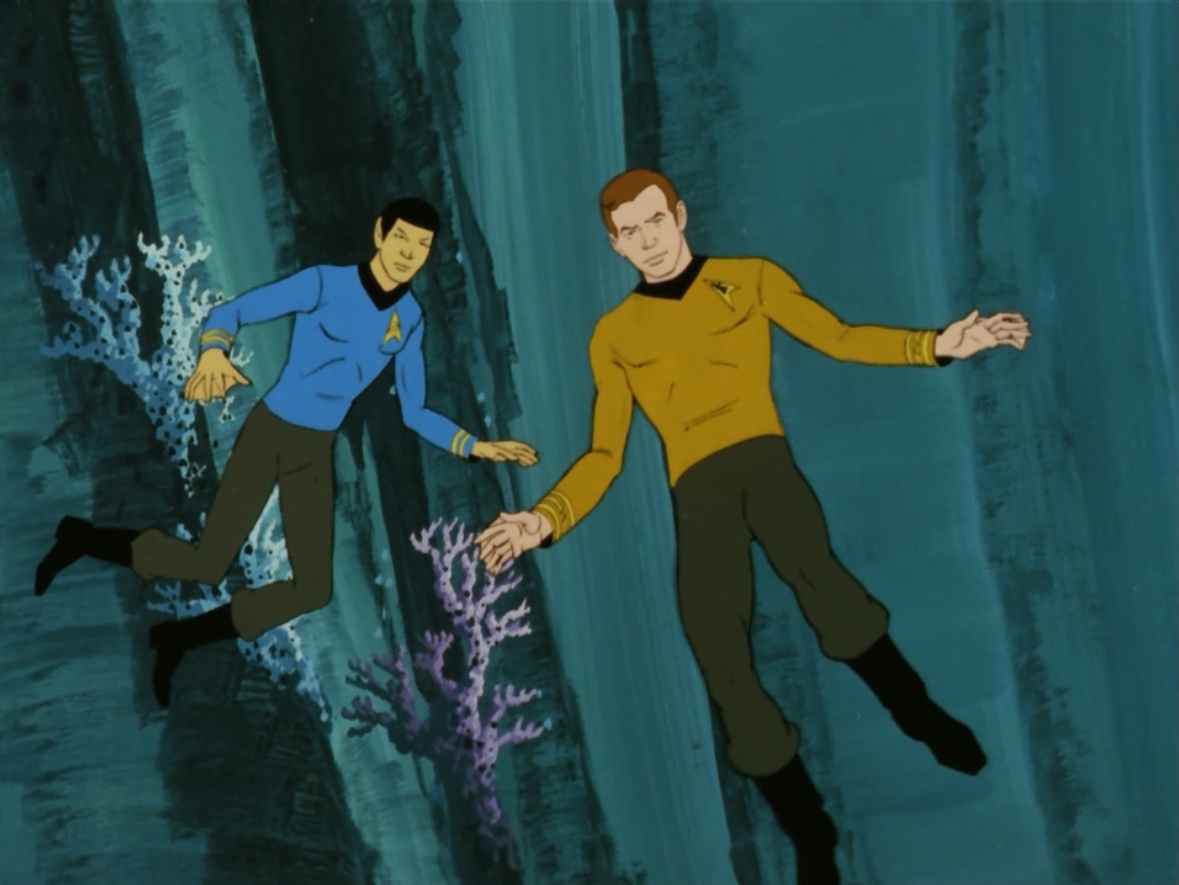
A combination of the pacing that syncs up perfectly with the animation style and the storytelling itself makes for an episode that is quintessentially Animated Series.  Kirk and Spock end up being transformed into water-breathers.  Watching them cope, or even just watching them swim, in the way the series tended to recycle scenes, puts a focus on the key differences between what was at that point the two contrasting Star Trek experiences.  While everything at that point was virtually the same, style and cast members, the expanded possibilities of animation had always promised to expand storytelling potential.  Here, in its own element, the series achieves exactly that.

It's almost sublime, really, watching this moment finally happen, as if the creators stopped trying to force it to happen, and stopped trying to recreate the original series itself.  Watching "Ambergris" ought to be considered the ultimate test as to whether or not you "get" the series at all.

Otherwise it really is just another episode of the series, with all the same basic elements, a heavy emphasis on a strange environment and strange aliens inhabiting it, the essence of the franchise in many respects, just having fun, which is something you realize perhaps this series does best as it nearly completely dispenses with any real concern over how the characters react or if they have lives of their own going on.  Given the failure of Deep Space Nine to find a significant portion of fan support, one might argue that this may in fact be the ideal.

four quarter analysis
franchise * series * essential * character

notable guest-stars:
James Doohan
Majel Roddenberry

Monday, March 2, 2015

The Animated Series 1x11 "The Terratin Incident"

rating: *

Memory Alpha summary

Honestly, if Deep Space Nine hadn't also done an episode where the crew shrinks ("One Little Ship"), I'd be tempted to dismiss "The Terratin Incident" as completely skippable.

And there you are, too, what happens for the majority of the episode: the crew shrinks, making various comments about their predicament.  It's exactly the kind of episode you'd expect from a show that can get away with anything without worrying about the budget.  The later (and in fact final) episode "The Counter-Clock Incident" features a similarly silly premise, the crew aging backward all the way to infants! but at least features a guest character who can carry the dramatic weight that otherwise keeps the action grounded in something fans can take a little more seriously.

via Tumblr.  Look at the size of that Kirk!  (Best I got.)
You have to wait until the end of the episode for any other element to be featured, which actually isn't that bad.  Honestly, a lot of otherwise bad stories, not just from Star Trek, could easily be redeemed if the good stuff weren't buried.  In this instance, "Terratin" turns into a kind of Kirk version of Brainiac from Superman lore.  Brainiac is a collector of worlds, famously creating the Bottle City of Kandor in the midst of Krypton's last days.  Unlike Brainiac, Kirk is doing the Terratins a favor.

Some allusions could be made to other franchise adventures in population relocation, but none of them like this.  

Otherwise, this is a silly episode.  It's a prime reason why most fans have a hard time taking the series seriously.  But then "One Little Ship" had to happen later.  And so we have yet another reason to reappraise the show's creative decisions, for good and otherwise.  

four quarter analysis
franchise * series * essential * character

notable guest-stars:
Nichelle Nichols
Majel Roddenberry
James Doohan

Tuesday, February 17, 2015

The Animated Series 1x10 "Mudd's Passion"

rating: ***

Memory Alpha summary

Poor Harry Mudd.  The guy was such a part of Star Trek lore, and the legacy of the original series (two episodes, even!), that he received one of the several "sequel episodes" in the series.  And now?  You couldn't con someone into caring about him...

It's the fault of the movies, really.  Once it was determined that Khan was the one who best suited the cinema treatment, the decidely uncinematic Mudd, and his original portrayer, Roger C. Carmel, was dropped by the wayside.  Carmel returned to voice Mudd in "Passion," such was his distinctiveness.

All the same, Mudd has a place in history if not memory, and perhaps "Passion" makes his best case for that.  Here he's involved in love potion nonsense (there's some echoes to be found in Deep Space Nine's "Fascination") that results in a lot of romantic shenanigans.  His prior appearances all had to do with robotic nonsense that invariably redirected mostly back to Mudd himself.

via Treks in Sci Fi
Leading the way is Nurse Chapel, making this episode notable for more than one recurring character.  Chapel's significance slowed significantly in later years, even though she did appear in the movies (you'd probably have to know that to really notice, though).  This is probably in part because the emphasis on the role diminished over time, and the fact that performer Majel Roddenberry became better known as Lwaxana Troi (in both Next Generation and Deep Space Nine), plus, y'know, having married Star Trek creator Gene Roddenberry (she was originally billed by her maiden name, Majel Barrett).

As an artifact of the series, "Mudd's Passion" has a peculiar place.  It's a strong bridging experience, and represents two experiences well, if not exceptionally.  As another candidate as an ambassador for the series, it does a fine job of displaying how animated Star Trek doesn't have to rely on anymore gimmicks than basic storytelling.

four quarter analysis
franchise * series * essential * character

notable guest-stars:
Roger C. Carmel
Majel Roddenberry
Nichelle Nichols
James Doohan

Monday, February 9, 2015

The Animated Series 1x9 "Once Upon a Planet"

rating: ***

Memory Alpha summary

In this sequel to "Shore Leave," the series ends up more relevant to a far different matter, the franchise theme of the emerging sentience of machines.  Can you say Data?

via The Viewscreen
The planet that was like a precursor to all the malfunctioning holodeck episodes returns, complete with Alice's Wonderland.

Unlike the other sequel episodes in the series, however, "Once Upon a Planet" has a distinctively new story to tell, about the planet post-guardian, with the mechanism that allows its basic function to operate running on its own.  No, this is not Next Generation's "Arsenal of Freedom" redux, but rather much more akin to The Motion Picture or even Next Generation's "Emergence" (which just happens to also feature a malfunctioning holodeck).

The basic idea of technology taking on an intelligence of its own is one of those fears that permeates our perception of the future, the robot uprisings featured in The Matrix and The Terminator.  As usual, Star Trek has a broader interpretation in mind.  Things look grim in The Motion Picture until humanity actually merges with the machine in question (which has long given speculation to how much of a connection to the later Borg there exists in the film), while in "Emergence" and "Upon a Planet" a dialogue between man and machine suffices.

"Planet" tackles the nature of the transition point directly: the moment of change occurs when the original programming is superseded by a change of circumstances.  Voyager played out a different scenario in "Prototype," in which a robotic army plays out the familiar "Let That Be Your Last Battlefield"/"Chosen Realm" scenario, a war of attrition that is the result of the worst possible outcome from a failure to change.  In "Planet," the machine listens to reason after initially assuming, as in Motion Picture, that it's the Enterprise itself that is the relevant entity (just as it's the ship in "Emergence" that produces new life).

It's an ideal story for the series to explore, something that might have seemed too outlandish in live action at the time, a few years ahead of Motion Picture itself (which, remember, was also a version of the earlier "Changeling"), which is still too hard to swallow as a near-purely intellectual exercise for fans more accustomed to more visceral franchise experiences (a peculiar dichotomy for a phenomenon that has always walked that fine line and draws equal support from both sides).

There's a small chance you will want to watch this as a spotlight for Uhura, although "Planet" doesn't indulge too much in the potential it sets up in that regard.  If anyone ever revisited this story, they could easily picks up on a number of possibilities, including the "Changeling" connection (an episode where she loses her memory and has to have it recreated to similarly limited exploration).

four quarter analysis
franchise * series * essential * character

notable guest-stars:
Nichelle Nichols
Majel Roddenberry
James Doohan

Tuesday, January 20, 2015

The Animated Series 1x6 "The Survivor"

rating: ***
Memory Alpha summary

From Khan and Cochrane in the original series to Emory Erickson in Enterprise (inventor of the transporter as seen in "Daedalus"), "The Survivor" follows a considerable franchise tradition of featuring the crew interacting with notable figures from Star Trek's fictional future history.  This time it's Carter Winston, a noted civilian who worked to spread the cause of humanity in space.

As usual, the circumstances are less than ideal, but the way "Survivor" handles these particular circumstances serves as one of the better illustrations of the series' potential.  Winston has been replaced by a shape-shifter, one of the many to precede Deep Space Nine's Odo and for the record have no relation to the Founders (another would be the Chameloid from Star Trek VI: The Undiscovered Country).
via the Viewscreen. Besides, Odo hates that color (except on Kira).
The fake Winston's been employed as a Romulan agent, thereby bringing another layer of significance to the episode.  But he proves invaluable when his morals get the best of him, thanks to Winston's fiancee, who helps him see things the way Winston himself would have.

A nuanced episode filled with a bunch of interesting elements, and it features this timeless quip from Spock as well: "[...]Two Doctor McCoys just might bring the level of medical efficiency on this ship up to acceptable levels."  Zing!

The episode also features the debut of feline communications officer M'Ress, one of several elements unique to the series for somewhat obvious reasons.  Also, the only canon reference to McCoy's daughter Joanna.

four quarter analysis
franchise * series * essential * character

notable guest-stars:
Nichelle Nichols
Majel Roddenberry
James Doohan
Ted Knight

Monday, January 12, 2015

The Animated Series 1x4 "The Lorelei Signal"

rating: *
Memory Alpha summary

This is the "space sirens" episode.  You remember sirens from The Odyssey, surely?

But enough about that.  If "Lorelei Signal" is significant or worth talking about at all, it's not for the elements that make it look like one of the worst possible episodes to sell you on the series, but rather its heavy focus on the female members of the crew.  Uhura takes command of the ship after all the male officers are compromised by a society of aliens who seem to come straight from...the worst episodes of Next Generation's first season.

Yes, Uhura in command!  Your one and only opportunity to see that happen!
via Mister Comfy Pants (let's just forget about that, shall we?)
The downside is that the episode, whether considered subsequently or not, also heavily features Nichelle Nichols in voice work for other characters in the episode.  A voice actor she is not.  Majel Roddenberry is not much better, and she's got a bunch of voices, too.  Which means if you want to enjoy and/or appreciate this rare Uhura spotlight, there's a very tall price to pay.  I was originally going to make this one of the rare episodes I wouldn't recommend for any reason, but "Lorelei" is at least significant even if it also happens to be tough to watch.

All that being said, not until Voyager would there be an opportunity for women in Star Trek to so thoroughly grab the spotlight.  Any lingering concerns on how the franchise viewed the female sex in its earliest years at least has the making of an argument with this episode.

four quarter analysis
franchise * series * essential * character

notable guest-stars:
Nichelle Nichols
Majel Roddenberry
James Doohan

Monday, October 27, 2014

The Animated Series 1x3 "One of Our Planets is Missing"

rating: **
Memory Alpha summary

"One of Our Planets is Missing" is the kind of episode (think Next Generation's "Galaxy's Child") where the ship comes across a space creature that turns out to be more complicated than the simple menace it at first appears to be (see also: "The Devil in the Dark").

During the course of the crisis, Kirk and Spock are forced to go beyond their typical Animated Series restraints and either insert their own views (Kirk's concerns about doing the right thing) or familiar behavior (Spock mind-melding with something other than a humanoid, such as in the aforementioned "Devil in the Dark" or The Motion Picture and The Voyage Home).
via John Kenneth Muir
It's an example of the series blending the best of its own instincts with what had been done before and what would be more typical of the emerging franchise, and as such is a nice bridge experience for those who don't want to rely on the more famous (justifiably so) "Yesteryear."  Not a major standout by any means, but an episode that doesn't rely on some of the more cartoonish elements that could sometimes dominate this cartoon series.

"...Planets is Missing" also features the speaking debut for series-specific element crewman Arex (voiced by Jimmy Doohan), one of those elements the Animated Series could pull off but would otherwise be difficult even now to feature in an ongoing capacity (although he could probably be an interesting addition to the movies).
via Daily Motion.  Arex on the left, third arm sticking out of his chest.
four quarter analysis
franchise * series * essential * character

notable guest-stars:
James Doohan
Majel Roddenberry

Sunday, October 26, 2014

The Animated Series 1x2 "Yesteryear"

rating: ****
Memory Alpha summary

A lot of fans don't consider The Animated Series to be part of official canon, but then, a lot fans also acknowledge the significance of "Yesteryear" itself, the most routinely-praised episode of the series.

It's significant in a number of ways, actually.  The least significant element is the return of the Guardian of Forever from "City on the Edge of Forever," which has apparently become a routine tool for studying history.

The episode is better known for Spock's journey to his own past.  The framing story deals with altered history (due to his trip, Spock is actually erased from history, and he's replaced by an Andorian among the Enterprise crew), but that's just more window-dressing.  This visit to Vulcan involves the return of his parents Sarek and Amanda, last seen in "Journey to Babel" and an examination of Spock's inner turmoil concerning his dual Vulcan-human lineage.  It also features a Vulcan rite-of-passage ritual and Spock's pet!  Established plenty that later ended up in other episodes, thereby solidifying it as part of the canon.

Lots of details.  They're all good.  It's the most fascinating episode of the series.

Star Trek (the 2009 reboot) even has conscious echoes of "Yesteryear," from a conversation Spock and Sarek have to the bullying the young Spock faces from his peers.
via John Kenneth Muir
It's one of the earliest direct character studies of the franchise and on that score alone stands out from the rest of the series, which more ordinarily used its time constraints to feature the story first and the characters as a distant second.

By any definition a classic.

four quarter analysis
franchise * series * essential * character

notable guest-stars:
James Doohan
Mark Lenard
Majel Roddenberry

Monday, October 20, 2014

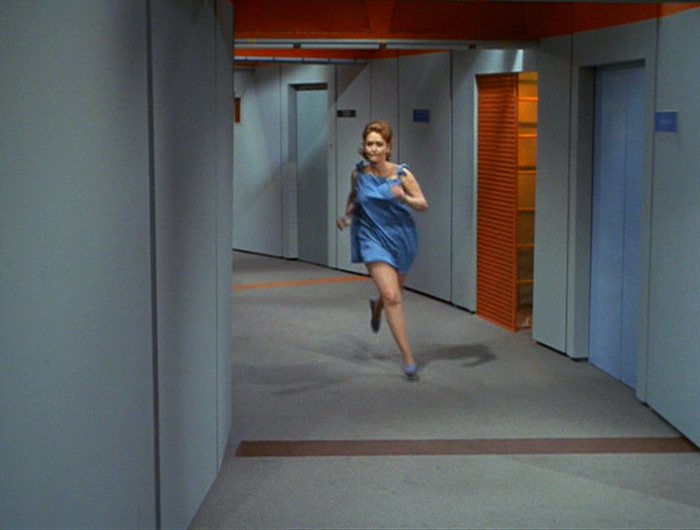
Star Trek 3x24 "Turnabout Intruder"

rating: **
Memory Alpha summary

It's the last episode of the series!

And as it turns out, the third season saved its dirtiest trick for last.  Throughout the season, the creators seemed to take every opportunity to challenge fans by flipping the script, or by simply seeing how far they could push things.  "Turnabout Intruder," in fact, plays almost like the Kirk version of "Spock's Brain."  Take that for what you will, but as with "Brain" this is not necessarily a bad thing.

In some ways, it's a very good thing.  It's our opportunity to view the captain long stereotyped as a ladies man from the other side, quite literally, as a woman who felt betrayed by him in the past assumes control of his body.

In a lot of ways, it's a pretty standard episode, and by modern standards hardly fitting for a series finale, but there was no more way to know then that it was going to be the last one than it would've been after the second season, or first, whenever the series seemed in mortal danger.

To put Kirk to the test like this, though, is in hindsight clever and entirely appropriate.  In the movies we would meet another defining love interest from Kirk's past, Carol Marcus.  It's still weird to think that everyone Kirk knew before the Enterprise was basically an obstacle in his life.  Most of the time he knew it.  This time he didn't.  In fact, he's the one who was the jerk.

Probably tough to see something like that explored about a character who is traditionally considered ideally heroic, and from the vantage point of someone obviously unbalanced (read: insane).  But there you go.
via Fanpop


And there the series goes!

four quarter analysis
franchise * series * essential * character

notable guest-stars:
Majel Roddenberry

Monday, October 6, 2014

Star Trek 3x20 "The Way to Eden"

rating: ***
Memory Alpha summary

Most often contended to be the "hippie episode" (although the earlier "This Side of Paradise" more accurately represents that description; perhaps the benefit of hindsight holds the difference, where one depicts how they're remembered now while the other how they considered themselves at the time), "The Way to Eden" is something of the Charles Manson story in space.

Star Trek V: The Final Frontier later paralleled much of the same story, while Deep Space Nine explored the back-to-nature idea in "Paradise," and there's Star Trek: Insurrection to consider as well, plus similarities to "Fusion" (the start of a whole character arc) in Enterprise.  That adds up to something of a considerable legacy for the episode.
via Pinterest
It's also a Chekov episode, continuing the third season trend of coming up with stories for the supporting cast a little more frequently.  It's his lady friend (in the original version it was actually McCoy's daughter, and the other half of the equation was Kirk...which would certainly have made things far more interesting...!) who's caught up in the would-be Manson's plot to rediscover Eden (in this case, the title of the episode is actually pretty straightforward for a change).  Eventually Chekov's spotlight gives way to Spock, and has the benefit of giving new insights into both characters, contrasting with what we previously thought we knew. 

All that adds up to plenty going on in the episode.  "Way to Eden" is one of those episodes that's probably better now then it seemed at the time.

four quarter analysis
franchise * series * essential * character

notable guest-stars 
Majel Roddenberry
Charles Napier
 
Related Posts Plugin for WordPress, Blogger...