Showing posts with label Nichelle Nichols. Show all posts

Saturday, March 28, 2015

The Animated Series 2x6 "The Counter-Clock Incident"

rating: ****

Memory Alpha summary

via Trekcore
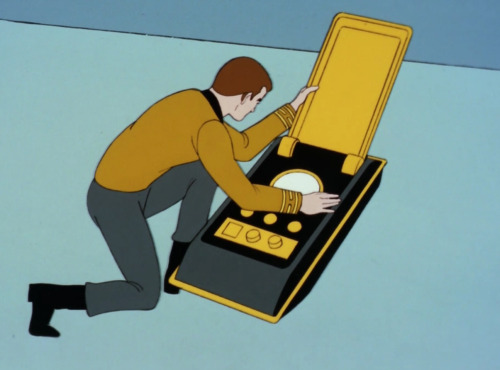
"Yesteryear" is the episode best remembered, and for fairly good reason, but "The Counter-Clock Incident" is the most important episode of the series.

A far, far better version of the de-aging idea (and as such, the much more prolific rapid-aging seen in many, many episodes) later featured in Next Generation's terrible "Too Short a Season," "Counter-Clock" most pointedly features Robert April.

(Also, Next Generation featured the crew de-aged into children in "Rascals."  That's the other half of what happens this episode.  It's cutesy without being annoying in a way similar developments in the series failed to be, but would not in itself be a reason to recommend it.  Unless you're amused by the familiar acting voicing themselves younger.  George Takei probably is the best in that sense.)

(The idea of a reluctant retirement, as April is facing, is again addressed in a Next Generation episode, "Half a Life.")

(Finally, a different series, Voyager, features an alien civilization aging differently in two episodes: "Innocence," with the idea of aging backward like "Counter-Clock" and The Curious Case of Benjamin Button, and "Blink of an Eye," with a planet whose rotations are far more rapid than the norm, as Janeway and company observe their epochal progress while stuck in orbit.)

Who is Robert April, you may be asking?  When Gene Roddenberry originally conceived of Star Trek, he was the original captain.  Before Kirk and before Pike, there was Robert April.

via Wikipedia
In fact, even though the character to date has never appeared in any live action series or movie, Roddenberry himself has traditionally been depicted as Robert April.  In a very real sense, other than the grand idea of the Great Bird of the Galaxy, this is the closest to inserting Roddenberry into his own creation the franchise has ever come.

And without "Counter-Clock," the character does not technically exist.  This is the most galling part of the common notion that the series does not exist canonically.  Take away the sentimentalism, and "Counter-Clock still functions in much the same capacity as "The Menagerie," the two-part original series episode that incorporated Pike's appearance in the first pilot, "The Cage," to make it canonical (and cost-effective).  Yes, the circumstances are different.  But here's Robert April, under unique circumstances actually getting to save the day.

With the appearance of April, this final episode of the series is also a definitive bookend to the franchise as it was at that point, however unintentionally, much as Enterprise would later attempt to accomplish, however dubiously, with "These Are the Voyages..."  And that's another reason why it, as well as the series as a whole, ought to be at last embraced as a part of the Star Trek legacy.  

four quarter analysis
franchise * series * essential * character

notable guest-stars:
James Doohan
Nichelle Nichols

Thursday, March 19, 2015

The Animated Series 2x2 "Bem"

rating: **

Memory Alpha summary

via Trekcore
If you watch only one episode for something only this series could have pulled off, make it "Bem."

Remember that Next Generation episode, "Liaisons," where alien ambassadors take a variety of ways to explore how the crew reacts (Troi gets the best one, because they spend the whole time eating chocolate)?  Well, "Bem" is kind of exactly that episode, except with a colony alien.

Colony alien?  Imagine the Trill (most memorably embodied by Jadzia and Ezri Dax), who have humanoid hosts and slug-like symbionts, but with a far more incomprehensible setup.  This time the body breaks down into independent component parts, such as the torso being able to separate, and the lower body producing an entirely new set of arms to compensate.

It's kind of completely insane, but the episode pulls it off.  The more time you spend time with Bem, the more you like him, regardless of how exasperated he makes Kirk.  (Actually, Kirk is exasperated throughout most of the series.)

Speaking of Kirk, "Bem" establishes his middle name as being Tiberius.  That's another historic element that should settle the matter of whether or not this series should be considered canon.  I mean, right?

But then, I guess the counterargument will always be, but weirdo concepts like Bem exist too...

four quarter analysis
franchise * series * essential * character

notable guest-stars:
Nichelle Nichols
James Doohan

Tuesday, March 10, 2015

The Animated Series 1x12 "The Time Trap"

rating: *

Memory Alpha summary

via Agony Booth (ouch!)
The Voyager episode "The Void," Enterprise's Xindi Council, Star Trek V: The Final Frontier, Next Generation's "Birthright Part II," and indeed the whole concept of the Federation all feature elements viewers of "The Time Trap" will find familiar.

It's the idea of an interspecies coalition.  As in "The Void," "Time Trap" features a reluctant one intended to make the best of a bad situation, and the featured crew looking for a way out of the unique circumstances that have forced everyone together, a given region of space that is the true trap of the story.  The other trap, the one concerning time, is an unnecessary layer that is basically irrelevant except as an element of added danger.

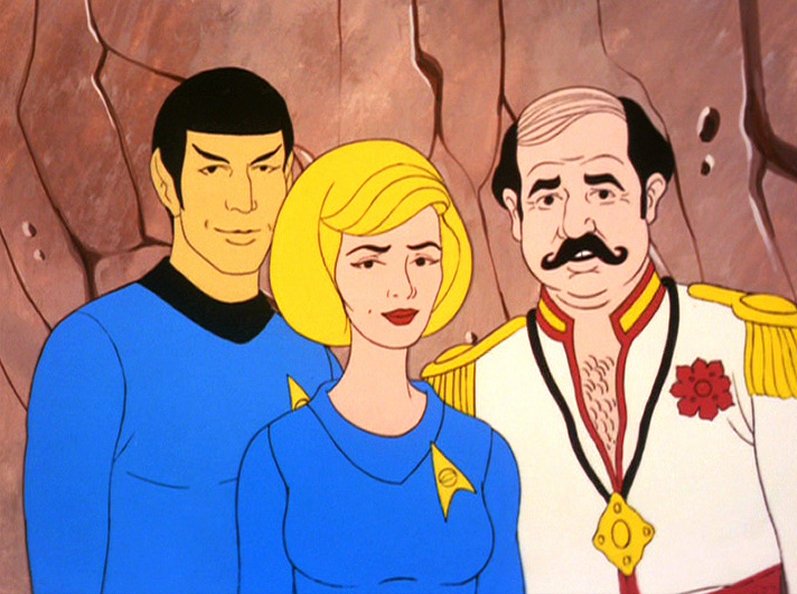
More significantly, perhaps, is that "Time Trap features Kor, one of the major Klingons of the franchise, usually portrayed by John Colicos but here voiced by Jimmy Doohan.  Kor debuted in the original series episode "Errand of Mercy" and was one of three Klingons from that time to later appear in Deep Space Nine ("Blood Oath"), ending up the longest-tenured in that regard with two additional appearances ("Sword of Kahless," "Once More Unto the Breach").

Which of course also makes this a Klingon episode.  As with Klingon appearances in the preceding live action series, the famed warrior race to this point has perhaps a far greater reputation than actual presence.  It isn't until the next Klingons appear in the franchise, with newly-revised appearances, Star Trek: The Motion Picture, four major roles in subsequent sequels, and the figure of Worf, that they're actually as prominent as they seem to be all along.  Without any of these later appearances, Klingons would have gone the way of Harry Mudd.

Thankfully they don't.  "Time Trap" is in some ways a rehash of previous Klingons episodes, a forced alliance and stab at peace, that sort of thing.

Perhaps the most significant element is a far harder one to recognize: this is the first time George Takei is allowed to join the voice actor talent pool outside of his most familiar role (Sulu), something Doohan and Nichelle Nichols, along with Majel Roddenberry, have been during throughout the series already.

The interspecies alliance features cameos from a number of familiar aliens, from Romulans and Orions to some that are unique to the series.  But this is not a particularly notable showcase for any of them.

four quarter analysis
franchise * series * essential * character

notable guest-stars:
George Takei
Nichelle Nichols
James Doohan

Monday, March 2, 2015

The Animated Series 1x11 "The Terratin Incident"

rating: *

Memory Alpha summary

Honestly, if Deep Space Nine hadn't also done an episode where the crew shrinks ("One Little Ship"), I'd be tempted to dismiss "The Terratin Incident" as completely skippable.

And there you are, too, what happens for the majority of the episode: the crew shrinks, making various comments about their predicament.  It's exactly the kind of episode you'd expect from a show that can get away with anything without worrying about the budget.  The later (and in fact final) episode "The Counter-Clock Incident" features a similarly silly premise, the crew aging backward all the way to infants! but at least features a guest character who can carry the dramatic weight that otherwise keeps the action grounded in something fans can take a little more seriously.

via Tumblr.  Look at the size of that Kirk!  (Best I got.)
You have to wait until the end of the episode for any other element to be featured, which actually isn't that bad.  Honestly, a lot of otherwise bad stories, not just from Star Trek, could easily be redeemed if the good stuff weren't buried.  In this instance, "Terratin" turns into a kind of Kirk version of Brainiac from Superman lore.  Brainiac is a collector of worlds, famously creating the Bottle City of Kandor in the midst of Krypton's last days.  Unlike Brainiac, Kirk is doing the Terratins a favor.

Some allusions could be made to other franchise adventures in population relocation, but none of them like this.  

Otherwise, this is a silly episode.  It's a prime reason why most fans have a hard time taking the series seriously.  But then "One Little Ship" had to happen later.  And so we have yet another reason to reappraise the show's creative decisions, for good and otherwise.  

four quarter analysis
franchise * series * essential * character

notable guest-stars:
Nichelle Nichols
Majel Roddenberry
James Doohan

Tuesday, February 17, 2015

The Animated Series 1x10 "Mudd's Passion"

rating: ***

Memory Alpha summary

Poor Harry Mudd.  The guy was such a part of Star Trek lore, and the legacy of the original series (two episodes, even!), that he received one of the several "sequel episodes" in the series.  And now?  You couldn't con someone into caring about him...

It's the fault of the movies, really.  Once it was determined that Khan was the one who best suited the cinema treatment, the decidely uncinematic Mudd, and his original portrayer, Roger C. Carmel, was dropped by the wayside.  Carmel returned to voice Mudd in "Passion," such was his distinctiveness.

All the same, Mudd has a place in history if not memory, and perhaps "Passion" makes his best case for that.  Here he's involved in love potion nonsense (there's some echoes to be found in Deep Space Nine's "Fascination") that results in a lot of romantic shenanigans.  His prior appearances all had to do with robotic nonsense that invariably redirected mostly back to Mudd himself.

via Treks in Sci Fi
Leading the way is Nurse Chapel, making this episode notable for more than one recurring character.  Chapel's significance slowed significantly in later years, even though she did appear in the movies (you'd probably have to know that to really notice, though).  This is probably in part because the emphasis on the role diminished over time, and the fact that performer Majel Roddenberry became better known as Lwaxana Troi (in both Next Generation and Deep Space Nine), plus, y'know, having married Star Trek creator Gene Roddenberry (she was originally billed by her maiden name, Majel Barrett).

As an artifact of the series, "Mudd's Passion" has a peculiar place.  It's a strong bridging experience, and represents two experiences well, if not exceptionally.  As another candidate as an ambassador for the series, it does a fine job of displaying how animated Star Trek doesn't have to rely on anymore gimmicks than basic storytelling.

four quarter analysis
franchise * series * essential * character

notable guest-stars:
Roger C. Carmel
Majel Roddenberry
Nichelle Nichols
James Doohan

Monday, February 9, 2015

The Animated Series 1x9 "Once Upon a Planet"

rating: ***

Memory Alpha summary

In this sequel to "Shore Leave," the series ends up more relevant to a far different matter, the franchise theme of the emerging sentience of machines.  Can you say Data?

via The Viewscreen
The planet that was like a precursor to all the malfunctioning holodeck episodes returns, complete with Alice's Wonderland.

Unlike the other sequel episodes in the series, however, "Once Upon a Planet" has a distinctively new story to tell, about the planet post-guardian, with the mechanism that allows its basic function to operate running on its own.  No, this is not Next Generation's "Arsenal of Freedom" redux, but rather much more akin to The Motion Picture or even Next Generation's "Emergence" (which just happens to also feature a malfunctioning holodeck).

The basic idea of technology taking on an intelligence of its own is one of those fears that permeates our perception of the future, the robot uprisings featured in The Matrix and The Terminator.  As usual, Star Trek has a broader interpretation in mind.  Things look grim in The Motion Picture until humanity actually merges with the machine in question (which has long given speculation to how much of a connection to the later Borg there exists in the film), while in "Emergence" and "Upon a Planet" a dialogue between man and machine suffices.

"Planet" tackles the nature of the transition point directly: the moment of change occurs when the original programming is superseded by a change of circumstances.  Voyager played out a different scenario in "Prototype," in which a robotic army plays out the familiar "Let That Be Your Last Battlefield"/"Chosen Realm" scenario, a war of attrition that is the result of the worst possible outcome from a failure to change.  In "Planet," the machine listens to reason after initially assuming, as in Motion Picture, that it's the Enterprise itself that is the relevant entity (just as it's the ship in "Emergence" that produces new life).

It's an ideal story for the series to explore, something that might have seemed too outlandish in live action at the time, a few years ahead of Motion Picture itself (which, remember, was also a version of the earlier "Changeling"), which is still too hard to swallow as a near-purely intellectual exercise for fans more accustomed to more visceral franchise experiences (a peculiar dichotomy for a phenomenon that has always walked that fine line and draws equal support from both sides).

There's a small chance you will want to watch this as a spotlight for Uhura, although "Planet" doesn't indulge too much in the potential it sets up in that regard.  If anyone ever revisited this story, they could easily picks up on a number of possibilities, including the "Changeling" connection (an episode where she loses her memory and has to have it recreated to similarly limited exploration).

four quarter analysis
franchise * series * essential * character

notable guest-stars:
Nichelle Nichols
Majel Roddenberry
James Doohan

Sunday, January 25, 2015

The Animated Series 1x7 "The Infinite Vulcan"

rating: *
Memory Alpha summary

There are a number of notable things to talk about concerning "Infinite Vulcan," but before I do, let's just get this out of the way: this is not really all that great an episode.

Okay!  The first notable aspect is that it's written by Walter Koenig, who's otherwise known as Chekov.  Chekov and/or Koenig do not appear in the series, which makes this the closest to a Chekov and/or Koenig fix you're going to get if you make the effort to watch it at all.  It speaks to Koenig's versatility and adaptability that he wrote an episode of Star Trek.  No other regular can say that in any incarnation.  A few directed, had story credit, but none wrote anything directly.

The second is that this is a Eugenics Wars-related episode.  Eugenics Wars, as in Khan ("Space Seed" from the original series, Wrath of Khan, Into Darkness), a three-episode suite from Enterprise ("Borderland," "Cold Station 12," and "The Augments") and even three from Deep Space Nine ("Doctor Bashir, I Presume?" and the tangentially-related "Statistical Probabilities" and "Chrysalis").  This is one of those classic elements of franchise lore that has never been able to be addressed directly (when Voyager visited 1996 in the two-part "Future's End," there was no mention at all, surely one of the great missed opportunities).  The unrelated WWIII is sometimes confused with it, and has been featured far more directly (I won't go into that here).

Khan, obviously, is the most famous element of the Eugenics Wars.  "Infinite Vulcan" features another veteran.  He's, ah, no Khan.

Actually, the episode uses this valuable setup to...redo "Spock's Brain," basically.  Yeah.  So that happened.  Data was collected ("The Most Toys"), and so was Seven ("Think Tank"), so it only figures that it would happen at least twice to Spock.  The Eugenics Wars guy decides Spock is the best specimen to continue his legacy.  This involves...duplicating him.  And making him...bigger.
via Visionary Trek
The only reason this ever worked, and perhaps works better in "Infinite Vulcan" than "Spock's Brain" (insofar as you never hear how horrible "Vulcan" is and you never stop hearing how horrible "Brain" is) is because of Leonard Nimoy.  He can sell anything.  It helps a great deal that this scenario is animated.  No attempt is made to alter Nimoy's voice in relation to the size increase, and that probably helps, too.  In my "Brain" review, I suggested it wasn't really worth getting so upset about, as fans have for fifty years.  If all of my correlating here makes you think "Vulcan" really is another "Brain," the same goes here.

Far, far more unfortunate is the silly Eugenics Wars guy.  I have no idea why Koenig, or someone else revising his work, thought this was a great way to use the Eugenics Wars.  It was not.  But this was back in the days when any Star Trek was more than anyone could ask.  Truly embracing the emerging franchise's potential wouldn't come til later.

four quarter analysis
franchise * series * essential * character

notable guest-stars:
Nichelle Nichols
James Doohan

Tuesday, January 20, 2015

The Animated Series 1x6 "The Survivor"

rating: ***
Memory Alpha summary

From Khan and Cochrane in the original series to Emory Erickson in Enterprise (inventor of the transporter as seen in "Daedalus"), "The Survivor" follows a considerable franchise tradition of featuring the crew interacting with notable figures from Star Trek's fictional future history.  This time it's Carter Winston, a noted civilian who worked to spread the cause of humanity in space.

As usual, the circumstances are less than ideal, but the way "Survivor" handles these particular circumstances serves as one of the better illustrations of the series' potential.  Winston has been replaced by a shape-shifter, one of the many to precede Deep Space Nine's Odo and for the record have no relation to the Founders (another would be the Chameloid from Star Trek VI: The Undiscovered Country).
via the Viewscreen. Besides, Odo hates that color (except on Kira).
The fake Winston's been employed as a Romulan agent, thereby bringing another layer of significance to the episode.  But he proves invaluable when his morals get the best of him, thanks to Winston's fiancee, who helps him see things the way Winston himself would have.

A nuanced episode filled with a bunch of interesting elements, and it features this timeless quip from Spock as well: "[...]Two Doctor McCoys just might bring the level of medical efficiency on this ship up to acceptable levels."  Zing!

The episode also features the debut of feline communications officer M'Ress, one of several elements unique to the series for somewhat obvious reasons.  Also, the only canon reference to McCoy's daughter Joanna.

four quarter analysis
franchise * series * essential * character

notable guest-stars:
Nichelle Nichols
Majel Roddenberry
James Doohan
Ted Knight

Monday, January 12, 2015

The Animated Series 1x4 "The Lorelei Signal"

rating: *
Memory Alpha summary

This is the "space sirens" episode.  You remember sirens from The Odyssey, surely?

But enough about that.  If "Lorelei Signal" is significant or worth talking about at all, it's not for the elements that make it look like one of the worst possible episodes to sell you on the series, but rather its heavy focus on the female members of the crew.  Uhura takes command of the ship after all the male officers are compromised by a society of aliens who seem to come straight from...the worst episodes of Next Generation's first season.

Yes, Uhura in command!  Your one and only opportunity to see that happen!
via Mister Comfy Pants (let's just forget about that, shall we?)
The downside is that the episode, whether considered subsequently or not, also heavily features Nichelle Nichols in voice work for other characters in the episode.  A voice actor she is not.  Majel Roddenberry is not much better, and she's got a bunch of voices, too.  Which means if you want to enjoy and/or appreciate this rare Uhura spotlight, there's a very tall price to pay.  I was originally going to make this one of the rare episodes I wouldn't recommend for any reason, but "Lorelei" is at least significant even if it also happens to be tough to watch.

All that being said, not until Voyager would there be an opportunity for women in Star Trek to so thoroughly grab the spotlight.  Any lingering concerns on how the franchise viewed the female sex in its earliest years at least has the making of an argument with this episode.

four quarter analysis
franchise * series * essential * character

notable guest-stars:
Nichelle Nichols
Majel Roddenberry
James Doohan
Related Posts Plugin for WordPress, Blogger...