Showing posts with label Michael Ansara. Show all posts

Friday, July 21, 2017

Voyager 3x2 "Flashback"

rating: ****

the story: Tuvok suffers visions that lead him and Janeway to his experiences aboard Sulu's Excelsior.

what it's all about: As celebrations of the franchise's 30th anniversary go, Deep Space Nine's "Trials and Tribble-ations" usually steals the thunder.  "Tribble-ations" incorporates actual footage from the classic "Trouble with Tribbles."  It's really hard to beat.  But "Flashback" is a more than worthy contender.  Like "Tribble-ations" it draws direct inspiration from previous material; in this case it's Star Trek VI: The Undiscovered Country, which in 1996 was a mere five years ago.  (Enterprise's "Judgment" later drew from the Klingon penal customs as seen in the movie, by the way.)  George Takei and his admirers had been vocal about a Sulu TV series; they would have to settle for one last TV appearance, the same most of his original series colleagues (except for Nichelle Nichols, who unlike Walter Koenig didn't even get a plush cameo in something like Star Trek Generations) enjoyed in years previous.

The episode, as suggested in my brief summary, draws on Sulu's scenes aboard the Excelsior in Undiscovered Country, when the ship monitors the destruction of Praxis.  We get to spend a little more time with familiar faces glimpsed in the movie, plus Takei and Grace Lee Whitney (Rand), as well as a bonus from Michael Ansara's Kang, last seen in Deep Space Nine's "Crossover," retroactively his first chronological appearance in full Klingon prosthetics. 

But putting all that aside, it's a fascinating glimpse at Tuvok's backstory.  Apparently he'd left a previous term of service in Starfleet before returning many decades later in an era that better suited him (ironically).  It's also, after "Meld," his best chance to exhibit the classic Vulcan mind-bridging technique, which seems appropriate for the occasion.

If there's a sour note in the episode, it's the rough child performance that's kind of at the heart of the story, which recurs horribly at the end.  Still, easy to sidestep given the rich window dressing.

criteria analysis:
  • franchise - Casual fans will appreciate the look back at Sulu's command.
  • series - A rare look into the past of a main character.
  • character - Which is of course Tuvok.
  • essential - Like its better-known counterpart, "Trials and Tribble-ations," "Flashback" is a wonderful nod at the history of the franchise.
notable guest-stars:
George Takei (Sulu)
Grace Lee Whitney (Rand)
Michael Ansara (Kang)   

Tuesday, January 17, 2017

Deep Space Nine 4x21 "The Muse"

rating: ***

the story: Odo's last fling with Lwaxana Troi, as well as Jake's flirtation with literary greatness.

what it's all about: Even though the title of the episode leans toward Jake's story, it's hard to tell which one should be considered the real lead.  This is the last of Lwaxana's nine appearances across Next Generation and Deep Space Nine.  In a lot of ways, this third appearance in Deep Space Nine is the completion of her redemption from the role of irritant in Next Generation, where she was second only to Q in that regard, with the occasional sympathetic outing whereas in this series only one in three ("Fascination") is she served up for comedic potential. 

Rather, since she first showed up in "The Forsaken," Lwaxana formed an unexpected bond with Odo.  Both were able to interpret the other better than anyone else had in their lives, and be comfortable around and accepting of each other, too.  In a lot of ways, Lwaxana is the reason Odo went on to a happy relationship with Kira, something that went beyond easy familiarity, and one step beyond what Lwaxan and Odo were able to do together.

The episode finds her in another bad relationship.  Unlike what would've happened in Next Generation ("Cost of Living" comes to mind), Lwaxana finds someone (Odo) willing to help her out of it, who isn't distracted by her brash impulses but instead recognizes what's at the heart of a complicated individual, because again, that's what Odo always wanted and needed, too.

The other side of the episode is Jake being inspired to work his best stuff, but at the cost of another of those parasitic aliens who're always cropping up in Star Trek.  Like "Shattered Mirror" immediately preceding this episode, it's like another callback to "The Visitor" earlier in the season, but one that somewhat unfortunately is tied up in gimmick storytelling, something that the series in general tried to avoid, and so it's always odd when it happens.  But the end result is the same, and it's that we get to see Jake truly advance along the road to his destiny, something the series never really revisited, except in the more war-pertinent role of journalist, which came with its own complications. 

Like the rest of the season, "The Muse" represents a definitive moment of transition, but it also shows the limitations of hesitation.  Lwaxana's story is very much her own.  Jake is very much caught up in a situation rather than his life.  Situations are what make up life, but more often than not, Deep Space Nine demonstrated more directly, less obliquely, how those situations add up.  If the work of resolution is left so completely to other episodes, and not merely in terms of serialization, something is lacking in the story.  This is an example of the series struggling to combine franchise expectations with its own best impulses, and falling short.

criteria analysis:
  • franchise - Formulaic elements abound.
  • series - Which hamper the best instincts of Deep Space Nine.
  • character - Still, this is good material for Jake, Odo, and Lwaxana.
  • essential - It's necessary connective material.
notable guest-stars:
Majel Roddenberry (Lwaxana)
Michael Ansara

Thursday, October 27, 2016

Deep Space Nine 2x19 "Blood Oath"

rating: ****

the story: Dax reunites with three legendary Klingons for one last glorious adventure.

what it's all about: Anyone who ever questioned Deep Space Nine's place in the greater franchise needs to have a look at "Blood Oath."  Forget the whole Dominion War.  Forget the heavy serialization.  Forget the seeming departures from Star Trek's ideals.  Forget all of that.  "Blood Oath" may be the single greatest access point any fan could hope for, the most unlikely, and at the very least the best episode of the second season.

"Playing God" was just the warm-up...Dax's evolution from "just a pretty face" to one of the best characters in the series was completed with "Blood Oath," in which three actors who had portrayed Klingons in the original series reprise their roles: William Campbell as Koloth ("The Trouble with Tribbles"), Michael Ansara as Kang ("Day of the Dove"), and John Colicos as Kor ("Errand of Mercy").  Ansara would actually appear once more as Kang in Voyager's "Flashback," while Colicos' Kor would return in Deep Space Nine's own "Sword of Kahless" and "Once More Unto the Breach," but "Blood Oath" is the one chance to see all three at once, a dream team of Klingons if there ever was one (Worf and Martok would both join Kor in his final appearance, in case you wanted another dream team).

When fans think of episodes featuring characters from other series, they typically bring up Next Generation's "Sarek," "Unification," and "Relics" as the best examples, a trilogy that is pretty tough to compete with, but where "Blood Oath" triumphs over them is telling a completely unexpected story, one where the Klingons, each of them originally presented as villains by the way, as the heroes, the transformation Worf helped initiate finally completed, well before Deep Space Nine had actually begun heavily featuring the classic aliens (with the addition of Worf in the fourth season).

"Blood Oath" is unlike any other episode in the franchise, a full Klingon romp, following Klingon ideals.  And in the center of it?  Dax.  The least likely character possible, right?  Remember that Dax is actually a Trill, a joined species, and that Jadzia was the latest host, and that the previous one, Curzon, had been a Federation ambassador to the Klingons (how Sisko met Dax).  If we never really got to meet Curzon, "Blood Oath" more than adequately presents how Jadzia was able to follow in his footsteps, embrace his legacy, and yes, make it possible for that later romance with Worf to happen.

It's a completely magical experience.  After the early series attempts at bringing in familiar Next Generation characters, many fans probably never even dreamed such a thing was possible.  This is exactly how Deep Space Nine fully came into its own.

criteria analysis:
  • franchise - An update of original series Klingons?  Heck ya!
  • series - A killer way to represent the difference between Deep Space Nine and the rest of the franchise.
  • character - All those Klingons, and Dax.
  • essential - It's positively irresistible. 
notable guest-stars:
William Campbell (Koloth)
Michael Ansara (Kang)
John Colicos (Kor)

Tuesday, August 26, 2014

Star Trek 3x7 "Day of the Dove"

rating: ****

Memory Alpha summary

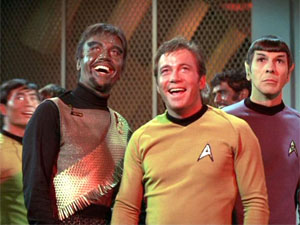
Following Kor  ("Errand of Mercy") and Koloth ("The Trouble with Tribbles"), the appearance of Kang in this episode completes the debuts of the big three Klingons featured in the series who would later appear in the Deep Space Nine episode "Blood Oath."

Like "Errand," "Day of the Dove" is about a conflict between Klingons and Kirk that revolves on weirdo manipulative aliens.  Being that as it may, it's a true highlight of the oft-maligned third season, showing a real flair for the budding Star Trek landscape, something the season did surprisingly often.

By this point, Klingons had appeared often enough that they weren't just familiar but a key component of series lore.  What's interesting is that it seems to anticipate the more nuanced role these traditional foes would develop over the course of Star Trek VI: The Undiscovered Country, Next Generation, and DS9, where they weren't just the enemy and in fact could even cooperate with Kirk when necessary.
via Danger Mouse. Leading to this improbable image.
Where fans tend to associate diminished quality with the season and diluted concepts, an episode like "Day" suggests, rather, how the creators began to loosen up a little, in a good way.  Far too often you'll see a critic dismiss genre entertainment for taking itself too seriously.  I have no idea what that means.  But I remember that some of the best material from the second season ("Tribbles," "A Piece of the Action") had exactly this attitude of letting the concept breathe a little.  I do think as the season progressed, it became a little more utilitarian and thus didn't really capitalize on its best instincts, but such a trend suggests that if there had been a fourth season, arguably the best material of the series had been yet to come.  A thought.

four quarter analysis
franchise * series * essential * character

notable guest-stars:
Michael Ansara

Related Posts Plugin for WordPress, Blogger...