Showing posts with label Star Trek: The Original Series. Show all posts

Saturday, February 4, 2023

Star Trek and the Changing Face of Eugenics

First airing February 16, 1967, the original series episode "Space Seed" introduced the genetic superman Khan Noonien Singh, who would appear twice more in the franchise (1982's Star Trek II: The Wrath of Khan and 2013's Star Trek Into Darkness).  Khan was described as a product of the Eugenics Wars, a still-nebulous concept in canon material that was supposed to take place somewhere in the 1990s.  In 1967, the term "eugenics" was broadly understood to have Nazi connotations, although it was a concept widely shared in the United States as well.  Eugenics was the idea that a "perfect" human could be engineered through selective breeding.  In Nazi hands it led to a genocidal purge of undesired ethnicities for a "pure" nation.  

Khan was presented as a monster incapable of reconciling his existence with those he found inferior, which was basically everyone else except the goons sent into the same exile as himself.  When Kirk finds his ship coasting in space and revives him, Khan attempts a coup of the Enterprise and is subsequently sent into a second exile, and an attempt at revenge.  

The extent of Khan's genetic engineering was physical as well as mental, so that he represented the idea of perfecting both by bypassing chance, willful education and fitness efforts.  In doing so, he developed a level of arrogance he couldn't see past, what Kirk eventually called two-dimensional thinking.  By taking his abilities for granted, Khan never considered that there was a chance anyone without his advantages could be his equal, much less superior.

In Star Trek lore, his existence and evident threat led the Federation to ban genetic engineering.  The franchise didn't seriously revisit the idea until the Deep Space Nine episode "Doctor Bashir, I Presume?" in 1997, a full thirty years after "Space Seed."  In it we learn that Doctor Bashir, a member of the regular cast since the first episode of the series, has been genetically engineered the whole time.  To look at him (a complete inverse of Khan physically, a beanstalk of a man), you would certainly have never guessed, and since this was a fifth season episode, nothing the writers had planned until plotting that episode.  Bashir had always had a healthy ego from his introduction on, a recent graduate of Starfleet medical school who boasted of his high academic achievements and selection of the assignment to a station at the edge of Federation space meant as a challenge he didn't think he'd find elsewhere.  The episode explains how his parents chose to modify his genes after finding themselves with a sickly child of no apparent prospects.

Now, no one will ever argue Julian Bashir to be the second coming of Khan.  Starfleet ends up making a special exception for him (he would otherwise have lost his career), instead punishing his father for making the decision in the first place.  For the rest of the series, the only real effect of the revelation is two episodes where he spends time with other products of recent genetic engineering, misfits whose outcomes weren't nearly as fortunate as his own.

The next time the franchise revisits the concept is the trilogy of Enterprise episodes from 2004, "Borderland," "Cold Station 12," and "The Augments," in which we learn the ancestor of Data's creator, Arik Soong, was inspired by the original Khan project in his work, and in fact nurtured the genetic material left over from it and even raised some of the results to adulthood.  (In later episodes, the series finally answers the question of how Klingons in the original series had such smooth foreheads; the Empire attempted to reverse engineer this work, and it...backfired.)  When Soong is repeatedly stymied, he eventually decides to pursues robotics instead.

Which brings us to the modern era of Star Trek programming and the reason I'm writing this.  Genetic engineering has played a prominent role in three series from this period, Picard, Strange New Worlds, and Prodigy.  We'll start with Picard, as it most resembles the franchise's historic stance on eugenics.

The second season of Picard features another member of the Soong lineage, Adam Soong, whose efforts in this field of science are meant to create a daughter for himself.  By this time the Eugenics Wars are long over, Khan has been put into cryostasis and shot into space, WWIII has yet to occur, and of course the Soongs have begun their long journey toward the creation of Data, one of the main cast members of The Next Generation, an android with an innovative positronic net powering him.  Adam Soong, although a renowned member of the scientific community, keeps his greatest work to himself, and has failed a number of times at creating a daughter of unlimited viability, genetic flaws continually cropping up and leading to premature death or debilitating conditions.  When we catch up with him, his daughter Kore has no idea she was created in a lab, although she certainly knows she can't stray far from home, since her skin can't withstand UV rays.  Eventually she runs away from home, and the Soongs continually evolve their pursuits.  Adam and Arik Soong are clearly presented as villains, although Kore, like Bashir before her, is an unwitting victim and sympathetic protagonist.  

The same can be said for Strange New Worlds and Prodigy's contributions.  Strange New Worlds gives us Number One, Una Chin-Riley, who has been hiding her Illyrian heritage since Illyrians maintain a regular practice of genetic engineering.  Prodigy's lead character is Dal, and in the 2022 episode "Masquerade" we learn that he's entirely the product of genetic engineering.

At the end of its first season, Strange New Worlds positions Chin-Riley in the same kind of peril Bashir faced when finally exposed, just as Prodigy finds Starfleet forced to reconcile Dal's existence with its ban.  Chin-Riley's case is in the past, before Khan is even revived, while Dal's is after Bashir's.  It seems recent creators are increasingly interested in challenging the moral qualms of the whole concept.  So is this a problem?

I think so.  It's one thing to argue, as Bashir does, that he had no say in what happened to him.  After all, although he knowingly lied throughout his Starfleet career, he didn't think he was otherwise responsible for conditions that ended up violating the ban.  Dal's case is different.  Although a character in a show geared toward kids and constantly presented as someone who just wants to fit in (and therefore it would be tough to come to any other conclusion), it becomes problematic that he's yet another unwitting victim we're asked to accept.  As I write this, the second season of Strange New Worlds has yet to premiere, so there's no way to know if and how Chin-Riley's case is handled, but it seems equally unlikely that she will end up unabsolved, whether by Starfleet or her crew.

I'm not making an argument against modern Star Trek, or these characters.  What I'm saying, here, is that it's a curious development in a franchise that has long been a champion of reason, spending the entire original series questioning basically everything, even the most precious indulgences of the counterculture that has long since been assumed to most closely align with its utopian ideals.  The franchise has also become a beacon of acceptance, in increasingly overt ways, and yet...this might be a step too far.  What some would call inevitable scientific progress still represents a Doctor Bashir who asks his parents, finally, why he wasn't good enough for them as he originally was.  No subsequent depiction of genetic engineering in the franchise has voiced such a thought, nor the cautionary tale (which is the foundation of the franchise) of Khan and the generation of augments that followed him.

This is a dangerous road to travel.  My hope is that someone at the controls realizes this at some point.  We don't need a Khan to point this out.  We certainly don't need another Hitler.  Star Trek is always at its best when it depicts humanity's efforts to better itself.  Through more conventional means.  Moral means.

Friday, April 30, 2021

Star Trek Arcs X: Kor

Here’s a fairly loose arc but it’s a pretty interesting one that goes deeper than it might seem, which is why I’m pulling one particular character from the many to appear in Deep Space Nine, and somehow not even one most fans are going to think about.

A somewhat lost element of Star Trek lore is that the first Klingon to ever appear was going to be a recurring character if actor John Colicos hadn’t been so busy. Kor makes his debut in “Errand of Mercy,” and would have also shown up in “The Trouble with Tribbles” and “Day of the Dove” (the other major Klingon appearances of the original series) if Colicos had been available.

So his replacements (Koloth in “Tribbles” and Kang in “Dove”) instead make their debuts, and the three of them then resurface three glorious decades later in the Deep Space Nine second season gem “Blood Oath,” which also finally cements Jadzia Dax’s credentials as a formidable character after a fair bit of waffling and uncertainty.

Long story short, Kor is appropriately the last of these Klingons standing, and he becomes subject to a prolonged arc of deciding what makes an aging Klingon’s life worth living.

First he shows up in “Sword of Kahless,” in which he competes with Worf on a mad quest to discover the legendary warrior’s weapon. Here he gets to nudge Worf into having a working relationship with another Klingon, which would eventually lead to his bond with Martok.

Which...would kind of be bad news for Kor himself, as we learn when we see him for the last time in the seventh season episode “Once More Unto the Breach,” in which we learn Martok’s backstory and Kor’s domineering role in it, and as such more about Kor’s backstory itself.

But the episode resolves Kor’s later dilemma by giving him the belated warrior’s death he had long sought.

The short arc is, all the same, a remarkable opportunity for the franchise to give a full story to a character (and species) that might have seemed one-note initially. But that’s Deep Space Nine in a nutshell, both in its own regard and how it deepens the franchise as a whole, sometimes in quite surprising ways. In no other series to date has an effort been made to flesh out such a seemingly minor character from another series, let alone itself. 

Saturday, February 27, 2021

Star Trek Arcs IV: Mirror Universe

The first truly ambitious arc of the franchise became one across eras. One of the most famous episodes of the original series is “Mirror, Mirror,” the Mirror Universe episode, in which Kirk accidentally ends up in an alternate reality where the Federation never existed, with the Terran Empire in its stead. By the end of the episode, he’s convinced the goatee-sporting Evil Spock to fight for change.

Now, Deep Space Nine revisiting the Mirror Universe some thirty years later probably would have felt like a much bigger deal if, say, Evil Spock had been in it, or if Deep Space Nine itself hadn’t later developed its own rich legacy revolving around the Dominion War. The first instance occurred near the end of its second season, in an episode called “Crossover.” The big shock is that Evil Spock did succeed! But that, at least as far as humans were concerned, it turned out to be a terrible idea!

When the Terran Empire turned its back on its old ways, it created a void filled by the Alliance, led by the Klingons and Cardassians, and overnight humans ended up in much the role the Bajorans had just before the series began, when they were subjugated by the Cardassians during the Occupation.

By the end of the episode, they begin their journey back to freedom.

The following season, that journey continues! In “Through the Looking Glass,” Sisko travels to the Mirror Universe to replace his dead doppelgänger, and in the process “reunites” with his dead wife’s lookalike. It’s the most personal Mirror Universe story...until another season later, in which his son Jake, in “Shattered Mirror,” experiences yet another painful family tragedy.

In the sixth season, the Mirror Universe Bareil (his counterpart died in the third season) visits the prime universe, which for fans always leaves “Resurrection” to be the least enjoyable entry in the Deep Space Nine sequels, as it mostly revolves around a personal story for Kira that does little to advance the arc.

In the seventh and final season, the arc, as it has certainly become by this point, concludes in “The Emperor’s New Cloak,” in which I’m pretty sure no Ferengi manage to die in the Mirror Universe for the first time! Probably!

That’s the end of the arc, but not the end of the Mirror Universe! A second arc begins in Discovery fifteen years or so later, although viewers don’t know it at first. Captain Lorca is eventually revealed to have come from the Mirror Universe, and his efforts to return introduce Mirror Georgiou, whose arc concludes in “Terra Firma, Parts 1 & 2.”

There’s more! Enterprise shows us the origin of the Mirror Universe, suggesting that if the events of First Contact hadn’t played out like that, and Cochrane had been left to his own devices, wary humanity would have reacted very differently to their Vulcan guests. And then “In A Mirror, Darkly, Parts 1 & 2” put on a fun little romp that also revisits “The Tholian Web.”

The Mirror Universe remains a unique experience in franchise lore, a pocket adventure with unique surprises that comments on the hopeful nature of Star Trek in the most unlikely way.

Saturday, February 13, 2021

Star Trek Arcs II: Khan

The second Star Trek arc is probably the most famous arc of the whole franchise: Khan Noonien Singh. 

Khan comes from our own lifetime, a genetic superman who rose to power in the 1990s as part of the Eugenics Wars, which other than this biographical detail have never been explored except in books. (Slightly more examined but still sketchy: WWIII.) Anyway, Khan loses power, is exiled into space in a sleeper ship called the Botany Bay, there to linger for hundreds of years until stumbled upon by Kirk and company near the end of the first season of the original series in “Space Seed” (which, for those keeping score, is of course before Chekov joins the cast).

And Khan immediately attempts his old shenanigans again, and once more finds himself in exile for his efforts, this time on a planet called Ceti Alpha V.

And then, in the second film of the franchise, Star Trek II: The Wrath of Khan, he returns once more. Fans still claim this particular adventure is the high water mark of at least the films, and were none too pleased when Star Trek Into Darkness revisited it. Like the other Kelvin films it essentially exists in its own timeline, so it doesn’t technically connect with the rest of the arc, but that doesn’t mean there isn’t more to the story.

Enterprise provides that. Remember how Data’s creator was named Noonian Soong? Well, we meet his ancestor, Arik, whose work begins with other “augments” from Khan’s heyday, similarly revived for additional mayhem, in the trilogy of episodes “Borderland,” “Cold Station 12,” and “The Augments,” before he decides to switch to robotics (the evolution of which itself carries into the first season of Picard).

That’s still not the end of the story!

The augments, during the course of their misbegotten adventures, crossed paths with the Klingons, and in “Affliction” and “Divergence” we learn the canonical explanation for the lack of ridges in the original series: they attempted an experiment to create augments of their own, and mostly the results were cosmetic (mostly so they didn’t accidentally annihilate themselves!).

A side note: Deep Space Nine revisits the idea of genetic engineering in “Doctor Bashir, I Presume?,” in which we learn that Bashir, naturally enough, is controversially entangled in it, thanks to his parents, and that the Federation still finds it otherwise as much a taboo as the Genesis Planet Khan helped create.

Saturday, January 16, 2021

Star Trek Arcs I: Pike

One of the great underappreciated legacies of Star Trek is the idea of the story arc. On the surface this seems to be a simple riddle to unfold, as Star Trek began, as with all TV programming of its era, as episodic storytelling. Yet, somehow, arcs have been a part of the franchise from the very beginning.

The first pilot of the original series, “The Cage,” featured Captain Pike and a completely different crew, aside from Spock, aboard the Enterprise. In the episode, Pike discovers a planet populated by beings who are capable of casting powerful illusions. 

NBC passed on the pilot but opted to let Gene Roddenberry take another swing, which with “Where No Man Has Gone Before” turned out to be worth three seasons.

Now, towards the middle of the first season, of course, “The Cage” was repurposed as flashback material for the two-part “The Menagerie,” in which we learn that Pike has been horribly mutilated and confined to a mobile chair. Spock has agreed to bring him back to Talos IV, the planet of the powerful illusions, so that he might continue some semblance of a normal life. The episodes themselves carry the framework of a trial Starfleet is prosecuting against Spock, as we watch footage from “The Cage” as evidence.

The idea of this being an arc is kind of a matter of hindsight. In 1966 audiences would really only have known of “The Cage” as part of “The Menagerie.” It’s later fans who get to enjoy the full scope of the story. Pike himself would later resurface in the Kelvin films, as well as Discovery, in which  material relevant to the arc is inserted during “Through the Valley of Shadows,” where he is given a glimpse into his fate and even the chance to avoid it.

The next franchise arc would prove to be more deliberate, not to mention dramatic. And cinematic!

Saturday, February 16, 2019

He Was a Particularly Troubled Romulan: Star Trek Post-9/11

"He was a particularly troubled Romulan."

That's what Spock says of Nero in Star Trek (2009).  The line always stuck out for me, but I never quite understood why until recently.  Spock, of course, is Vulcan, and Nero is Romulan, an offshoot of the Vulcans.  Further characterizing the Romulans was always a little difficult.  In the original TV series, they were presented as another Cold War analogy, like the Klingons, who had fought the Federation in the past but had retreated into reclusiveness.  In fact, the fact that Romulans descended from Vulcans wasn't even generally known until they emerged again, and they went back into isolation until The Next Generation, where they became a recurring threat, until the events of Star Trek Nemesis, in which a clone of Picard named Shinzon attempted another full-scale war against the Federation, but ended up suffering the loss of their home planet in the backstory of Star Trek

Characterizing Nero as "particularly troubled" is a telling detail.  Nero's response to the destruction of Romulus is to blame Spock, the older one still alive in Picard's day, and all of the Federation, and to once again declare open war.  He sets about a plan to what is in his mind equitable retaliatory action, affecting the destruction of the Vulcan home world and then the rest of the leading Federation worlds, starting with Earth.

And it made me wonder what exactly Nero represented.  Longtime fans tend to look down on the new films, claiming they lack the spirit of the franchise by putting too much focus on flashy special effects.  But that's simply not the case.

Since 9/11, Star Trek has had terrorism on the brain.  Star Trek: Enterprise famously launched within weeks of 9/11.  By the end of its second season, Enterprise launched a major story arc in direct response, an act of terrorism against Earth that led to a preventive mission against the aliens responsible. 

As you read above, the franchise was responsive to its times from the very beginning.  The Klingons and the Romulans were both reflective of the Soviet Union, an idea that culminated in Star Trek VI: The Undiscovered Country with its breakup.  The Next Generation continued the tradition; the Troubles in Ireland were often reflected in its storytelling.  Deep Space Nine echoed the collapse of the imperial age with the end of the Cardassian Occupation of Bajor, reflecting back to the days of WWII but often evoking present times, if not the Troubles then the ongoing conflict in Israel.

Which brings us back to Star Trek.  What if Nero was a Palestinian analogy?  Or Islamic terrorists such as those who struck on 9/11?  I find it likely.  And then Star Trek Into Darkness doubled down on the idea. 
                                                                                                                                                                          
 
You'll recall the above promotional poster, meant to evoke Khan's early terrorism in the movie.  Khan himself might as well have depicted the perception that America's response to 9/11 ended up being excessive or misguided, to put it mildly.
 
Things worth considering.


Monday, October 20, 2014

Star Trek 3x24 "Turnabout Intruder"

rating: **
Memory Alpha summary

It's the last episode of the series!

And as it turns out, the third season saved its dirtiest trick for last.  Throughout the season, the creators seemed to take every opportunity to challenge fans by flipping the script, or by simply seeing how far they could push things.  "Turnabout Intruder," in fact, plays almost like the Kirk version of "Spock's Brain."  Take that for what you will, but as with "Brain" this is not necessarily a bad thing.

In some ways, it's a very good thing.  It's our opportunity to view the captain long stereotyped as a ladies man from the other side, quite literally, as a woman who felt betrayed by him in the past assumes control of his body.

In a lot of ways, it's a pretty standard episode, and by modern standards hardly fitting for a series finale, but there was no more way to know then that it was going to be the last one than it would've been after the second season, or first, whenever the series seemed in mortal danger.

To put Kirk to the test like this, though, is in hindsight clever and entirely appropriate.  In the movies we would meet another defining love interest from Kirk's past, Carol Marcus.  It's still weird to think that everyone Kirk knew before the Enterprise was basically an obstacle in his life.  Most of the time he knew it.  This time he didn't.  In fact, he's the one who was the jerk.

Probably tough to see something like that explored about a character who is traditionally considered ideally heroic, and from the vantage point of someone obviously unbalanced (read: insane).  But there you go.
via Fanpop


And there the series goes!

four quarter analysis
franchise * series * essential * character

notable guest-stars:
Majel Roddenberry

Sunday, October 19, 2014

Star Trek 3x23 "All Our Yesterdays"

rating: ****
Memory Alpha summary

In Deep Space Nine, Dax finds herself in a situation where she can't join a civilization in a remarkable transition ("Meridian").  In Voyager, Tuvok undergoes a personality change ("Riddles").  Combine these and toss in time travel, and you have the ingredients for the last classic episode of the series.

By the end, the series had begun to spin its wheels.  Like the second season before it, the third season had lost much of what it had originally set out to do.  Creatively, it had been on autopilot.  "The Savage Curtain" was a chance to seize the kinds of opportunities the season had been exploring early on.  "All Our Yesterdays" was the last time it let loose.

It's an episode that revolves squarely on the familiar three leads, Kirk, Spock and McCoy.  Curiously, Kirk quickly goes on in a fairly classic, dull Kirk tangent.  It's much better understood to be a Spock and McCoy episode (in the tradition of DS9's "The Ascent" or Voyager's "Rise"), an opportunity to finally put them at odds, something that seemed inevitable from the moment they first shared a scene together.

All three have visited a world about to be destroyed by its star going supernova.  Its citizens have devised a brilliant solution to their dilemma: relocating to the world's past.  It's a concept the episode exploits well, although curiously, where Kirk's elements otherwise squander it with typical trivial danger, these scenes still make clear that integration and memory were very much on the survivors' minds and as such are still worthwhile to the whole experience.

Still, it's Spock behaving atypically that proves the best incentive to watch this one.
via Star Trek
Unlike the random romance of "The Cloud Minders," there's great care to explain everything that happens to Spock in "Yesterdays," its relevance to the character, and significance.  That alone makes the episode special, but it's overall a great concept executed dynamically, exactly what you expect from Star Trek at its best.  With time travel such an important motif of the franchise, to stand out any one such story has to do something unique.  "Yesterdays" certainly does that.  It's an episode that could easily be revisited as a movie, even.  Just saying.

four quarter analysis
franchise * series * essential * character

Tuesday, October 14, 2014

Star Trek 3x22 "The Savage Curtain"

rating: ***
Memory Alpha summary

In one of the final episodes of the series, a couple of Star Trek icons debut.  That's about as much as you need to know about "The Savage Curtain."

Both of them are historical figures, Surak of Vulcan and Kahless the Unforgettable (a Klingon).  A third, Colonel Green, is less significant but also important.

Historical figures, history lesson: Surak was the founder of Vulcan logic.  His legacy is later explored in the Enterprise episodes "The Forge," "Awakening," and "Kir'Shara."  Kahless was likewise the founder of the Klingon code of honor.  His clone appears in the Next Generation episode "Rightful Heir," while Deep Space Nine features the rediscovery of "The Sword of Kahless."  Green is from Earth's past, a figure from the WWIII era prior to First Contact, who also serves as the inspiration for xenophobic madman John Frederick Paxton in the Enterprise episodes "Demons" and "Terra Prime."

All of which makes "Savage Curtain" itself historic.

Curiously, all of the reasons to recommend the episode don't necessarily reflect on the series itself.  (When I say that, it may indicate that at base, it may just not be that awesome an episode.  Even when there are very good reasons to watch one, there may be some others that mean you have to have a good excuse to care.)  At the start of the story, it's basically an Abraham Lincoln episode, which means the series has reverted back to the second season trend of basically trying to do every general story type available at the time.  Lincoln has an enduring cultural appeal.  That's basically all he's here to do, blatantly.  If it had just been Lincoln, "Savage Curtain" might end up representing everything you've always believed about the third season (assuming you had any preconceptions).  There's nothing wrong with Lincoln, using Lincoln, or trying to make a point with Lincoln, but that smacks of egregious gimmickry in a series that sometimes smacked very badly of such offenses.

So it's good to have Surak.  Outside of Spock's dad Sarek, he counts as only the third notable Vulcan in the whole series.  Any episode (that's another reason why "Amok Time" has always endured in the minds of fans) that spends time with another Vulcan will always have to be considered notable.  Even though Kahless ultimately emerges as a better character to explore, once the franchise takes a more nuanced view of Klingons in general (though the characteristic lighthearted approach of the original series will always be something worth revisiting), it's Surak who's the winner in their mutual debut.  It's basically a Surak episode disguised as a Lincoln episode disguised in what basically seems like a fairly throwaway episode.  Series fatigue.  But unknowingly at the time, a very fruitful case of it.
via Star Trek
The other notable thing about the episode is that the aliens who create this somewhat nonsensical situation are rock creatures.  William Shatner later wanted rock creatures in Star Trek V: The Final Frontier (didn't get them, obviously).  Galaxy Quest featured rock creatures.  Clearly a compelling idea.  The rock creatures' idea in the episode is to test humanity's sense of good and evil.  Q tested humanity throughout Next Generation (at least in the first and last episodes, and everyone's patience, including the casts of DS9 and Voyager).  Anyway, another link if you want.  More if you want to look.  That sort of thing.

four quarter analysis
franchise * series * essential * character

Monday, October 13, 2014

Star Trek 3x21 "The Cloud Minders"

rating: *
Memory Alpha summary

"The Cloud Minders" is another of the episodes that saw the series tackle the racial issues of the day, although this time it might also be considered a general social commentary of a stratified culture.  In its study of class inequality, "Minders" might be considered comparable to the later "Dear Doctor" (Enterprise), which generally is a better version of the story.

It deals with terrorism (certainly a considerable portion of the Deep Space Nine legacy), too.  And it has Kirk as well as Spock involved in romances.  It's Spock who bags the major beauty, Kirk who's interested in the one who represents the crux of the problem.  But Spock's wears considerably less.
via Trek Core
Next Generation and of course the series itself dealt with worlds deluded into believing themselves utopias ("The Masterpiece Society," "Plato's Stepchildren").  "Minders" features a cloud city about a decade before The Empire Strikes Back.  Less carbon freezing, about the same amount of torture.

Admirable for what it wants to say, but it's the series kind of spinning its wheels at this point.  Kirk and Spock both taking arrows from Cupid is a little on the nose, clearly pandering to the fans and less the demands of the story.  Spock being fascinated by physical beauty is pretty out of character.  

four quarter analysis
franchise * series * essential * character

notable guest-stars:
Fred Williamson

Monday, October 6, 2014

Star Trek 3x20 "The Way to Eden"

rating: ***
Memory Alpha summary

Most often contended to be the "hippie episode" (although the earlier "This Side of Paradise" more accurately represents that description; perhaps the benefit of hindsight holds the difference, where one depicts how they're remembered now while the other how they considered themselves at the time), "The Way to Eden" is something of the Charles Manson story in space.

Star Trek V: The Final Frontier later paralleled much of the same story, while Deep Space Nine explored the back-to-nature idea in "Paradise," and there's Star Trek: Insurrection to consider as well, plus similarities to "Fusion" (the start of a whole character arc) in Enterprise.  That adds up to something of a considerable legacy for the episode.
via Pinterest
It's also a Chekov episode, continuing the third season trend of coming up with stories for the supporting cast a little more frequently.  It's his lady friend (in the original version it was actually McCoy's daughter, and the other half of the equation was Kirk...which would certainly have made things far more interesting...!) who's caught up in the would-be Manson's plot to rediscover Eden (in this case, the title of the episode is actually pretty straightforward for a change).  Eventually Chekov's spotlight gives way to Spock, and has the benefit of giving new insights into both characters, contrasting with what we previously thought we knew. 

All that adds up to plenty going on in the episode.  "Way to Eden" is one of those episodes that's probably better now then it seemed at the time.

four quarter analysis
franchise * series * essential * character

notable guest-stars 
Majel Roddenberry
Charles Napier
 

Thursday, October 2, 2014

Star Trek 3x19 "Requiem for Methuselah"

rating: ****
Memory Alpha summary

"Requiem for Methuselah" is a classic, but it's a different kind of classic.  It tackles some of the essential questions of the series and reflects on later elements of the franchise as well, but in ways that may still be surprising.

Whether "What Are Little Girls Made Of?" or Harry Mudd is your fancy, artificial life was a running theme of the series well before Data in Next Generation or The Doctor in Voyager.  The android in 'Methuselah" isn't necessarily the central figure (that would be long-lived Flint), but is at least another familiar type: a love interest for Kirk.

And perhaps this is the rival "City on the Edge of Forever" always needed.  In "City," Kirk has to watch a love interest die.  In "Methuselah," the love interest literally falls apart rather than choose between Kirk and the life she's previously known with Flint.  Kirk falls hard for her, and at the end of the episode, Spock performs a kind of miracle for him, erasing his memory of the whole incident (a rare, organic reset button), an act of mercy that adds yet another layer of significance to the proceedings.
via Fanpop
The title itself is iconic, one of the most poetically evocative of the whole series (a running theme that is one of its many distinctive features).  Methuselah is a biblical figure, mostly significant for being long-lived, so it's a clear enough metaphor.  Chances are if you can't immediately identify the episode's contents with its title, you remember a title like that anyway.  

Yet the episode itself is an instance of the third season betraying its reputation for mediocrity, for failing to leave a good enough impression for the final run of the series.  It's perhaps one of the best examples of the season being a reward for the fans, certainly for that closing scene with Spock, and for closure on a theme the show had attempted to explore multiple times already.  And when you know the franchise would later finally tap this theme with main characters, "Methuselah" ends up becoming a preview (Voyager's excellent "Latent Image") of greater things still to come.

In a lot of ways, you can overlook the episode's significance all too easily because so much of it seems like so much you've seen before.  But not like this.  It's an experience of subtle pleasures and resonance.  And none the less for it.  It's a moment that catches everything the series tried to be all along, a profound examination of the human condition, and manages to do so with the fine touch seldom previously managed.

four quarter analysis
franchise * series * essential * character

Wednesday, October 1, 2014

Star Trek 3x18 "The Lights of Zetar"

rating: **
Memory Alpha summary

There are twelve-hundred million episodes throughout the franchise featuring aliens attempting to take over the bodies of the regular crew.  This is an early one.  In that regard, it's so completely average that you hardly have to watch this one in particular to know and/or care about the proceedings.  However, it's a precedent, part of a Star Trek trope, whatever way of saying it that makes you think it's worth watching in some way, at least in that regard.

It's also a Scotty episode.
via Daily Drew
I know, even though it technically happens several times throughout the series, it's basically a surprise every time.  Scotty was always the fourth lead of the series, after Kirk, Spock and McCoy, memorable for any number of reasons, whether his reputation as a "miracle worker" or that distinctive accent or general rank of importance among the crew.  Still, the fourth lead was about as thankless a positioning as the three below him (Uhura, Chekov, Sulu) in most respects.  Scotty episodes, not considering how rare they were, just weren't to par with the ones featuring those above him.

But this one's a romance.  Unlike "Wolf in the Fold," this is a good thing for the chief engineer.  It's about as shocking to have a romance feature someone other than Kirk as it is to discover you're watching a Scotty episode, so for combining the two, it should be considered a landmark of some kind.

The last and perhaps most significant contribution of "Zetar" (the title evokes classic science fiction if not Star Trek in general, one of those titles that leaves no real impression of the story it represents) is the debut of Memory Alpha, the Federation library that was subsequently adopted by the fans, as you may have noticed a time or two.  

In that regard, you wish, once again, that the series were less pedantic in the types of stories it was willing to do, not merely yet another harrowing alien encounter, but a simple Starfleet visit to the library.  Sounds crazy, I guess, but even adding in Scotty's romance, that could've sufficed, couldn't it?

four quarter analysis
franchise * series * essential * character

notable guest-stars:
Majel Roddenberry

Thursday, September 25, 2014

Star Trek 3x17 "That Which Survives"

rating: **
Memory Alpha summary

So, "That Which Survives" is later echoed in "Arsenal of Freedom" (Next Generation), "Civil Defense" (Deep Space Nine), "Prototype" (Voyager).  It's basically an episode about a defense mechanism that outlasts both its civilization and its need.

Because it's this series, it takes the form of a hot chick, naturally.
via Let's Watch Star Trek.  Many redshirts were killed to bring us this information.
But perhaps more interestingly, a lot of other standard elements take different shape in the episode.  For a change, when characters and/or ships go missing, that's not even the end of the crisis.  Which leads to this being a kind of Scotty episode, as he works feverishly to get the Enterprise back under control.  If all you care about Scotty is how awesome an engineer he is (and let's face it, in the series itself, what else is there?), this may be the ultimate episode for you.

And to a certain point, it even seems as if it's a Sulu episode, too.  (How often does that happen?  How about...never?)  He's part of the landing party, and when it seems the Enterprise has been lost he begins offering suggestions.  Sure, Kirk dismisses them.  But Sulu's making them.  It's another small step toward that captaincy waiting in his distant future.  It's him being almost taken seriously!  And then later, the hot chick seems like she's choosing him rather than Kirk!  That definitely never happens!  Weird circumstances, sure, but that's one of the story beats.  So if you're a fan of Sulu, this an episode to catch in that regard as well.  

Wonders never cease, right?  And, and that title?  It's Kirk's summation of the whole experience.  Naturally.  Beauty survives.  All he'll remember is the hot chick.

four quarter analysis
franchise * series * essential * character

notable guest-stars:
Lee Merriwether
 

Wednesday, September 24, 2014

Star Trek 3x16 "The Mark of Gideon"

rating: *
Memory Alpha summary

"Mark of Gideon" is a Federation episode, explaining what goes wrong horribly after a planet petitions for membership and Kirk visits to check out what it's like.  That's all well and good.  In some ways, that's all you need to know about Deep Space Nine as a series (the Bajor problem is easy to forget after the long Dominion War years).

Aside from that relevance, "Gideon" is also a lot like a lot of other episodes, in that it's basically Kirk running up against a planet with a particular problem, this one being overpopulation.  As usually happens in these cases, the planet has elected for an extreme solution.  Happened before, would happen again, across multiple series, usually in one-off episodes.

via Star Trek
When you're a Simpsons episode you can change the story you're telling whenever you want.  When you're not, vacillating isn't always such a good thing.  The idea of overpopulation is introduced but isn't really important until the end of the episode, when an explanation for why Kirk goes missing and the planet proves so uncooperative must be made.  But by that point it could have been anything.  It's arbitrary, and is a clear example of the limits of the kind of storytelling the series favored.  

Better to remember that it was an effort at exploring not just strange new worlds but those who attempting to join the existing framework.  The fact that it's a story template later revisited, and with equally spotty results, is an indication that it's a tough idea that was never truly solved.  Even DS9 walked away from it.  A challenge to be tackled more directly next time?  Although it might be argued that Enterprise did exactly that, as it explored the founding of the Federation.  And so perhaps another reason to reconsider that series...

four quarter analysis
franchise * series * essential * character

Thursday, September 18, 2014

Star Trek 3x15 "Let That Be Your Last Battlefield"

rating: **
Memory Alpha summary

Okay, let me rephrase the third season again.  I think I'll get it right this time.  I think it was a last ditch effort to make the series iconic in the minds of viewers.  Not just good or challenging or memorable, but so they couldn't ignore what it tried to do during its run.  And that's what "Let That Be Your Last Battlefield" is all about.  This is the episode that has these guys:
via WC Tech.  E-e-ebony and i-i-ivory!
It's that moment where subtlety goes out the window.  "Hey!  We're all human!  To quote Michael Jackson, 'It doesn't matter if you're black or white!'  Because we happen to be BOTH!" But of course these two knuckleheads don't get that.  An Enterprise episode, "Chosen Realm," borrowed the whole concept of its ending: if you don't learn to get along with each other, you wipe each other out.  

It's probably the most famous episode of the third season, the epitome of the go-for-broke attitude that happened to also add important bits of material to the canon, like Tholians, Surak, Kahless the Unforgettable, Memory Alpha.  And aliens whose skin pigmentation has this slight variation outsiders would never even notice, but to them is of vital, deadly importance.  Sound like any struggles you might have heard about in our own times?

Take it for what you will.  Commendable, courageous, but...Great historic significance, maybe not the greatest of episodes.

four quarter analysis
franchise * series * essential * character

notable guest-stars:
Frank Gorshin
Majel Roddenberry

Wednesday, September 17, 2014

Star Trek 3x14 "Whom Gods Destroy"

rating: **
Memory Alpha summary

This is the cautionary tale for Starfleet captains.  Garth was a legend who went mad, and subsequently becomes a problem for Kirk to handle.  That's the gist of "Whom Gods Destroy."
via Dude Rocket. On the plus side, Green Yvonne Craig!
Or, to put it another way, this is how Kirk could have ended up after any number of his own crazy adventures.  It's also an episode that helps foster the idea that, much as how a lot of his costars came to consider William Shatner, Kirk was basically the only game in town.  I get that the star of a show is prone to having a lot of Big Dramatic Things fall in his lap, and saving the galaxy becomes the prerequisite for a sci-fi hero, but it's easy to assume that Kirk's era is somehow completely dominated by him.  He's the only competent captain, the only hero...you get the picture.  When some other Starfleet or Federation figure comes along, it's Kirk who's got to rescue them from their foibles.

"Gods Destroy" is a quintessential third season episode.  Unlike the relative world-building of the second season or the iconic development of the first, it's a season replete with ideas that leave a considerable impression on the franchise without seeming to.  That's Garth in a nutshell.  It's not that, like Commodore Decker in "The Doomsday Machine" where he's faced with a threat that's arguably more significant than he is.  Leonard Nimoy apparently had a ton of problems with the episode, and there are endless parallels to be made with "Dagger of the Mind."  Yet "Gods Destroy" is distinctive from "Dagger" thanks to Garth.  "Dagger" has no Garth.  His presence alone makes this an episode that could have been Kirk's, or directly significant to Kirk himself, but in the end is, as I said, a story of what could have been, a worst case scenario.  

There are Andorians, Tellarites, and Orions running around.  This whole season was a last-ditch effort to remind viewers what made the series memorable in the first place.  If few people argue that it was the best season or had the best episodes, then at least it can be said that it was an effort to blend the instincts of the two preceding seasons.

The episode also features the familiar trope of someone impersonating a main character.  As usual, it's Kirk.  (It's more memorable in The Undiscovered Country.)

four quarter analysis
series * franchise * essential * character

notable guest-stars:
Yvonne Craig

Thursday, September 11, 2014

Star Trek 3x13 "Elaan of Troyius"

rating: **
Memory Alpha summary

Like the later Next Generation ("The Perfect Mate") and Enterprise ("Precious Cargo") episodes, "Elaan of Troyius" is about a bride on the way to a politically-motivated wedding whose journey is complicated by her encounter with a formidable Starfleet officer.
via Trek Core. Looks Egyptian but she's Greek to Kirk!
As the title certainly evokes for me, this is another of the many episodes drawing from classical history, specifically Greek or Roman figures.  "Troyius" owes its origins to The Iliad, the story of the Trojan War, and Elaan is a kind of Helen of Troy figure, a problematic bride if there ever was one.
via Trek Core.  From the little-known Greek Green Goblin myth.
The most intriguing element element of the episode is that it seems to be the quintessential setup for Kirk Is A Cad storytelling, but he in fact resists the easy romance the whole time.  Elaan is kind of like an Orion Slave Girl (less dancing, more like how they were explained in Enterprise), irresistible.  Yet Kirk does resist her.  Picard had a far less easy time of it (though, in fairness, he was matched up against Famke Janssen, while Trip's impossible scenario pitted him against the equally alluring Padma Lakshmi).

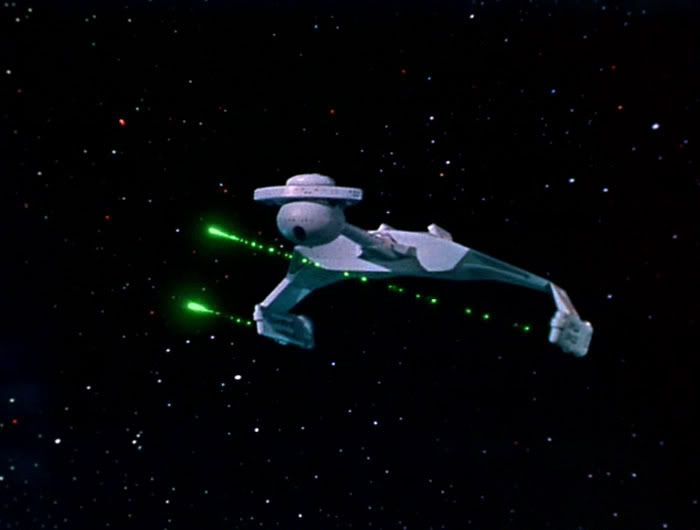
Interestingly, this is also a Klingon episode, certainly not famously so, but it does present, if not in broadcast than at least production order (meaning it was created for "Elaan"), the iconic first Klingon starship of the franchise:
via RPF.  I had a model of it.  Glued it badly together myself!
I won't overstate how much you need to see "Elaan of Troyius," but there are reasons to consider it fairly significant in a minor kind of way.  (Such glowing praise!)  And if you're looking for near-Uhura episodes, this is another one to catch in that regard.  We see her quarters.  That sort of thing.

four quarter analysis
franchise * series * essential * character

notable guest-stars:
Majel Roddenberry


Wednesday, September 10, 2014

Star Trek 3x12 "The Empath"

rating *
Memory Alpha summary

Like Q in The Next Generation, an entire aliens species is tested, although in "The Empath" it's with a single individual.  The results probably would have been better with a better choice as to how to represent that individual.

As the title suggests, the individual is an empath, like Troi in Next Generation (it's easy to assume the episode was considered somewhat heavily in the formative development of the second series, kind of merged with The Motion Picture and Gene Roddenberry's attempts at launching a TV show with a robotic lead character).  But she's also a mute, and therein lies the rub.  The performance falls flat for anyone who doesn't particularly want melodrama inserted into the mix, but there it is and there's very little else to be said about it.
via Tom Taylorville
It's the kind of episode that's just kind of there, reminiscent of "The Cage," the original pilot in concept and execution.  If so much of it hadn't apparently been duplicated to much greater effect, I'd say it should otherwise very easily be stricken from the record, a contender for the distinction of worst episodes in the way "Spock's Brain" is usually much more easily considered.

four quarter analysis
franchise * series * essential * character

Thursday, September 4, 2014

Star Trek 3x11 "Wink of an Eye"

rating: *
Memory Alpha summary

There are some episodes that are neither good nor bad, are just adventures you take in if you generally like what you've been watching.  I have four distinctions every episode is measured by.  I begin with the premise if it's worth watching at all, it gets at least one of them, whether for a viewer who happens to be a fan of the series, the franchise in general, or if there's a reason to watch for a specific character, and the fourth one as to whether it's essential for any one of the three.  (I always rank character last because for me it's the mark of the best stories regardless of any other factor.)

I begin with all that because there's...really nothing else worth talking about with "Wink of an Eye."  There are countless examples of other episodes throughout the franchise where the ship is hijacked by aliens.  This one happens to feature a particular gimmick in order to achieve it (as in fact they all do), which is that the aliens move faster than our crew (hence the title).

It's the kind of episode that's a reminder that Star Trek at its heart is a science fiction vehicle.  So often the gimmick isn't necessarily geared toward the genre so much as traditional elements either from it or the Star Trek template as it slowly emerged.  So that's all you really need to know.
via Trek Core.  Well, that and a skimpy outfit!
four quarter analysis
franchise * series * essential * character

notable guest-stars:
Majel Roddenberry

Related Posts Plugin for WordPress, Blogger...