Tuesday, May 12, 2015

The Next Generation 2x1 "The Child"

rating: ***

Memory Alpha summary

via Star Trek; looks a lot like my nephew Julian, actually
After a sometimes abysmal first season, Next Generation was determined to switch things up.  The series became a wide success after the changes made for the third season, but the second season deserves far more credit than it usually gets for everything it did, and "The Child" introduces all of them.

Riker's beard, by the way, is by far the least significant one, even if it became a signature of the character.

Introduced, for instance, are Whoopi Goldberg's mysterious bartender Guinan and Diana Mulder's Dr. Pulaski.  Replacing Dr. Crusher for the duration of the season, Pulaski became known by the fans as "the female Bones," but she represented a new and more mature dynamic, something that to that point in the series Picard had failed to accomplish.  Of the two, Pulaski receives more attention, and right away starts in on one of her signatures, a contentious relationship with Data that led all the way to "The Measure of a Man," the episode that defined the nature of his android existence, something Pulaski routinely questioned.

With the departure of Dr. Crusher, her son Wesley took on new significance as well, making official his as-yet unofficial status as Starfleet prodigy-in-residence, dialing down the more annoying aspects of the character in favor of a more directed approach at what was to become his yearning path to adulthood.  In the absence of his mother, the whole ship adopts Wesley, and in turn he helps symbolize the turning of the crew into more of a family.

Speaking of which..."The Child" as a title refers to none of these aspects but rather an offspring Troi unexpectedly has, an accelerated pregnancy and life that was later echoed-of-a-sort in Deep Space Nine's "The Abandoned" and Enterprise's "Similitude" as well as, basically, the whole concept of the Ocampa (as in Kes) in Voyager.  The experience helps Troi and Riker revisit their relationship, gives Troi the most work she's had since "Skin of Evil" (actually the first time in the whole series where she's had a positive experience despite the obvious complications), and does some fancy footwork over an old franchise trope, so that you don't even have to care too much that the trope even exists in the episode (alien species wants to know what it's like to be human).

It's the rare episode that spends most of its time visiting with the characters and giving token nods to the more traditional storytelling style of Star Trek.  In a lot of ways, it presages how Deep Space Nine would eventually operate on a near-full time basis, sets up modern Star Trek as a whole, and helps begin the process of making Next Generation, you know, actually watchable.  I don't want to say it's a classic, but "The Child" is certainly a step in the right direction for the series, and in that sense its worth is immeasurable.

four quarter analysis
franchise * series * essential * character

notable guest-stars:
Diana Mulder
Whoopi Goldberg
Colm Meaney

Saturday, March 28, 2015

The Animated Series 2x6 "The Counter-Clock Incident"

rating: ****

Memory Alpha summary

via Trekcore
"Yesteryear" is the episode best remembered, and for fairly good reason, but "The Counter-Clock Incident" is the most important episode of the series.

A far, far better version of the de-aging idea (and as such, the much more prolific rapid-aging seen in many, many episodes) later featured in Next Generation's terrible "Too Short a Season," "Counter-Clock" most pointedly features Robert April.

(Also, Next Generation featured the crew de-aged into children in "Rascals."  That's the other half of what happens this episode.  It's cutesy without being annoying in a way similar developments in the series failed to be, but would not in itself be a reason to recommend it.  Unless you're amused by the familiar acting voicing themselves younger.  George Takei probably is the best in that sense.)

(The idea of a reluctant retirement, as April is facing, is again addressed in a Next Generation episode, "Half a Life.")

(Finally, a different series, Voyager, features an alien civilization aging differently in two episodes: "Innocence," with the idea of aging backward like "Counter-Clock" and The Curious Case of Benjamin Button, and "Blink of an Eye," with a planet whose rotations are far more rapid than the norm, as Janeway and company observe their epochal progress while stuck in orbit.)

Who is Robert April, you may be asking?  When Gene Roddenberry originally conceived of Star Trek, he was the original captain.  Before Kirk and before Pike, there was Robert April.

via Wikipedia
In fact, even though the character to date has never appeared in any live action series or movie, Roddenberry himself has traditionally been depicted as Robert April.  In a very real sense, other than the grand idea of the Great Bird of the Galaxy, this is the closest to inserting Roddenberry into his own creation the franchise has ever come.

And without "Counter-Clock," the character does not technically exist.  This is the most galling part of the common notion that the series does not exist canonically.  Take away the sentimentalism, and "Counter-Clock still functions in much the same capacity as "The Menagerie," the two-part original series episode that incorporated Pike's appearance in the first pilot, "The Cage," to make it canonical (and cost-effective).  Yes, the circumstances are different.  But here's Robert April, under unique circumstances actually getting to save the day.

With the appearance of April, this final episode of the series is also a definitive bookend to the franchise as it was at that point, however unintentionally, much as Enterprise would later attempt to accomplish, however dubiously, with "These Are the Voyages..."  And that's another reason why it, as well as the series as a whole, ought to be at last embraced as a part of the Star Trek legacy.  

four quarter analysis
franchise * series * essential * character

notable guest-stars:
James Doohan
Nichelle Nichols

Wednesday, March 25, 2015

The Animated Series 2x5 "How Sharper Than a Serpent's Tooth"

rating: *

Memory Alpha summary

via Dan Hauser Trek
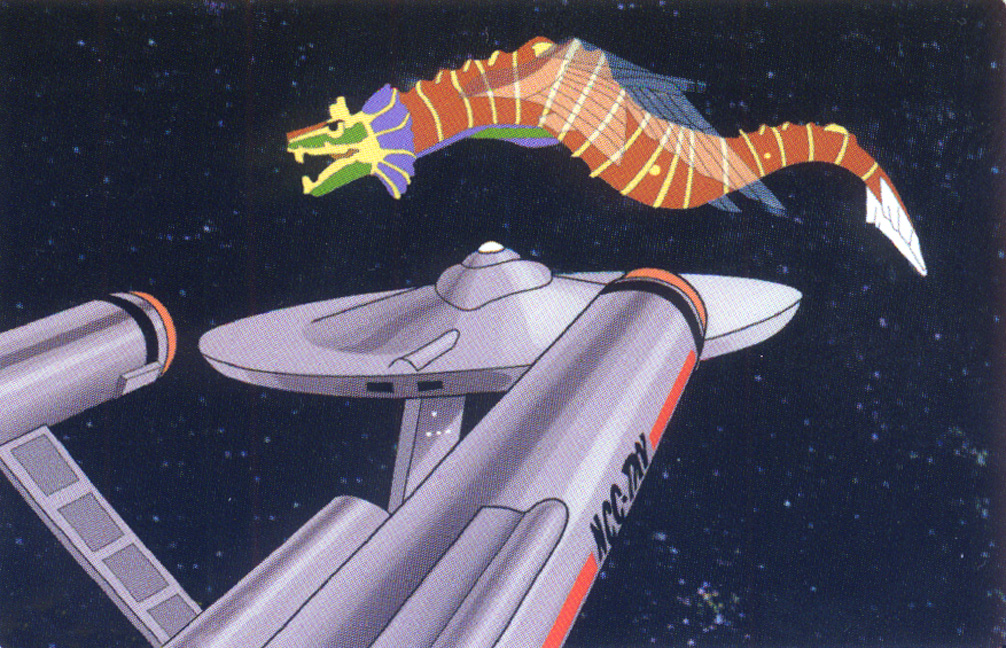
More successful than the earlier "Magicks of Megas-Tu," and right there you can see that "Serpent's Tooth" is part of a tradition, and that is Star Trek's arguable defining trope, at least through the duration of Q's appearances, of trying to grapple with the existence of divine beings.

The episode also famously pivots around a Native American crewman, a sort of predecessor to Voyager's Chakotay.  The story itself is not wholly recommendable, spending a lot more time on ideas than making them particularly credible and thereby demonstrating once and more all the limits of the series, although of course the live action show that came before it did about the same on numerous occasions ("The Apple," "Who Mourns for Adonais?").  "Serpent's Tooth" is basically an homage to those stories, and in that regard is also perhaps a sign that the series was mercifully coming to an end (only one episode remained after it).

Perhaps most notable and memorable is in fact the title, which is one of several to draw from Shakespeare.  It may have the distinction of being the most overly elaborate, but it's also artful.  Other than "Eye of the Beholder," it's the only instance in the series where this common practice from the original series is continued, and it's not again until Deep Space Nine when the practice is picked up again.  By Enterprise, it's been completely abandoned, alas.

four quarter analysis
franchise * series * essential * character

notable guest-stars:
James Doohan 

Tuesday, March 24, 2015

The Animated Series 2x4 "Albatross"

rating: ****

Memory Alpha summary

via Cygnus X1; and they remained the best of friends
for years and years and years!
Here's an episode you can absolutely watch if you want a good sense of the Kirk-Spock-McCoy dynamic at work, in any series or movie, with the rare perspective of being a McCoy episode.

"Albatross" acts as a fine example of the sometimes dubious franchise instinct for stories about a Starfleet officer being condemned by an alien civilization.  It's also a medical mystery, which you would probably expect from a McCoy episode.  And it's the only instance in the series, other than "Yesteryear," that reaches into a character's past for the purposes of the present.  

To reach that point, "Albatross" is also the incredibly rare franchise story that features Starfleet deliberately returning to the scene of a previous mission.  One of my personal frustrations with Star Trek has always been the trope that, say, Khan's marooning on Ceti Alpha V seems to have been completely forgotten, which is to say that Starfleet's records seem pretty terrible, that once a world is visited it is basically never visited again.  In a series like Deep Space Nine, where they literally stick around the same place the whole time, you can see the benefits of continued contact in a whole spectrum of ways.  "Albatross" is not a Deep Space Nine episode by any means, and is otherwise typical of its own series in most other respects, but it's another indication of what the series learned from its predecessor, and what it might have become, or in other words, the beginning of the franchise as fans would come to know it.

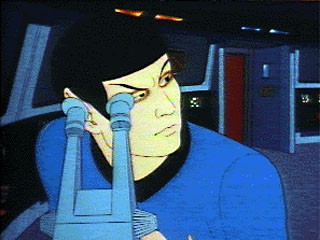
And yes, it features some classic character work, which was actually somewhat rare for the series, there being so little time to explore something other than the story at hand in a half-hour animated format.  But with one of the central characters in peril, and that being McCoy, you can bet Spock has some quip to make eventually.  And of course he does.  That's just how these guys are.  It's always good to see.

four quarter analysis
franchise * series * essential * character

notable guest-stars:
James Doohan


Friday, March 20, 2015

The Animated Series 2x3 "The Practical Joker"

rating: *

Memory Alpha summary

via Cygnus X1; most illogical...
"The Practical Joker" is popularly regarded as the retroactive first appearance of the holodeck, later to debut officially and become a staple in The Next Generation and its successors, but in many ways it may even be considered the first "holodeck episode" in all its notorious glory.

Oh, and speaking of Next Generation, "Joker" is pretty similar, all told, to "Emergence" as well.

That and it's a Romulan episode.

No, not Romulan episode as in "Balance of Terror," but more like, and you just knew there would be another Next Generation reference, "The Neutral Zone," which is an episode you might not typically think of as a Romulan episode (you may even consider the third element of that one, the first hint of the later Borg invasion, more significant!), yet there they are all the same.

And that's the kind of episode "Practical Joker" is.  Equal parts relevant and complete nonsense, it's not exactly "Trouble with Tribbles" hilarious in humor, but probably that's another association you can make in terms of what they were thinking when it was made.  

You can, ah, inflate or deflate the episode's worth at your own risk.  (There's an in-joke in the preceding sentence.  Yeah.)

four quarter analysis
franchise * series * essential * character

notable guest-stars:
Majel Roddenberry
James Doohan

Thursday, March 19, 2015

The Animated Series 2x2 "Bem"

rating: **

Memory Alpha summary

via Trekcore
If you watch only one episode for something only this series could have pulled off, make it "Bem."

Remember that Next Generation episode, "Liaisons," where alien ambassadors take a variety of ways to explore how the crew reacts (Troi gets the best one, because they spend the whole time eating chocolate)?  Well, "Bem" is kind of exactly that episode, except with a colony alien.

Colony alien?  Imagine the Trill (most memorably embodied by Jadzia and Ezri Dax), who have humanoid hosts and slug-like symbionts, but with a far more incomprehensible setup.  This time the body breaks down into independent component parts, such as the torso being able to separate, and the lower body producing an entirely new set of arms to compensate.

It's kind of completely insane, but the episode pulls it off.  The more time you spend time with Bem, the more you like him, regardless of how exasperated he makes Kirk.  (Actually, Kirk is exasperated throughout most of the series.)

Speaking of Kirk, "Bem" establishes his middle name as being Tiberius.  That's another historic element that should settle the matter of whether or not this series should be considered canon.  I mean, right?

But then, I guess the counterargument will always be, but weirdo concepts like Bem exist too...

four quarter analysis
franchise * series * essential * character

notable guest-stars:
Nichelle Nichols
James Doohan

Wednesday, March 18, 2015

The Animated Series 2x1 "The Pirates of Orion"

rating***

Memory Alpha summary

via Star Trek; we're not just green, you know
If it's the start of a new season from a series featuring Kirk as captain, you can bet it's an episode featuring some trauma happening to Spock.  Yeah, the second season of the original series kicked off with the classic "Amok Time," while the third with the infamous "Spock's Brain."  This time it's "The Pirates of Orion."

The problem this time is a little like condensing "Amok" and "Brain" into one, Spock in a straight-up medical emergency that sends the crew scrambling to save him.  I shouldn't need to point out that this is the third episode to focus primarily on Spock (after "Yesteryear" and "The Infinite Vulcan"), demonstrating a clear series preference for the character.

Beyond Spock, as the title suggests "Pirates" also features the enigmatic Orions, usually at that point best known for their green-skinned "slave girls," or for that surprise element of "Journey to Babel" in which they were saboteurs.  In Deep Space Nine, two episodes ("Honor Among Thieves" and "Prodigal Daughter") focus on the Orion Syndicate, which might be considered an update of the eponymous pirates, how the culture in general tends to act when not dominated by their women (as revealed in one of several Enterprise appearances, "Bound").

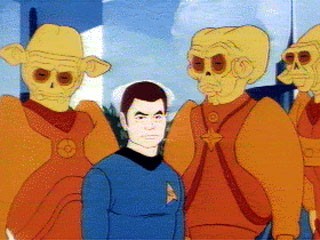
As the image suggests, the episode features Orions who are not, in fact, green-skinned.  This is commonly considered a production mistake.  But obviously humans feature diverse pigmentation, and so do Klingons and Vulcans.  If this series is to be considered canon at all, "Pirates" might as well be considered canon establishment of the same for Orions. 

It's a fine episode that stays away from the weirder inclinations of the series and a strong link to the rest of the franchise, in various and surprising ways.

four quarter analysis
franchise * series * essential * character

notable guest-stars:
George Takei
Majel Roddenberry
James Doohan

Related Posts Plugin for WordPress, Blogger...