Wednesday, August 6, 2014

Star Trek 2x26 "Assignment: Earth"

rating: ***
Memory Alpha summary

"Assignment: Earth" may be the most interesting piece of Star Trek trivia ever.  If it had succeeded in what it set out to do, Star Trek as we know it wouldn't exist.

By the end of the second season, the series was on the brink of cancellation.  It seemed even Gene Roddenberry was resigned to that fact.  He originally pitched this episode as the pilot of a completely new series.  Instead it became the season finale.  That's why it seems to be such a dramatic departure from virtually every other episode ever.  It's about as standalone as you can get, but it's of significantly higher quality than usual, because of course at that point being a standalone episode was par for the course.

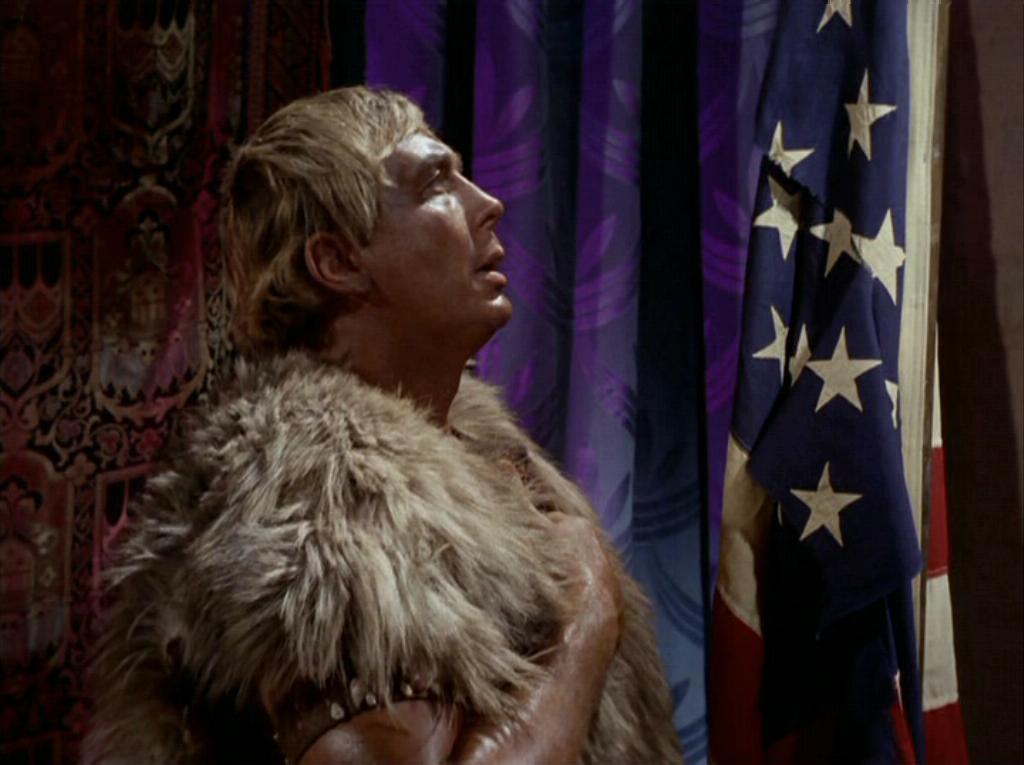
Enter: Gary Seven.  Basically a human drafted into being an agent of an alien species, Central Intelligence Aliens if you will.  "Assignment: Earth" is very blatantly far more his story than our crew's.  The first and last time that ever happened.  If he'd ever appeared again, I might have been given the excuse to recommend it on all four of my qualifiers and therefore certify it as a classic.  I contend that the episode could very easily inspire more onscreen material.  If and when that happens, consider the upgrade immediate.
via Trek Core.  And he kind of looks like Gene, too.

Gary's mission was to stop humans from crossing the brink of nuclear war.  He succeeds, by the way.

Our crew does factor into the episode.  The other great distinction of "Assignment: Earth" is that it's the only casual instance of time travel in franchise history.  The crew visits 1968 in order to resolve a riddle in the records.  Later franchise lore would establish Starfleet having, y'know, rules about time travel, but that doesn't exist yet.

All around, this is a fascinating episode.  If this is the first time you hear about it, then consider yourself initiated.  There are comic books and prose books that feature Gary Seven, but of course he never again appeared onscreen.  If Star Trek had turned into a Gary Seven experience, we certainly wouldn't have anything that we know today.  The third season, although routinely creatively maligned, gave fans probably a better experience than they'd had in the latter third of the second season, but more importantly a full extra season to remind them of why they loved the series to begin with, and it looked nothing like Gary Seven.

But watch this episode and ask yourself, this guy could have developed into a cult phenomenon, too, couldn't he?  And chances are if he'd stuck around, Kirk would have come back eventually too, right?

Anyway, that's speculation.  Take it for what it's worth.  Bottom line is, even if you know none of what might have happened, "Assignment: Earth" is a unique experience, a standout episode, one that turned around the fortunes of the late second season at the very last moment, and even on that note probably helped invigorate the creators for the final season.  And that's worth celebrating, too.

four quarter analysis
franchise * series * essential * character

notable guest-stars:
Terri Garr
Barbara Babcock

Tuesday, August 5, 2014

Star Trek 2x25 "Bread and Circuses"

rating: *
Memory Alpha summary

Just through the sheer repetition of Kirk being forced to literally fight for his survival, this is either one too many or perhaps the tipping point in making it a legitimate trope in the series (and franchise, as in Voyager's "The Fight" and "Tsunkatse" and Deep Space Nine's "In Purgatory's Shadow"/"By Inferno's Light").

Anyway, "Bread and Circuses" also continues the gimmick of doing every story type in existence, this time the Roman Empire, just because.
via Star Trek
I don't have a ton to say about this one.  It is what it is.  Take it or leave it.  As I've been saying, clearly the writers had become exhausted by the end of the season.  They were just throwing whatever they wanted at the screen, the total reverse of how it had begun, richly exploring the bugging mythology.  This is the opposite.  The complete opposite, especially as compared to "A Piece of the Action."

An oblique reference to Christianity, extremely rare in any Star Trek incarnation, may be the one notable element of the episode.  Until DS9 faith and/or religion never got much positive press, as it were, in the franchise.  That was a decision Gene Roddenberry made about humanity's future.  (Now if this had been the whole point of the episode, we'd be having a different discussion.  Incidentally, original Pike actor and series lead Jeffrey Hunter played Jesus in King of Kings.)

four quarter analysis
franchise * series * essential * character

Friday, August 1, 2014

Star Trek 2x24 "The Ultimate Computer"

rating: **
Memory Alpha summary

An episode that bucks the late second season trend, "The Ultimate Computer" ended up creating a franchise legend in Richard Daystrom thanks to the later Daystrom Institute from Next Generation.  It might be argued that the same series benefited more directly from the events of this episode, which explored the upper reaches of artificial intelligence.
via The Viewscreen.  You're... -A legend.  Yes I am.
Although Daystrom fares poorly in the episode (this is basically the worst experience of his life), which is basically how we meet everyone who isn't named James T. Kirk, his reputation and legacy prior to these events serve as an important building block.  He also happens to represent our continuing fears about what advanced technology will do if left unchecked (apocalypse! so sayeth Terminator!  The Matrix!  Johnny Depp!).

This is the guy who dares suggest a computer can do a better job than Kirk.  Clearly not!  But then later we have Data.  Sure, and the Borg.  It just goes to show that even in the future, humans have the same fears.  It's pretty interesting stuff.

four quarter analysis
franchise * series * essential * character

Thursday, July 31, 2014

Star Trek 2x23 "The Omega Glory"

rating: *
Memory Alpha summary

This is one of the earliest drafted stories of the series, originally in consideration to have become the second pilot.  Consequently, having sat around for nearly two seasons, its impact is significantly diminished after multiple episodes and different scenarios, not to mention the introduction of the iconic Romulans and Klingons, explored its Cold War parallels before "The Omega Glory" finally became reality.

So there's that.  There are also parallels to later franchise stories, perhaps most significantly Star Trek: Insurrection with its Fountain of Youth, as well Voyager's "Resolutions" and even "Basics," about Starfleet officers becoming marooned on alien worlds, either for their health or simply among relatively primitive natives.

I could expound on any of these topics if you'd like, but the fact remains that this episode's real legacy is being part of a string of episodes that saw the second season lose all of its momentum.  Doubtless reason enough for the network to have considered cancelling the series.  Without its greatest inspirations, Star Trek might be considered very disposable indeed, no matter how memorable it intrinsically was, how inspired, how iconic.  And "Omega Glory" takes a very circuitous route to embodying everything that went wrong and nearly ended the journey before it had properly begun.

So there's that.
via Strangers and Aliens
The episode also features one of two instances where the series attempted to address the plight of Native Americans.  This was far more obvious, of course, in "The Paradise Syndrome" only a handful of episodes later, early in the third season.  Perhaps another argument that the series seemed to have already run its natural course by the time it was cancelled.

One last element worth mentioning: Although typically any other Starfleet crew besides Kirk's met a quick and sticky end, it was always worth noting that there did, in fact, exist other crews.  So the presence of such in this episode is notable.  As such.

Incidentally, if you find you have no memory of "The Omega Glory" other than perhaps its distinctive title, now you know why.  And "omega" in this instance refers to the alien planet-of-the-week, not so much a magic particle that would later fascinate the Borg...

four quarter analysis
franchise * series * essential * character

Wednesday, July 30, 2014

Star Trek 2x22 "By Any Other Name"

rating: *
Memory Alpha summary

Somewhat suspiciously, the way this episode ends is very similar to "Return to Tomorrow" as a whole just a few episodes earlier.  Creatively, the season ended much more weakly than it'd begun.  That's okay.  Fans still argue that it's the best season in franchise history.

Speaking of the franchise as a whole, that's really the only thing worth talking about "By Any Other Name."  Sometimes a setup is better than the seemingly contractual additional conflict that is tacked on to complicate it.  This happens.  It spoiled Enterprise's "The Catwalk," too.  The setup is actually a kind of prototype for Voyager.  And that's pretty interesting.

via Star Trek Prop Authority. Show mine if you show yours.
At its heart, "Other Name" is about an alien ship just trying to get home.  Granted, a new home.  (So, like the Sphere Builders from Enterprise.)  But home all the same.  Imagine if Janeway had gone about demanding whoever she came across give their home to her.  Colonization by way of conquest.  (Hey, North America knows a thing or two about that.  Come to think of it, it's a little surprising that this episode didn't think of that.)

But you can probably skip it.  I was going to give the episode no stars at all, but decided there were a few useful associations to be found.  Aside from those, though, not much worth watching here.

four quarter analysis
franchise * series * essential * character

notable guest-stars:
Majel Roddenberry


Friday, July 25, 2014

Star Trek 2x21 "Patterns of Force"

rating: **
Memory Alpha summary

It should be remembered that in 1968, when "Patterns of Force" was originally broadcast, WWII was a memory from a little over twenty years in the past.  A little over twenty years ago as of the writing of this review, 2014, the Cold War came to an end, and we still don't have ideal relations with Russia (to perhaps put it mildly).  So to have a Nazi episode at that time (and I still can't adequately reconcile a sitcom like Hogan's Heroes, which would have been in its third season at the time) would have been something like a bold gesture on the part of the series.

The episode is an allegory of the classic adage concerning those who fail to learn from history.  A Federation historian actually thinks it's a good idea to base the working conditions of a whole culture on the Third Reich.  Things go horribly wrong, and so we get literal Space Nazis.
via Trek Core
I've stated in other reviews that the series seemed hellbent on exploring all the typical story templates of its day, and maybe that's why there's a Nazi episode.  But then, maybe it was important to the mindset of the show's creators to do this, the way it was equally important, say, to constantly relay the message that War Is Bad.

Nazis became a recurring staple in the franchise.  Voyager's "The Killing Game" revisited them in a holodeck setting.  Enterprise's "Storm Front" saw the conclusion of its Temporal Cold War arc in this context.  Taken as a whole, that's a whole legacy, and I would submit an important one.

On its own, is "Patterns" a truly notable episode?  Or is it merely something that from a distance looks like a story told in poor taste?  It's certainly striking, easily identifiable from some of the more anonymous adventures.

I think it's worth considering.  And that's as much an argument for watching an episode as you can find.

four quarter analysis
franchise * series * essential * character

Thursday, July 24, 2014

Star Trek 2x20 "Return to Tomorrow"

rating: **
Memory Alpha summary

Callbacks I can think of: Next Generation's "Power Play," Deep Space Nine's "The Passenger," Voyager's "Vis a Vis" and "Demon" (with its sequel "Course: Oblivion"), and Enterprise's "Observer Effect."

The idea of body-hopping, borrowing someone else's body.  That's what "Return to Tomorrow" is all about.  It's pretty interesting in this original incarnation.  There's even a prototype for Kirk's "Risk is part of the game" quote from Generations.
via Trek Caps. Not a young Dr. Pulaski.  But the same actress.
A fun episode.  I'm bumping the rating up by one star from what I originally gave it, just because it's a good representation of the series and a clear predecessor for something that franchise did in abundance (clearly not all classics, but they were all interesting).  At its core Star Trek, and certainly its original incarnation, is about visiting different sci-fi concepts every week.  Sometimes the execution is better than other times.

And sure, it must be noted that the title is hardly a memorable, descriptive, or even evocative one, poetic in a very roundabout way.  So that'll be one reason you probably don't remember it.  But all told, you probably should.

four quarter analysis
franchise * series * essential * character

notable quest-stars:
Diana Muldaur
Majel Roddenberry

Related Posts Plugin for WordPress, Blogger...