Thursday, August 28, 2014

Star Trek 3x9 "The Tholian Web"

rating: ****
Memory Alpha summary

Perhaps the single most important episode of the season, the most iconic one, the one that added the most to later franchise lore (which is surprisingly saying something), "The Tholian Web" boasts iconic visuals (the eponymous web), the debut of important new aliens, another of those lost starships but perhaps the most important one, and Kirk in peril while Spock and McCoy once again try to fill his void.

Like the Andorians and Tellarites, the Tholians would be essentially one-off aliens for virtually the entire run of the franchise until, some four decades later, Enterprise shows up to bring them back.  But, like the Andorians, it would prove well-worth the wait.  First there were the Tholian ships in "Future Tense," then the debut of the Tholians themselves in "In A Mirror, Darkly, Part I" (a true highlight of that episode, especially when Mirror Phlox tortures the hapless specimen!).

The idea and look of the web was echoed in Next Generation for its pilot episode, "Encounter at Farpoint," by Q.
via Star Trek

The missing starship Defiant, also featured in the Enterprise outing "Mirror, Darkly," became a true legacy of Star Trek lore when Deep Space Nine introduced a warship identically named, proving once and for all that the Enterprise wasn't the only ship capable of creating a lineage.

All of that is window-dressing if the story doesn't carry dramatic weight, though, which comes in the form of Kirk apparently being lost bringing the ever-present personality conflict between Spock and McCoy dramatically to the surface.  It's an important moment for the series to see this played out, which is echoed in Star Trek.

All in all, an episode that becomes timeless but worth viewing in its own right, the definition of a classic.

four quarter analysis
franchise * series * essential * character

notable guest-stars:
Majel Roddenberry

Wednesday, August 27, 2014

Star Trek 3x8 "For the World Is Hollow and I Have Touched the Sky"

rating: *
Memory Alpha summary

Among the distinctive features of the series that the later franchise never quite managed to live up to are the episode titles, poetic and elaborate.  There was never more poetic or elaborate a title than this one.  Kind of instantly iconic.

But more importantly, "Touched the Sky" is a McCoy episode.  This happened surprisingly rarely, and that's too bad.  McCoy was one of the Big Three, of course, along with Kirk and Spock, and so never hurt for attention, but as far as stories built entirely around him, he was hardly their equal.  Similar to "City on the Edge of Forever," it's a story based on the good doctor developing a medical condition.  Being a doctor, it's too bad that "physician, heal thyself" would need to apply to him at all, but there you go.  It's really a matter of his basic humanity coming to the surface.  McCoy was always considered the most human of the characters, and of course Spock the most alien, with Kirk bridging the gap between them, so there's that.

Like Voyager's "Resolutions," McCoy finds safe haven, but that thrusts him into a whole, fairly typical drama.  Long story short, he helps a civilization heal itself, and is in return granted a cure for his own condition.
via Trek Core
There's a lost episode concerning McCoy's origins, which is addressed directly in Star Trek for the first time, and that would have been nice to see.  Maybe in the future his full story will be explored more fully.  In the meantime we have what we have, which is material like this, which is common for the series.

four quarter analysis
franchise * series * essential * character

notable guest-stars:
Majel Roddenberry

Tuesday, August 26, 2014

Star Trek 3x7 "Day of the Dove"

rating: ****

Memory Alpha summary

Following Kor  ("Errand of Mercy") and Koloth ("The Trouble with Tribbles"), the appearance of Kang in this episode completes the debuts of the big three Klingons featured in the series who would later appear in the Deep Space Nine episode "Blood Oath."

Like "Errand," "Day of the Dove" is about a conflict between Klingons and Kirk that revolves on weirdo manipulative aliens.  Being that as it may, it's a true highlight of the oft-maligned third season, showing a real flair for the budding Star Trek landscape, something the season did surprisingly often.

By this point, Klingons had appeared often enough that they weren't just familiar but a key component of series lore.  What's interesting is that it seems to anticipate the more nuanced role these traditional foes would develop over the course of Star Trek VI: The Undiscovered Country, Next Generation, and DS9, where they weren't just the enemy and in fact could even cooperate with Kirk when necessary.
via Danger Mouse. Leading to this improbable image.
Where fans tend to associate diminished quality with the season and diluted concepts, an episode like "Day" suggests, rather, how the creators began to loosen up a little, in a good way.  Far too often you'll see a critic dismiss genre entertainment for taking itself too seriously.  I have no idea what that means.  But I remember that some of the best material from the second season ("Tribbles," "A Piece of the Action") had exactly this attitude of letting the concept breathe a little.  I do think as the season progressed, it became a little more utilitarian and thus didn't really capitalize on its best instincts, but such a trend suggests that if there had been a fourth season, arguably the best material of the series had been yet to come.  A thought.

four quarter analysis
franchise * series * essential * character

notable guest-stars:
Michael Ansara

Thursday, August 21, 2014

Star Trek 3x6 "Spectre of the Gun"

rating: *
Memory Alpha summary

Would you believe that this was actually the first episode produced for the season?  Yeah.

Clearly another attempt to cover all the given genres of the day, and an especially popular one of TV (Gene Roddenberry even famously pitched the series originally as Wagon Train to the Stars), "Spectre of the Gun," which improbably thrusts Kirk and crew into an alien reenactment of the Gunfight at the O.K. Corral featuring the Earps, Doc Holliday and others, actually ended up setting a franchise precedent.

I love making references to other episodes.

Next Generation visited Westerns in "A Fistful of Datas," one of its many holodeck-run-amok episodes, while Enterprise ran across cowboys during its Xindi-infested third season in "North Star."
via The Viewscreen. When you put it like that it makes perfect sense!
Otherwise, do you really need to know much more?  Apparently it was conceived as a spotlight for Chekov.  Presumably because Wyatt Earp was a Russian hero.  Nonsense fun, Star Trek style!

four quarter analysis
franchise * series * essential * character

Wednesday, August 20, 2014

Star Trek 3x5 "Is There In Truth No Beauty?"

rating: ****
Memory Alpha summary

A classic by any other name, "Is There In Truth No Beauty?" is in a lot of ways an inversion of the series, a beautiful woman who ends up being associated with Spock, not romantically but intellectually.

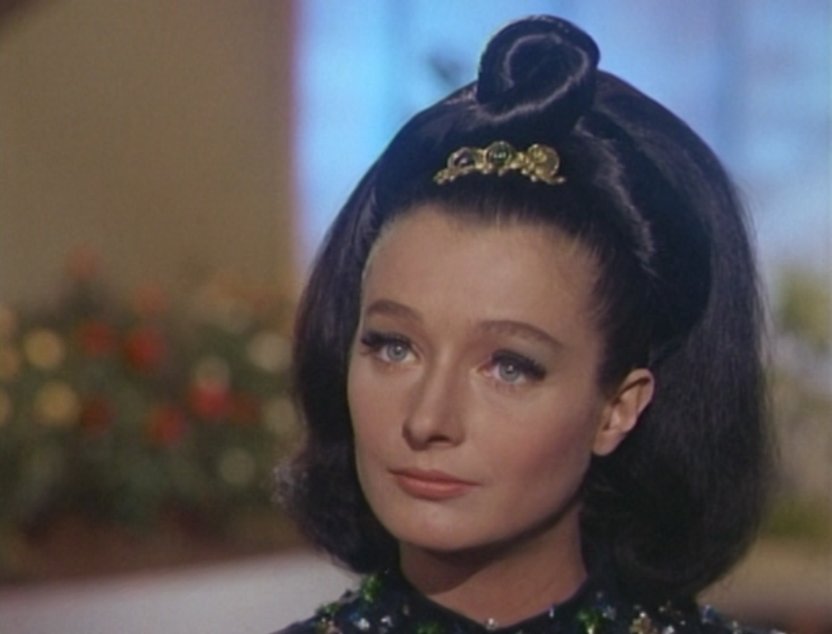
This is what most of the series strove for.  There are points in the story that are about as generic as possible, developments that occur all the time, just to provide conflict, but the overriding arc of the guest character, portrayed by Diana Muldaur in arguably her best franchise appearance, is a perfect encapsulation of what the whole season had set out as a goal, putting a strong focus on Spock as the acknowledged best character of the series.
via Trek Movie

Muldaur had previously appeared in "Return to Tomorrow" the previous season in an unrelated role, and spent the whole of Next Generation's second season as Dr. Pulaski, who might be viewed as a cynical version of the hopeful Miranda Jones.  Jones is the rare guest character who is allowed to remain strong and even heroic throughout their appearance.  She's a stark contrast to Spock, having studied on Vulcan to master her telepathic abilities, and their dynamic drives "Beauty."

The title alludes to the concept of beautiful women, certainly a running theme in the franchise, and also the alien species Jones is attempting to understand better so that they can become productive partners in the Federation, a little like Picard's experience in Next Generation's "Darmok" or Archer's in Enterprise's "A Night in Sickbay."  It's a philosophical matter in the way Star Trek has often attempted although seldom appreciated by its observers, looking beyond the surface.

It's got a a mouthful of a title, which doubtless has hindered "Beauty"'s reputation over the years, but it deserves greater recognition, and another good argument to give the whole third season another look.  Often the argument was that the series became fatally compromised in its final season, and that ending it was an act of mercy.  But in truth there is greatness to be found within it.  When they really wanted to, the creators could perform real magic.  Such as this episode.

four quarter analysis
franchise * series * essential * character

notable guest-stars:
Diana Muldaur

Tuesday, August 19, 2014

Star Trek 3x4 "And the Children Shall Lead"

rating: *
Memory Alpha summary

Like an uncomfortable echo of the first season child actors episode "Miri" (which at least had the good sense to cast a really young Phil Morris), the third season drops its first real turkey (okay, okay; "Spock's Brain" is usually afforded the "honor," but this is my reckoning).

In short, a bunch of bratty kids are manipulated by an evil alien to do naughty things.  A later echo-of-a-kind can be found in Deep Space Nine's "Move Along Home" as far as chanting goes.  Otherwise, you can easily skip this otherwise uncomfortable reminder that the series had some unfortunate tendencies.  Note that I said tendencies, as in "Children" isn't even so much an example of the routinely-stated poor quality of the third season, but representative of the whole series in some regards.  The best of the series had competition from its worst, and for too many viewers, lost out.  (Then again, genre programming tended to have brief lifespans, then as now, anyway, so there's always that, too.)
via John Kenneth Muir.  No, that's not Wesley.

The thing that's usually referenced about this episode is that the dude who plays the evil alien was a famous lawyer of the day.  If I bother to mention his name now, it'll be meaningless, except to say he's the rube who defended Jack Ruby.  That's a name you'll know.  John Adams post-Boston Massacre this guy was not.

Move along!

four quarter analysis
franchise * series * essential * character

notable guest-stars:
Majel Roddenberry

Thursday, August 14, 2014

Star Trek 3x3 "The Paradise Syndrome"

rating: **
Memory Alpha summary

So, unlike the tepid "Omega Glory" effort late in the second season, "The Paradise Syndrome" is a full-blown Star Trek version of Native Americans In Space.  It's the episode where Kirk loses his memory, is adopted into the tribe, and has an honest-to-Gene wife.
via Trek Core
All that's fine.  It's not a fantastic episode.  Other than the typical trying-to-do-every-story-type nature of the experience that the series by this point had made a well-known trope (and wasn't finished exploring yet!), there's a franchise precedent for a couple later episodes in a prophecy seemingly being fulfilled and a character being mistaken as a god.  Prophecies were a major part of Deep Space Nine, and the idea was also exploited by a couple of Ferengi in Voyager's "False Profits."  Picard was mistaken for a god in Next Generation's "Who Watches the Watchers?"

There's all that.  Native Americans were featured perhaps more flatteringly in Next Generation's "Journey's End" and Voyager's first officer Chakotay.

It's an episode that you take for what it is.  Kirk had to lose his memory to make a lasting commitment to someone, although the bride's dead by the end of the story, not to mention the groom having his memory back.  All the same, it's basically similar to any number of other series episodes, including Spock's experiences in "This Side of Paradise" (another episode that, like "Omega Glory," serves as an archetype for a much more overt exploration of a cultural topic, which in that case is hippies, a topic better known from "The Way to Eden" late in the third season).

four quarter analysis
franchise * series * essential * character

notable guest-stars:
Majel Roddenberry
Related Posts Plugin for WordPress, Blogger...