Wednesday, June 24, 2015

The Next Generation 2x22 "Shades of Gray"

rating: **


Memory Alpha summary
via Treks in Sci Fi
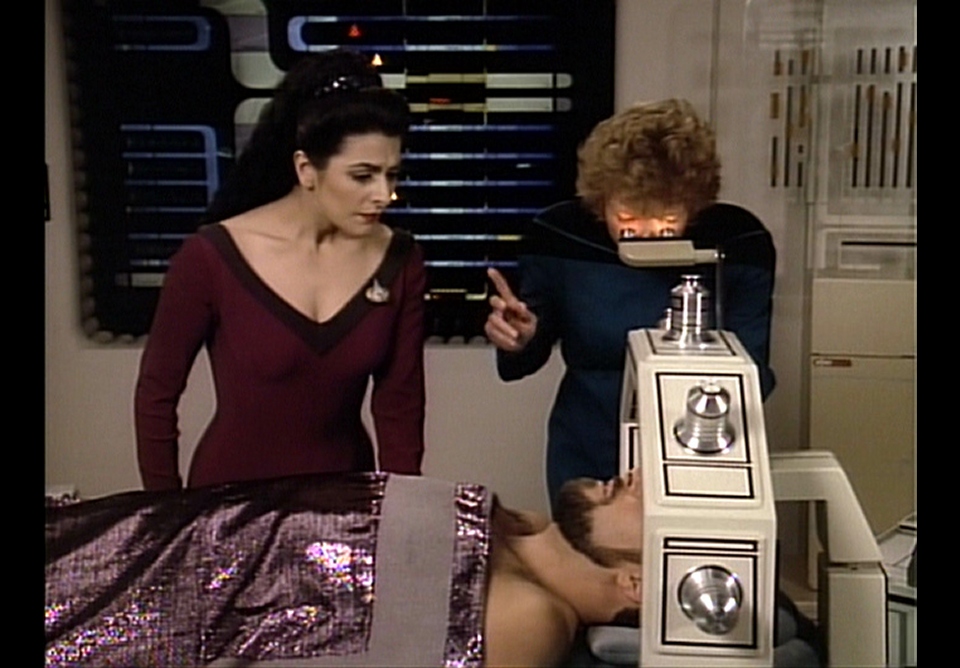
Pulaski: "Just one more minute."
Producers: "You realize this is
a clip show, right? And you want to
waste some of that valuable non-clip
time on you?"
Pulaski: "Dammit, I'm a doctor
not a screenwriter."
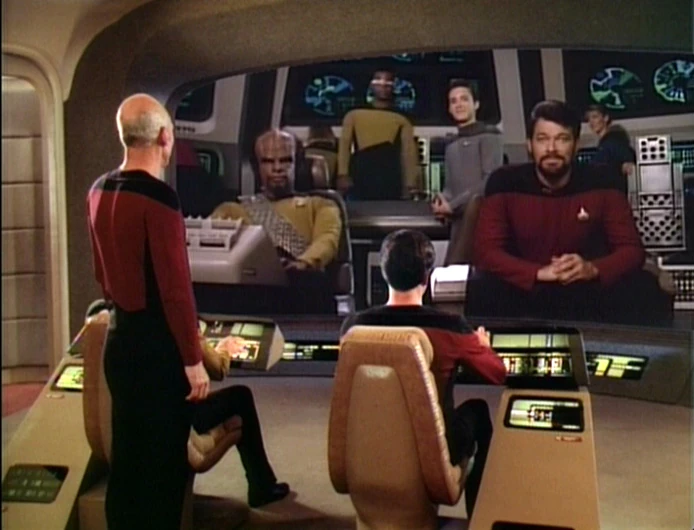
The clip show.  For some fans, this has always been an unforgivable waste of an episode.  They don't particularly care that the whole second season was compromised by the '88 Writers Guild strike (if you can't remember that, how about the '07/08 one?), just that this particular episode made for a poor season finale at the very least.

But there's more than one way to view "Shades of Gray," one of which being hindsight, which actually turns out to be quite valuable.

In context, "Shades" is pretty valuable.  It's one last reminder of how the whole second season seemed poised to make Riker the lead character over Picard, if need be to fix continuing creative ailments, find the show's true voice.  Of course, later the voice turned out to be just fine with the characters as they were, more or less, just more properly balanced.  Nobody knew that at the time.  Something more radical was considered.  This is pure speculation on my part, but the evidence of the second season speaks for itself.

"Shades" also serves as a testament to everything the first two seasons tried, a best (or perhaps best and worst) of the series to that point, which might actually serve as an excellent way for fans who don't otherwise want to wade into the complete experience to get a feel for what the show was like before the third season brought it into what everyone remembers best.  

For anyone looking for more nuanced opinions of Star Trek than what immediate, gut reactions said at the time and continue to inform general thought, "Shades" is everything you need to know in a nutshell.  In one sense, a clip show for a series two seasons old with every indication of continuing seems improbable even now, and creatively it couldn't have been very fulfilling, but conceptually it ends up doing a lot more than it seems.  This is where perspective comes into play.  No, I am not saying it's a classic, but it's far more significant than a lot of other episodes that try to do a lot more and fail more spectacularly.  And it's character-focused, in ways the second season routinely tried to be and in fact was generally at its most successful when it was, which is exactly the lesson the third season took, that Next Generation was better when it focused on its rich cast of characters rather than, like its predecessor in the original series, just throwing concepts at fans and hoping they'd stick, with the odd amusing commentary from a handful of memorable personalities.

That's how you defend an otherwise maligned episode.

four quarter analysis
franchise * series * essential * character

notable guest-stars:
Diana Muldaur
Colm Meaney

Tuesday, June 23, 2015

The Next Generation 2x21 "Peak Performance"

rating: ***


Memory Alpha summary

via Tim Lynch Reviews
Picard vs. Riker...
need I go on?
Consider this, if you are going to be a fan terminally disgruntled with the clip show season finale "Shades of Gray," the real end of the second season.  The fight that seems to have been pitched metaphorically between Picard and his first officer, Riker, finally happens.  Sort of.

"Peak Performance" boasts significance for a number of Next Generation creations aside from the leading officers of the Enterprise.  The whole episode is predicated on preparations for further Borg encounters.  It's also the only Ferengi episode of the season.  (Fun fact!  The Borg were created to make up for how lousy the Ferengi turned out to be, at least initially.)  And that strategist from the Zakdorn.  Yeah.  The episode didn't quite nail the strategist or the Zakdorn, unfortunately.  If you have an unfavorable opinion of the episode, it's because of that guy.

But you can almost ignore him, because the crew rises to the occasion, easily the best ensemble effort of the season.  The stars, however, are the ones simulating war in opposing starships, Picard and Riker.  I've been postulating in my thoughts throughout the season that it seemed somewhat likely that the creators had seriously entertained the idea of finding a fix for the series by replacing Picard with Riker as the lead character.  Riker had an excellent head-start with "A Matter of Honor," and generally came off better than Picard throughout the season, though they notably both shined in the series standout "The Measure of a Man," which may have also been the point where they started to realize, maybe Picard is not such a lost cause after all.  And so both are put to the ultimate test at last in "Peak Performance."

Picard retains the Enterprise in this scenario, while Riker is given command of a far lesser ship, which again puts the emphasis on where they currently stand, Riker having to prove himself while all Picard has to do is prove competent, a little opposite of the dynamic from the rest of the season, but by this point completely earned, and exactly as it should be.

And the funny thing is, much as in "Measure of a Man," standing between them, as it were, is Data, who also finally has a culmination of the odd relationship he's had with Pulaski throughout the season.  Data is challenged to defeat the master strategist (never mind that the challenge itself looks silly), can't do it (leading to a precursor of his self-doubt in Star Trek Generations and even The Doctor's internal conflicts in Voyager), but finally manages a draw, a novel solution to what is otherwise something of a variation on the famous no-win scenario known as the Kobayashi Maru test (as featured in the second and eleventh films).

Well, as I said, an excellent alternative for concluding the season.

four quarter analysis
franchise * series * essential * character

notable guest-stars:
Diana Muldaur
Armin Shimerman

Monday, June 22, 2015

The Next Generation 2x20 "The Emissary"

rating: ****


Memory Alpha summary

via Treknologic
"Today is a good day for style!"
When Next Generation's second season nailed it, it really nailed it.  And thus we reach the last great episode of the season, "The Emissary."

Which means we've finally reached the point where the series has figured out how to present Worf, a character whose importance not just to the series but the franchise would grow exponentially.  So basically what I said about "Manhunt" in regards to Lwaxana Troi.  This was a season dedicated to figuring out the characters.  Sometimes it worked exceptionally ("The Measure of a Man") and other times not as much ("The Icarus Factor").

In terms of lasting significance, "Emissary" may have the second greatest legacy of the season after "Q Who?" (which introduced the Borg) as it features K'Ehleyr, perhaps the best of the franchise's periodic efforts to feature "a former lover" (seriously, this is a whole Star Trek trope, and yes it's a fiction trope in general but Star Trek embraced the idea almost as enthusiastically as Space Nazis...and now we will end this parenthetical phrase...).

K'Ehleyr herself only survived to make one additional appearance ("Reunion"), but it completely opened up Worf's possibilities, not just because of the son they had together (Alexander, who would become a recurring character), but after "A Matter of Honor" (another second season classic, which actually featured Riker rather than Worf) stands as the birth of true Klingon nuance, a culture that flourished throughout the rest of the franchise until reinvention in the reboot era.

But aside from legacy, again, the episode itself works miracles for Worf, who until that point had languished under writers who seemed about as eager as Gene Roddenberry to have a Klingon in Picard's crew.  Worf's own alienation was previously poorly defined and depicted, until he had another strong Klingon to play off against (and in subsequent Worf episodes, having other strong Klingons to play against proved to be a continuing source of strong material).

All of which makes the ending ironic, because Worf's not the only one who has a hard time being Klingon, his lover does, too, but they have to pretend to be exactly that, just a couple of regular warriors.  But after this, it's much, much easier for regular Klingon warriors to populate Star Trek.  For the first time, being Klingon means something other than cunning or prowess.  And that is a very good thing.

four quarter analysis
franchise * series * essential * character

notable guest-stars:
Suzie Plakson
Diana Muldaur
Colm Meaney
Diedrich Bader

Friday, June 19, 2015

The Next Generation 2x19 "Manhunt"

rating: ****


Memory Alpha summary

via The Viewscreen
"And then, sir?"
"Then we eat them."
We first meet Lwaxana Troi in the first season episode "Haven."  But this is her proper introduction.  It is an out-and-out classic, and every subsequent appearance, whether in Next Generation or Deep Space Nine, is an effort to recapture exactly this magic.  Only in her DS9 appearances, actually, does Lwaxana get to do much that's substantially different, thanks to her odd relationship with Odo (though Next Generation's "Half a Life" serves as something of a preview for that).

In short, she drives everyone crazy.  Usually you need Q to accomplish that, but then, maybe Lwaxana always was Q without all the omnipotence.  She's just omnipresent.  Yay!

In fact, let's take that a step further.  Q episodes before "Manhunt" feature Q in the role of a challenger.  Q episodes after "Manhunt" feature Q in the role of a trickster.  Is this a coincidence?  I think not.  Now, just imagine an episode with Q and Lwaxana...Thankfully this never, ever happened.  Everyone would've gone insane...

"Manhunt" also features the prism of Picard and Riker contrasting against each other, which "Peak Performance" two episodes later also does (not to mention the preview from "The Measure of a Man").  In that sense, it's the culmination of a season's worth efforts to distinguish the two and make it less of a competition, perhaps the tipping of the scales away from Riker and back toward Picard, as the second season had clearly flirted with early on.  The show's creators knew there was a problem.  They didn't necessarily know what the problem was, but they did considerable work trying to figure it out.  Again, as I've stated previously, the revelation that was the third season would not have been possible without all the work from the second.  "Manhunt" is so casual about it you probably wouldn't even expect that kind of effort behind it.  

But then, like Q, Lwaxana was a character designed to find stress points.  She just happened to be the first of the two to actually push the series to its best all on her own.  

four quarter analysis
franchise * series * essential * character

notable guest-stars:
Majel Roddenberry
Diana Muldaur
Robert O'Reilly
Carel Struycken
Colm Meaney

Thursday, June 18, 2015

The Next Generation 2x18 "Up the Long Ladder"

rating: [no stars]


Memory Alpha summary

via Trekcore
And then she takes that skirt off
and there's one that rides much lower
beneath it.  Sexy Trek.
Clearly the idea of a society strapped for new DNA was something of a cherished trope.  Suffice to say that if it were at all possible to recommend this episode for actual viewing, I'd cite that.  But I won't even give you further franchise examples.  Just skip this one.  Run screaming over the hills.

And the funny thing is, this horrendous "Irish episode" (if you have any memory of this episode at all, assuming prior viewing, that should tell you all you need to know; well, that and the caption text to the left) is not even the "Irish episode" that fans tend to call a terrible, terrible episode.  That dubious honor goes to Voyager's "Spirit Folk," a follow-up to its own "Fair Haven."  I never understood the problem with Voyager's version of the "Irish episode."  Because it couldn't possibly be this bad.

And it bad on a number of levels, and offensive on a number of them, too.  Some of them are not even cultural.  This is a huge step back for the entire series, really, the proof that everything needed to be thoroughly re-examined so something like this could never, ever happen again.  It's bad like the worst of the first season.  It is the worst of the second season.  In its faint defense, it's not as bad as the worst of the first.  But it definitely belongs in the first, although its presence in the second, as I've suggested, is a sign that things really did need to change, no matter how much the second season started turning things around.

And well, anyway, it's even a bad episode for the original series, which "Up the Long Ladder" seems desperate to evoke in a quasi-Next Generation way (even the title leans that way).  When you have Scotty or Chekov using ridiculous accents it's one thing.  When you visit alien cultures or evoke clearly identifiable human cultures, it's much more advisable to consider what you're about to do.  The original series usually had some reason to do this sort of nonsense.  No such excuse here, even. 

And it's another huge step back for Riker, casting him in all the wrong light, just as "The Icarus Factor" before it.  And I stress again, the second season was in most other ways such an excellent showcase for Riker.  But I guess I understand why the season finale, the infamous clip show "Shades of Gray," despite being a Riker episode, is generally considered poorly by fans.  Because by that point, all the commander's good will had virtually dried up.

And to top it all off, there's a tepid Worf subplot that's like a bad rip-off of Picard's from the previous episode, "Samaritan Snare."  Just overall completely baffling.  And yet when fans talk about the worst episodes in the franchise, they generally bring up episodes in which they're basically quibbling with the premise.  When you talk about bad episodes, talk about the ones that are absolutely, unquestionably, executed poorly.  Like this one.

And the absolutely saddest part?  O'Brien is in this episode.  You know, the most famous Irishman in Star Trek history.  The one who is perhaps the character in Star Trek with the most dignity imaginable, even though most of his episodes did horrible, horrible things to him.  What were they thinking???

four quarter analysis
franchise * series * essential * character

notable guest-stars:
Diana Muldaur
Colm Meaney

Wednesday, June 17, 2015

The Next Generation 2x17 "Samaritan Snare"

rating: ***


Memory Alpha summary

via Star Trek
Geordi and friends!
Let's just get this out of the way: the idiotic Pakleds are all but Next Generation acknowledging and apologizing for how poorly the Ferengi turned out in the first season.  And in their idiotic way, they're brilliant.  A species that gleefully steals everything they have, it's genius.

And to watch La Forge interact with them, it's kind of the beginning of the series realizing he works best when he's immensely frustrated.  Frustrated La Forge is different from how virtually any other character would be.  He doesn't get angry.  He works around it.  In fact, it's strong motivation for him.  And it proves that you don't have to be a miracle worker to be a great engineer.  (Although to be fair, in contrast to the Pakleds, anyone would be a great engineer.  Or a miracle worker, for that matter...)

Putting all that aside, however, this episode ought to be known for one thing: the big reveal concerning Picard's artificial heart.  Later (in "Tapestry") we get a vivid look at how exactly that happened, but like La Forge among the Pakleds, this is a major character breakthrough as well, another sign that the second season really was the turning point of the series, where the pieces began to fall into place and greatness began to enter the discussion.

What's great about Picard's dilemma is that it's also good for Wesley, putting him into a new and better context as well, not to mention the moment where Picard and Wesley finally move past that whole awkwardness of Picard not exactly being comfortable with someone so young being around.  And it's not just Wesley who benefits from the events of the episode.  In fact, it nicely contextualizes Picard's relationship with the whole crew, something the whole series had been waiting for since the start and possibly very necessary indeed (right up until "Best of Both Worlds" it's entirely conceivable that Next Generation actually had Riker around as a kind of backdoor option).  This is to say nothing about Patrick Stewart but rather the character as it had been used to this point.  Finding a reason why he behaves the way he does, not just that he's the opposite of Kirk but why and why that's not a bad thing, is the first step in what then amounts to a very short journey.  Because as of the third season, with Picard finally in shape, the rest of the series is, too...

four quarter analysis
franchise * series * essential * character

notable guest-stars:
Diana Muldaur

Tuesday, June 16, 2015

The Next Generation 2x16 "Q Who?"

rating: ****


Memory Alpha summary

via Pinterest
Of particular interest in this debut of the Borg
...is the clash between Guinan and Q!
This is a Q episode.  This is the debut of the Borg.  And surprisingly, this makes perfect sense.

Let's start with Q.  After his debut in the series pilot "Encounter at Farpoint" and follow-up appearance in "Hide and Q," the god-like being to end all franchise god-like beings is on-hand to help shove the series to new and greater heights, like a cue (heh) for everyone to acknowledge that to this point Next Generation had not really lived up to its potential.

Everyone loves Q, though, right?  Do I have to do a hard sell for him here?  Yet this is perhaps the only other time besides the concept of the trial in the pilot and reprised in the series finale ("All Good Things...") where he gets to be something other than an imp, can be taken seriously, because he forces Picard to acknowledge once and for all that humanity has much to learn.  And it's the one and only time he scores on that point, too, beyond a shadow of a doubt.

By introducing the Borg.  Yes, the first season teased these most formidable of foes, but it took until "Q Who?" to not only to know what they actually look like, but what they are, what they represent, and that, yeah, they really are like nothing Star Trek had seen before.

I call this a classic although it's to be understood that "Q Who?" doesn't really compare to the series high point, "The Best of Both Worlds," in which the Borg make their biggest-ever impact, in effect giving Next Generation its lasting legacy.  For one the look of the Borg isn't quite nailed, although everything else is, including their cube ships that are perhaps more distinctive and menacing than any drone could ever hope to be.  The menace of the cube is amply demonstrated all right...

Besides Q and the Borg, there's also Guinan.  Throughout the series but especially in her debut season the amiable bartender existed in an impenetrable air of mystery, and only sometimes is there any real attempt to dispel it.  Even after two additional appearances in the movies, the portrait remains unfinished, even though she emerges as less than she's suggested to be in moments like the one that helps make "Q Who?" that much more impactful.  She is in fact presented as a legitimate threat to Q.  Which ends up being, for anyone knows based on all remaining evidence, a wild overstatement, but in this moment it does more than any prior appearance to prove how important Guinan really is.  Like Q she ultimately transcends any efforts to limit her despite growing familiarity doing its keen best.

So that's a lot to chew on.  Aside from "Measure of a Man," it's hard to conceive of another episode from the first two seasons as significant or worthy of significance as "Q Who?," and that's really all you need to know if you're looking for a simple enough recommendation.

four quarter analysis
franchise * series * essential * character

notable guest-stars:
John De Lancie
Whoopie Goldberg
Colm Meaney
Related Posts Plugin for WordPress, Blogger...