Wednesday, November 25, 2015

The Next Generation 4x7 "Reunion"

rating: ****


Memory Alpha summary

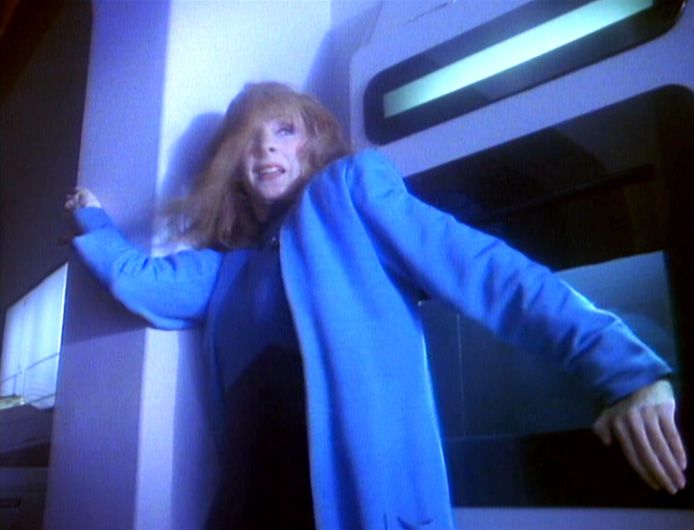
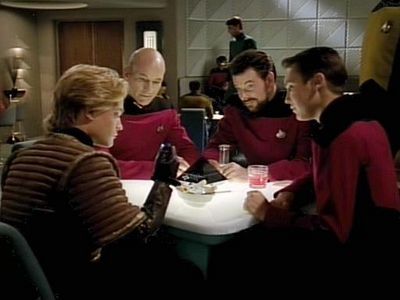
Not pictured: Gowron
(even though he's the best
Klingon ever!)
There's a lot to know about this episode:

1) It's the return, and death, of K'Ehleyr.
2) Alexander officially becomes a fixture of Next Generation.
3) Duras makes his second and final appearance, but with hugely lasting ramifications.
4) The debut of Gowron!

Besides that, it's the Klingons are their politically operatic best.  For a series that was reluctant to use the Klingons at all, some of Next Generation's best work involved them, not merely because of Worf's presence, but because the series discovered in the classic aliens a rich source of storytelling potential, using them less as villains and more as the springboard for high drama which might otherwise have forever eluded the franchise.  More than in the several film appearances, including the climactic Undiscovered Country, with which "Reunion" shares some blood, this episode was the moment everything came together.

Thus, very easily, a classic.  Both K'Ehleyr and Duras had made impactful appearances before, but seeing them converge, and not even necessarily over their mutual acquaintance Worf, was the catalyst the episode needed.  Alexander, Worf's son with K'Ehleyr, could be even more polarizing than Wesley Crusher before him in later appearances, but here he represents the great tragedy of what unfolds.

And it might indeed be called great tragedy.  When Klingon fan culture began linking them with Shakespeare, it wasn't just Undiscovered Country that brought the Bard to mind, but "Reunion" as well, perhaps more grandly.  Thrust into the mix is the would-be king Gowron, making the first of many welcome appearances in Next Generation and then Deep Space Nine.  I don't often talk about the actors in these reviews, but Robert O'Reilly is absolutely essential in how "Reunion" takes shape and makes history.  He may be the first great Klingon actor, and at times he achieves this distinction merely with his bulging eyes!  It takes considerable talent to produce something under that heavy prosthetic forehead.  O'Reilly was born for the task.

While Worf takes his rightful place in the course of events, it's Picard who truly rises to the occasion.  Long groomed as the true ambassador of Starfleet's peaceful potential, here he's given the unlikely role of mediating in the midst of Klingon egos, which he takes in stride.  With so many moving parts, the captain still finds his chance to shine and is the secret heart of the episode.  It's a defining moment for all involved, including the series and franchise as a whole.

Can you watch it and appreciate "Reunion" on its own?  Sure?  But remember, too, that without it the more serialized nature of Star Trek in the years ahead might never have happened.

four quarter analysis
franchise * series * character * essential

notable guest-stars:
Suzie Plakson
Robert O'Reilly

Monday, November 2, 2015

Countdown to 2017

In addition to the forthcoming film Star Trek Beyond, it was just announced that fans will have the first TV series since the end of Enterprise in 2005 arriving January 2017.  Yeah, I couldn't be happier.  The premiere will broadcast on CBS (for the first time ever; NBC, syndication, and UPN/The CW were the franchise's other small screen homes) before airing subsequent episodes digitally.

Obviously, nothing has been announced yet as to setting or casting, but the reports so far have suggested an all-new set of characters. 

A decade has passed since Star Trek has had new adventures in its original format.  Since then, a lot of thing have changed, not merely with the most successful films in franchise history, but a much more broad genre audience than has existed in decades (ever?).  In addition, the parameters for success have shifted considerably (remember the anecdote of ratings that looked better in hindsight for the original series?), and the digital format alone promises less concern about such things.

It's entirely likely that the new series will take into account the grumblings that plagued the fan community in the final years and last few series of the previous era.  Then again, it's ironic that procedural drama picked up considerable momentum in the last decade.  Imagine a crime-oriented Star Trek!

For now, though, we have a little over a year of anticipation, and updates, to enjoy...

Tuesday, September 29, 2015

To watch or remember, that is the question...

Continuing my thoughts from yesterday, when I write a review, it's not on an episode I've just watched.  If anything, a fresh viewing can have a distorting effect.  If you have a good memory, an episode falls into all the right contexts, and that's what I want my focus to be, the context.

I take for granted that if you're watching Star Trek at all, and if you care what I think, you're not a hate-watcher.  I don't like hate-watchers.  I mean, I've been that kind of viewer myself.  Not of Star Trek.  But other things.  It's just not fun.  So I've tried to not express hate-watching thoughts.  I don't see the point.

If you're watching Star Trek, chances are you know what other fans think about the franchise.  You know what's popular and what isn't.  The distinction I try to make is, just because something is popular, or isn't, doesn't mean it's good (or not).  Granted, I tend to make that distinction change course with episodes that aren't.  If it's popular, there's probably a good reason.  Star Trek fans, especially with the older shows, are good for acknowledging what needs acknowledging, what's generally good in the franchise.

The problem is, the newer material usually gets left behind.  That's where I see my greatest contribution to the discussion.  Since every Star Trek episode at this point is at least a decade old (Enterprise ended in 2005), that's a lot of material an existing fan has to consider.  Watching an episode all over again, whether previously loved or otherwise, opens room for a new evaluation.  That's what I'm trying to do, but I'm also attempting to see what has truly stood the test of time.  Which means, for all the older fans who lived for years with episodes that have long been considered classics, it's time to admit new ones into the fold.  Star Trek fans can be surprisingly reluctant to do so.  Over time, as the franchise grew less and less popular, it grew virtually impossible.

And so, it's no longer about popularity, but rather quality, about adding something of genuine value.  Sometimes, again, all this can be one and the same.  But sometimes it just isn't.  For someone watching, piecemeal, the franchise whether for the first or a multiple time, they get caught up, in the same way fans did when these episodes originally aired.  They lose perspective.  When you have a franchise with hundreds of episodes, it becomes a dialogue.  One experience resonates with another, across series, across decades.

What else is there to say?  Watch Star Trek however you like, but a broad appreciation is what you're after, hopefully I can help.

Monday, September 28, 2015

How to read a review...

Recently I've been rewatching Next Generation's first season.  I've already reviewed, episode by episode, it here.  When I left off, I was in the midst of reviewing the show's fourth season.  Slowly, I've been making my way through every episode of the franchise.

Now, I've sort of rediscovered the first season.  Traditionally, it's been considered one of the worst seasons of Star Trek ever, a bad start to an otherwise excellent series.  It had a lot to accomplish, not the least being to prove that the franchise could be viable on television again, twenty years later, and with an entirely new cast.  After a somewhat equally shaky second season, Next Generation came into its own and officially entered the books with the landmark "Best of Both Worlds."

I've got two ways to read my reviews.  I've got the star system, and I've also got the franchise/series/character/essential designations I award as I deem warranted.  The start system should be easy enough to interpret.  Movies have been using them for decades.  The designations, which I've attempted to explain in the past, are always trickier, but in their way what I believe to be the best way to interpret Star Trek for new fans, and even open-minded existing ones (in this Internet age, very few people are open-minded, alas).  People tend to coalesce around existing opinions, which tend to the extreme.  You either love it or hate it.

At some point I found myself drifting toward "hate it" for Next Generation's first season.  In the rather brief way I talk about most episodes, you will know pretty quickly whether I recommend it or, well, hate it.  I don't bog myself down with in-depth analysis.  The whole point of what I've doing is to provide helpful shorthand, so you can decide for yourself everything else.

When it comes to judging an episode, the first thing I consider is whether it's worth remembering in the grand scheme of the franchise, if it evokes another episode, whether fairly or poorly.  Since most viewers can't be expected to watch the whole franchise and like it, the next designation is for the series itself.  If it's a particularly good episode, it can earn an "essential" distinction.  Because I've found Star Trek to explore its characters profitably, this is the fourth designation.  In case an episode doesn't stand out any other way, if you like a particular character (and they've all got a standout story or two), I figure that's another way in.

To speak of the story, its execution, that's implied in whether or not it's a good representation of the series.  A good episode reflects well on the series.  Very rarely have I given episodes no stars at all, no designations.  And even among those I have, cases could be made for one or other designation.  The point of omitting a designation is that the story is so run-of-the-mill, there are plenty of other episodes worth considering well before, if you must, you consider taking that particular one seriously.

Next Generation's first season is emblematic of the complaints fans have had against the least popular episodes of the franchise.  It tends to feature a lot of bad decision-making, not by the characters but in the storytelling itself.  And yet, even an episode like "Justice," which has always been one of my least favorite, the story seems perfectly self-aware of this fact.  The season knew it had a lot of work ahead of it, and that's worth remembering, too.

Reviews are hardly ever as cut-and-dry as they seem.  They're always laced with personal bias.  I like to remind any readers I might have of my Star Trek reviews exactly how I'm approaching them, in case it doesn't come through in the reviews themselves.  The truth is, the series has plenty of episodes deep into its run that are less than fully-inspired, and much of the love Next Generation has experienced over the years is as protective as hate-watchers love to follow something just to join in the hate.

Make sense?  Here's a handy guide to how people watch stuff like Star Trek (which is to say, anything, which is to say, how they read or listen, generally experience life):

  • Pleasure-watcher (These guys will like anything.)
  • Critical-watcher (These guys are the nuanced fans.)
  • Fan-watcher (These guys are usually the ones who don't have strong opinions of their own.)
  • Hate-watcher (These guys think they're nuanced, but they're really just piling on after someone else said how much they hated it.)

Thursday, July 30, 2015

The Next Generation 4x6 "Legacy"

rating: *


via Trekcore
Data is dubious about this
early debut of T'Pol's catsuit...
The most awkward thing that ever happened to Tasha Yar was that they finally made a Yar-relevant episode...three seasons too late.  Because Denise Crosby left in the first season, and so the character was dead, leaving "Legacy" to feature her sister.  And the result is generally terrible.

Well, like I said: awkward.

The timing is even more awkward.  Flush with the creative reboot that was the third season and the chance to build on that with the fourth, Next Generation became more interested in exploring its cast of characters.  But "Legacy" is less about Yar's legacy and more a generic con job that sucks in Data for a while (because of the bond he developed with Yar) without ultimately saying much about Data or the late Yar, and a whole lot of nothing at all about her sister, whose legacy quickly comes to just that.

And do you really want to know the most awkward thing about the episode?  The bad fashion on display.  The horrible, horrible fashion...

Still, the effort was made.  But this is a classic instance of too little, too late.  Thankfully, this is nearly the worst stumble of the season (see, or really, don't: "Night Terrors"), so the rest of it delivers much better material, everything that the show runners hoped to accomplish, and everything the fans could really appreciate.

four quarter analysis
franchise * series * essential * character

notable guest-stars:
Colm Meaney

Wednesday, July 29, 2015

The Next Generation 4x5 "Remember Me"

rating: ****


Memory Alpha summary

via Planet Shannon
"Do the Crusher," alas,
fails to catch on either
as a pop song or a dance,
the latter being far crueler
to our dear light-footed doctor
Arguably the best Dr. Crusher episode and one of the best concept stories of the franchise, reminding everyone that Star Trek is science fiction not just because it's set in the future, but because it can execute some cool ideas when it wants to as well.

As a Crusher episode, "Remember Me" is crucial to the character's legacy.  Easily the weakest of the Next Generation ensemble, dropped for an entire season (the second), Crusher was eventually a near-complete non-factor in the movies, and in the series was mostly interesting either as a mother (to Wesley) or sometimes-lover (Picard).  As a doctor she could be shrill ("Ethics") and even surprisingly close-minded ("The Host"), putting her at the bottom of the profession in the franchise as a whole, too.

All of that meant that she was a hard character to write for, receiving the minimum of spotlight episodes throughout Next Generation's run.  So to make her shine, considerable effort had to be made, and on this occasion, the writers truly went above and beyond.  This is the episode that includes the classic line: "If there's nothing wrong with me, maybe there's something wrong with the universe!"

Think of it as kind of the inverse of Deep Space Nine's "The Visitor," which was an episode about Jake Sisko dealing with the loss of his father to a freak anomaly.  Here it's Crusher attempting to reconcile the loss of, progressively, everyone!

The big payoff for the whole experience is that it becomes part of the Traveler cycle, which was kind of like Next Generation's version of the later Enterprise Temporal Cold War, something neat that popped up every now and then but never really got the focus it needed to leave the lasting franchise impact it deserved.  Which also means that this is the only time Crusher is relevant in her son's biggest arc.

The only other time Crusher has an episode nearly as compelling is "Suspicions," which in fact seems designed to try and recapture the magic of "Remember Me."

four quarter analysis
franchise * series * essential * character

notable guest-stars:
Eric Menyuk
Colm Meaney

Tuesday, July 28, 2015

The Next Generation 4x4 "Suddenly Human"

rating: *


Memory Alpha summary

via Lockerdome
"And you're sure we can't
convince Jane Seymour to join you?"
There's nothing much wrong with "Suddenly Human" except the later, similar Deep Space Nine episode "Cardassians" makes a much stronger case for your continued attention.

This is the story of a human boy who ends up raised in an alien culture, and Starfleet's subsequent attempts to reunite him with his human family.  It doesn't go well.  I don't know if it's Stockholm Syndrome, exactly, or merely the fact that he's lived most of his life with the alien culture, and whether or not it amounts to the same.  Either way, that's basically all you need to know about this episode.  Which is to say, it really doesn't have much more resonance than that, for any particular character (this would perhaps have been an excellent spotlight for Worf).

In "Cardassians," meanwhile, it's very much series-specific, one of the episode that addresses head-on the continued ramifications of the Occupation on the Bajoran population, and its subsequent relationship with the Cardassians, when a Cardassian youth who has been adopted by a Bajoran family is subject to a Cardassian effort at repatriation.  This was a context that spoke directly to the heart of Deep Space Nine as originally conceived.  Meanwhile, "Suddenly Human" shows the limitations, if you choose to view them that way, of the more episodic approach that had originally Star Trek's calling card.  With Next Generation having begun a deeper storytelling approach, an episode like "Suddenly Human" will always be a challenge to reconcile as to its ultimate worth, especially near the beginning of a season that made a concerted effort to delve more deeply into the characters of the series.  You can view it as a refreshing change of pace, or one of the less challenging, ultimately, episodes of the season, no matter what it happens to accomplish in its own right.

four quarter analysis
franchise * series * essential * character

notable guest-stars:
Chad Allen
Sherman Howard
Related Posts Plugin for WordPress, Blogger...